
Robert W. Floyd
American computer scientist
About Robert W. Floyd
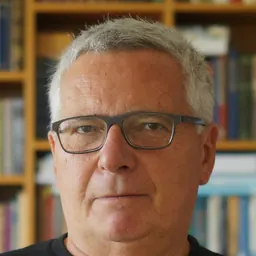
Lived 1936 – 2001 (aged 65). Robert W. Floyd was an American computer scientist, engineer and university teacher, known for ALGOL, Floyd's cycle-finding algorithm and Floyd's triangle.
Robert W. Floyd (born Robert Willoughby Floyd; June 8, 1936 – September 25, 2001) was an American computer scientist. His contributions include the design of the Floyd–Warshall algorithm (independently of Stephen Warshall), which efficiently finds all shortest paths in a graph and his work on parsing; Floyd's cycle-finding algorithm for detecting cycles in a sequence was attributed to him as well. In one isolated paper he introduced the important concept of error diffusion for rendering images, also called Floyd–Steinberg dithering (though he distinguished dithering from diffusion). He pioneered in the field of program verification using logical assertions with the 1967 paper Assigning Meanings to Programs. This was a contribution to what later became Hoare logic. Floyd received the Turing Award in 1978.
Life Born in New York City, Floyd finished high school at age 14. At the University of Chicago, he received a Bachelor of Arts (B.A.) in liberal arts in 1953 (when still only 17) and a second bachelor's degree in physics in 1958. Floyd was a college roommate of Carl Sagan.
Floyd became a staff member of the Armour Research Foundation (now IIT Research Institute) at Illinois Institute of Technology in the 1950s. Becoming a computer operator in the early 1960s, he began publishing many papers, including on compilers (particularly parsing). He was a pioneer of operator-precedence grammars, and is credited with initiating the field of programming language semantics in . He was appointed an associate professor at Carnegie Mellon University by the time he was 27 and became a full professor at Stanford University six years later. He obtained this position without a Doctor of Philosophy (Ph.D.) degree.
He was a member of the International Federation for Information Processing (IFIP) IFIP Working Group 2.1 on Algorithmic Languages and Calculi, which specified, maintains, and supports the programming languages ALGOL 60 and ALGOL 68.
He was elected a Fellow of the American Academy of Arts and Sciences in 1974.
He received the Turing Award in 1978 "for having a clear influence on methodologies for the creation of efficient and reliable software, and for helping to found the following important subfields of computer science: the theory of parsing, the semantics of programming languages, automatic program verification, automatic program synthesis, and analysis of algorithms".
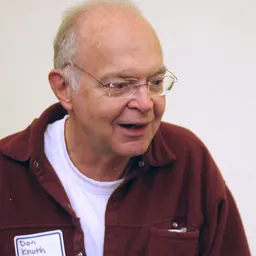
Floyd worked closely with Donald Knuth, in particular as the major reviewer for Knuth's seminal book The Art of Computer Programming, and is the person most cited in that work. He was co-author, with Richard Beigel, of the textbook The Language of Machines: an Introduction to Computability and Formal Languages. Floyd supervised seven Ph.D. graduates.
Floyd married and divorced twice, first with Jana M. Mason and then computer scientist Christiane Floyd, and he had four children. In his last years he suffered from Pick's disease, a neurodegenerative disease, and thus retired early in 1994.
Selected publications
Don’t just read it —
keep it.
Full-length biographies made to live with: read them, listen on the way to work, watch them tonight.
- E-book
- Audio
- Video
Instant download · yours to keep · every purchase keeps this site free
Important facts
Family & relationships
People in Robert W. Floyd's life
Named in this biography and alive at the same time


Related people
Same field, nearest in time


Contemporaries
People whose lives overlapped Robert W. Floyd's






Frequently asked questions
Who was Robert W. Floyd?
American computer scientist (1936-2001)
When was Robert W. Floyd born?
Robert W. Floyd was born on 8 June 1936 in New York City.
When did Robert W. Floyd die?
Robert W. Floyd died on 25 September 2001 in Stanford.
What was Robert W. Floyd's occupation?
Robert W. Floyd was a computer scientist, engineer and university teacher.
What was Robert W. Floyd known for?
Robert W. Floyd was known for ALGOL, Floyd's cycle-finding algorithm, Floyd's triangle, Floyd–Steinberg dithering and Floyd–Warshall algorithm.
What nationality was Robert W. Floyd?
Robert W. Floyd was American.
Sources & further reading
Cite this page
APA: Biography.guide. (2026). Robert W. Floyd. https://biography.guide/robert-w-floyd/
MLA: "Robert W. Floyd." Biography.guide, https://biography.guide/robert-w-floyd/.
Chicago: "Robert W. Floyd." Biography.guide. https://biography.guide/robert-w-floyd/.
Data last updated: 2026-09-20 · Spot an error? Report a correction.
Page generated 2026-09-27 05:13 UTC