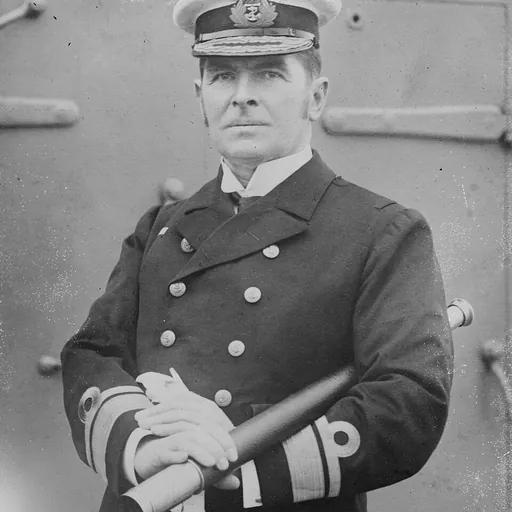
About Robert Swinburne Lowry
Lived 1854 – 1920 (aged 66). Robert Swinburne Lowry was a naval officer.
Admiral Sir Robert Swinburne Lowry, (4 March 1854 – 29 May 1920) was a Royal Navy officer who became Admiral Commanding on the Coast of Scotland.
Early life
Lowry was the eldest son of Emily Rohesia (née Ward) and Lieutenant General Robert William Lowry. He was educated at the Royal Naval College, Dartmouth,
Naval career While a Midshipman, he was one of three crew of HMS Invincible to be awarded a Royal Humane Society Bronze award for saving a life off the coast of Gibraltar.
Lowry was made a lieutenant in the Royal Navy on 15 October 1875.
Lowry while still a lieutenant as the first to suggest the use of large-scale underway replenishment techniques in an 1883 paper to the think tank Royal United Services Institute. He argued that a successful system would provide a minimum rate of 20 tons per hour while the ships maintain a speed of five knots. His proposal was for transfer to be effected through watertight coal carriers suspended from a cable between the two ships.
Lowry was promoted to the rank of commander on 31 December 1889.
On 7 January 1890 Lowry was appointed to command of the armoured cruiser HMS Undaunted. In April 1891, while serving with the Mediterranean Fleet HMS Undaunted and HMS Melita went to the aid of the French cruiser Seignelay when she ran aground off Jaffa. In recognition of his assistance, the French government presented Lowry with two small Sèvres vases. After handing over command of the Ramillies on 27 February 1902 he was in May 1902 appointed in command of the battleship HMS Hood, also serving in the Mediterranean. During combined manoeuvres with the Channel squadron in the Aegean sea, the Hood damaged her rudder on the seabed, and in November 1902 she had to return to Chatham for repairs and a refit. Lowry paid her off on 5 December 1902, and was appointed Commanding officer of the Royal Naval Engineering College at Keyham on the following day, serving as such until 6 December 1905.
He became naval aide-de-camp to the King in 1905 He was made Commander of the 5th Cruiser Squadron in November 1908, Commander of the 2nd Cruiser Squadron in February 1909 and then Admiral Commanding on the Coast of Scotland in July 1913,
He retired from active service on 19 August 1917. to his home at Wickham Lodge at Wickham in Hampshire.
Honours
He was appointed a Knight Commander of the Order of the Bath on 3 June 1913.
Don’t just read it —
keep it.
Full-length biographies made to live with: read them, listen on the way to work, watch them tonight.
- E-book
- Audio
- Video
Instant download · yours to keep · every purchase keeps this site free
Important facts
People in Robert Swinburne Lowry's life
Named in this biography and alive at the same time


Related people
Same field, nearest in time

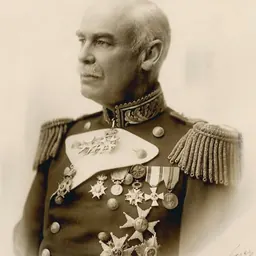
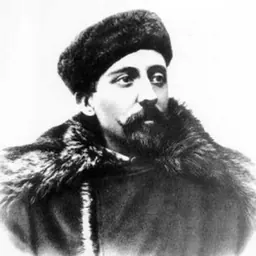
Contemporaries
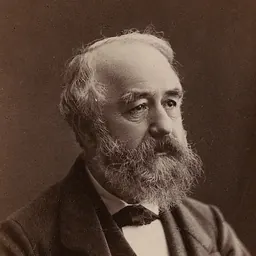
People whose lives overlapped Robert Swinburne Lowry's




Frequently asked questions
Who was Robert Swinburne Lowry?
Royal Navy admiral (1854-1920)
When was Robert Swinburne Lowry born?
Robert Swinburne Lowry was born on 4 March 1854.
When did Robert Swinburne Lowry die?
Robert Swinburne Lowry died on 29 May 1920.
What was Robert Swinburne Lowry's occupation?
Robert Swinburne Lowry was a naval officer.
Sources & further reading
· Wikipedia: Robert Swinburne Lowry
· DBpedia: Robert Lowry (Royal Navy officer)
Cite this page
APA: Biography.guide. (2026). Robert Swinburne Lowry. https://biography.guide/robert-swinburne-lowry/
MLA: "Robert Swinburne Lowry." Biography.guide, https://biography.guide/robert-swinburne-lowry/.
Chicago: "Robert Swinburne Lowry." Biography.guide. https://biography.guide/robert-swinburne-lowry/.
Data last updated: 2026-09-20 · Spot an error? Report a correction.
Portrait: Wikimedia Commons · author & licence
Page generated 2026-09-27 04:58 UTC