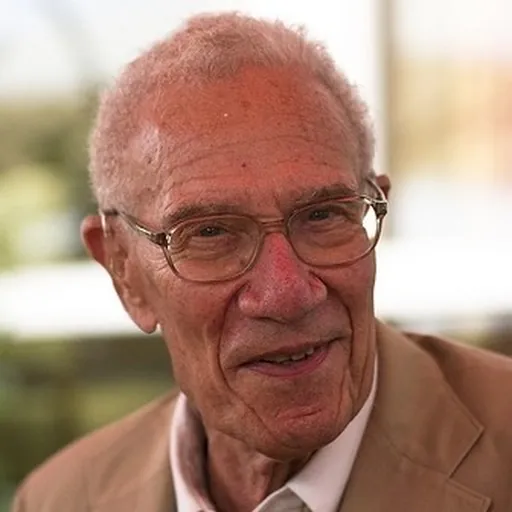
About Robert Solow
Lived 1924 – 2023 (aged 99). Robert Solow was an American economist, university teacher and professor.
Robert Merton Solow, GCIH (; August 23, 1924 – December 21, 2023) was an American economist known for his studies of economic growth and the development of the Solow–Swan model, for which he won the 1987 Nobel Memorial Prize in Economic Sciences.
He was Institute Professor Emeritus of Economics at the Massachusetts Institute of Technology, where he was a professor from 1949 on. He was awarded the John Bates Clark Medal in 1961, the Nobel Memorial Prize in Economic Sciences in 1987, and the Presidential Medal of Freedom in 2014. Four of his PhD students, George Akerlof, Joseph Stiglitz, Peter Diamond, and William Nordhaus, later received Nobel Memorial Prizes in Economic Sciences in their own right.
Biography Robert Solow was born in Brooklyn, New York, into a Jewish family on August 23, 1924, the oldest of three children. He attended local public school and excelled academically early in life. In September 1940, Solow went to Harvard College with a scholarship at the age of 16. At Harvard, his first studies were in sociology and anthropology as well as elementary economics. He served briefly in North Africa and Sicily, and later in Italy until he was discharged in August 1945. Shortly after returning, he proceeded to marry his girlfriend, Barbara Lewis (died 2014), whom he had been dating for six weeks.
Solow was interviewed for a 1994 on journal rejections by leading economists where he noted that he had never had a journal article rejected. He added, "Probably this is because I hate writing articles."
Solow was the founder of the Cournot Foundation and the Cournot Centre. After the death of his colleague Franco Modigliani, Solow accepted an appointment as new Chairman of the I.S.E.O Institute, an Italian nonprofit cultural association which organizes international conferences and summer schools. He was a founding trustee of the Economists for Peace and Security.
Solow's students include Nobel Prize winners Peter Diamond, George Akerlof, Joseph Stiglitz, and William Nordhaus, as well as Michael Rothschild, Halbert White, Charlie Bean, Michael Woodford, and Harvey Wagner.
Solow was one of the signees of a 2018 amicus curiae brief that expressed support for Harvard University in the Students for Fair Admissions v. President and Fellows of Harvard College lawsuit. Signers of the brief include Alan B. Krueger, George A. Akerlof, Janet Yellen, and Cecilia Rouse.
Solow was one of the supporters of Joe Biden's Inflation Reduction Act of 2022.
Solow died at his home in Lexington, Massachusetts, on December 21, 2023, at the age of 99.
Model of economic growth Solow's model of economic growth, often known as the Solow–Swan neoclassical growth model as the model was independently discovered by Trevor W. Swan and published in "The Economic Record" in 1956, allows the determinants of economic growth to be separated into increases in inputs (labour and capital) and technical progress. The reason these models are called "exogenous" growth models is the saving rate is taken to be exogenously given. Subsequent work derives savings behavior from an inter-temporal utility-maximizing framework. Using his model, Solow (1957) calculated that about four-fifths of the growth in US output per worker was attributable to technical progress.
Solow also was the first to develop a growth model with different vintages of capital. The idea behind Solow's vintage capital growth model is that new capital is more valuable than old (vintage) capital because new capital is produced through known technology. He first states that capital must be a finite entity because all of the resources on the earth are indeed limited.
Since Solow's initial work in the 1950s, many more sophisticated models of economic growth have been proposed, leading to varying conclusions about the causes of economic growth. For example, rather than assuming, as Solow did, that people save at a given constant rate, subsequent work applied a consumer-optimization framework to derive savings behavior endogenously, allowing saving rates to vary at different points in time, depending on income flows, for example. In the 1980s efforts have focused on the role of technological progress in the economy, leading to the development of endogenous growth theory (or new growth theory). Today, economists use Solow's sources-of-growth accounting to estimate the separate effects on economic growth of technological change, capital, and labor.
Honors
Member, American Academy of Arts and Sciences (1956) Member, United States National Academy of Sciences (1972) Member, American Philosophical Society (1980)
Publications
Books
Book chapters
Journal articles
Pdf.
See also: Nicholas Georgescu-Roegen and Joseph Stiglitz.
Don’t just read it —
keep it.
Full-length biographies made to live with: read them, listen on the way to work, watch them tonight.
- E-book
- Audio
- Video
Instant download · yours to keep · every purchase keeps this site free
Important facts
People in Robert Solow's life
Named in this biography and alive at the same time




Related people
Same field, nearest in time



Contemporaries
People whose lives overlapped Robert Solow's


Frequently asked questions
Who was Robert Solow?
American economist (1924–2023)
When was Robert Solow born?
Robert Solow was born on 23 August 1924 in Brooklyn.
When did Robert Solow die?
Robert Solow died on 21 December 2023 in Lexington.
What was Robert Solow's occupation?
Robert Solow was an economist, university teacher and professor.
What nationality was Robert Solow?
Robert Solow was American.
Sources & further reading
Cite this page
APA: Biography.guide. (2026). Robert Solow. https://biography.guide/robert-solow/
MLA: "Robert Solow." Biography.guide, https://biography.guide/robert-solow/.
Chicago: "Robert Solow." Biography.guide. https://biography.guide/robert-solow/.
Data last updated: 2026-09-21 · Spot an error? Report a correction.
Portrait: Wikimedia Commons · author & licence
Page generated 2026-09-27 04:59 UTC