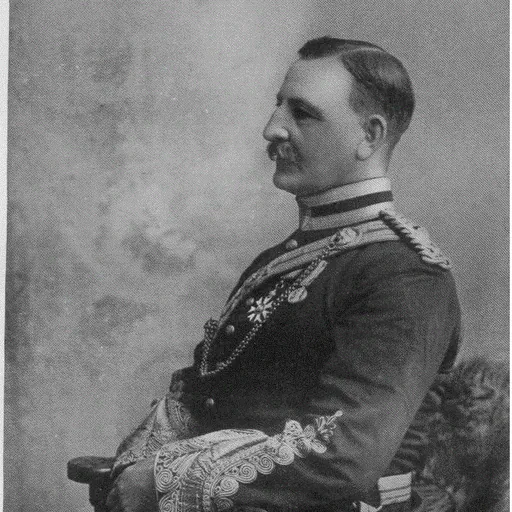
Robert Sandilands Frowd Walker
Colonial administrator, footballer
About Robert Sandilands Frowd Walker
Lived 1850 – 1917 (aged 67). Robert Sandilands Frowd Walker was an association football player.
Lieutenant-Colonel Robert Sandilands Frowd Walker (13 May 1850 – 16 May 1917), also known as R. S. F. Walker, was a prominent figure in Malaya during the British colonial era in the late 19th century.
During his youth he was an amateur sportsman, and played three times for the English football XI against Scotland, scoring four goals, in the 1870 to 1872 representative matches.
Early life and education Walker was born in Chestercastle, in Chester, the son of John and Camilla Walker. He was educated at Brentwood School, Essex before entering the Royal Military College, Sandhurst. The following year he was captain of the cricket team.
On graduating from Sandhurst in 1870, he was awarded the Sword of Honour which was presented to him by the Duke of Cambridge, who was then Commander-in-Chief. He continued to use the sword throughout his career and had it re-hilted to conform to the 1895 regulations. In November 1870, he was selected by C. W. Alcock to represent "England" in the second "pseudo-international" match against a Scottish XI. He scored England's goal in a 1–0 victory; according to the match reports "[following] a well-executed run-down by C.W. Alcock, in conjunction with a final kick from the foot of R.S.F. Walker, enforced the surrender of the Scottish goal" and "barely ten minutes had elapsed before a neat run down by C.W. Alcock, resulted in a goal to the side of England, the final kick which secured the coveted honour for the South being administered by R.S.F. Walker".
The following February, Walker was again England's scorer in a 1–1 draw; the match report included a reference to the Combination Game style of football: It seemed as if the [Scottish] defence would prove more than equal to the attack, until a well-executed run-down by C.W.Alcock, W.C. Butler and R.S.F. Walker, acting in concert, enabled the last-named of the trio to equalise the score by the accomplishment of a well-merited goal for England. The match report concludes: "For England, R.S.F. Walker was untiring in his efforts forwards until the close." Walker scored both England's goals in a 2–1 victory; the match report describes his goals thus:So persevering were the attacks of the English, that at last a loud cheer proclaimed the fall of the Scotch citadel to a well-directed shot by Walker.It appeared as if [England] were likely to have the game entirely in their own hands, as within a very short time a second goal was obtained for England by R.S.F. Walker. In conclusion, the report describes Walker as "the hero of the English eleven". and thence to Lieutenant; he was one of the last ensigns to be gazetted in the British Army.
Early in 1879, he entered the service of the Federated Malay States as Acting Commissioner of the Perak Armed Police, and was also the Acting Assistant Resident. In 1902, he was granted the local rank of Lieutenant-Colonel while employed as Commandant of the Malay States Guides.
He acted as Assistant Resident in Perak (1882), Secretary to the Government of Perak (1889), acting British Resident in Selangor (1899) and acting British Resident in Perak (1900). from Major Paul Swinburne turning it into a quasi-military force based almost entirely on Sikh and Pathan recruits. At this time, the police force had a strength of 650 men, some of whom were sent to Parit Buntar and Telok Anson. Others performed guard duties at the residency in Taiping and maintained law and order in the State of Perak, including a section of cavalry troopers. a brothel skirmish in Papan escalated into a violent clash which became known as the "Papan Riots", the most serious Chinese secret society clash ever to take place in the Kinta district. The riots were quelled by Walker and the Perak Sikhs but flared up again in September 1889. In "a show of force", Walker and the Perak Sikhs, responding to reports received from the acting magistrate, visited the mining areas at Kinta, inspecting the kongsis in which the secret society members lived. The appearance of the feared "Mungkali Kwai" (Sikh Devils) helped prevent any "untoward incidents".
Walker's efforts to quell the riots were praised by the Governor:[He] has done himself great credit, often working from daybreak to midnight – and he has settled some very difficult disputes between Chinese Towkays and mobs of coolies, with great patience, tact, judgement and decision. During the mining boom years of the early 1890s, Kinta was hit with a wave of crime, influenced by drinking and gambling. As a result of the breaking down of the secret societies, there was less organised crime but the region was plagued with roving gangs of robbers. Walker complained to his superiors that he could not police the district with a police force of only 196:Police work in Kinta, as elsewhere, has increased with the population, and the number of men for work does not increase proportionally. New places . . . keep opening out, but although the old places do not die as these spring up, the same number of men are still supposed to be sufficient to efficiently check crime.
In early 1892, a large force from the Perak Sikhs was sent to Pahang to quell an uprising there. Following the suppression of the "Pahang disturbances", Walker was again able to concentrate his attention on the situation in Perak. Following a sudden increase in crime in the Ipoh division in the second half of the year, Walker visited all the main towns, inspecting the mines and meeting the towkays [mine owners] who "cried out for police protection". Walker telegraphed his headquarters in Taiping to request reinforcements and within two months his forces in Ipoh had been strengthened by about 100 men. I beg very earnestly to request the Government to remove the headquarters of my Department from Batu Gajah to Ipoh. From the latter place the officer commanding can regulate his duties with greater efficiency. Almost any portion of his District could be proceeded to with greater rapidity from Ipoh. His living at Batu Gajah merely means an excessive amount of travelling. with Lt. Colonel Walker as their first commandant. their total strength was 900 personnel.
Personality Walker had the reputation of being something of a disciplinarian with a fierce temper, and was known to the local Malays as the "Black Panther".
In his "Personalities of Old Malaya", written in 1930, Cyril Baxendale relates an incident involving Walker and Chief Inspector John Symes. During a visit by Frank Swettenham, then the Resident of Perak, to the Police barracks, Swettenham admired a row of trees providing shade to the parade square. On being told by Symes that Walker had ordered the trees to be felled, Swettenham insisted that they should be spared. On a subsequent formal visit attended by Walker, Swettenham was surprised to see that the trees had been cut down. On inquiring why, Symes replied:"Colonel's Order, Sir," replied Symes. "Inspector Symes, did you tell Colonel Walker that the Resident gave you orders not to cut down those trees?" "Yes, Sir." "What did Colonel Walker say?" A few moments of hesitation and then Symes sprang to attention and as he raised his hand in formal salute: "Damn the British Resident, Sir."
Sport and leisure in Malaya Perak Cricket Team in 1895 including Frank Swettenham (Middle row, 2nd left) and Walker (Middle row, centre)Walker continued to be involved in all forms of sport throughout his life. Together with Sir Frank Swettenham, Governor of the Straits Settlements, and Mr. E. W. Birch, C.M.G., later British Resident in Perak, he helped introduce cricket to Perak and surrounding areas.
Walker also helped introduce football to the state; he founded a team in Taiping and donated the Ship Challenge Trophy.
He helped found the Perak Club in 1881 which had a playing field used for cricket, football, hockey and tennis. Described as the "father of cricket and football in the [Malay] Peninsula", the club organised the first inter-state matches in Malaya. The Perak Club became the premier social institution of Taiping and the senior club in the Malay States.
Walker was a member of many other sporting, service and social clubs including the Perak Turf Club, the United Service Institute, the Naval and Military Club, the Wellington Club and the Ranelagh Club.
Contributions to Malayan society During his time in Perak, Walker made several contributions to local society, many of which still remain.
The esplanade in the town centre was originally the Parade Square and was laid out by Walker in 1890.
Taiping Lake Gardens In 1880, Walker conceived the idea of transforming a disused mining site in Taiping into a garden for the benefit of the townspeople. The land was donated to the town by its owner, Mr. Chung Thye Phin, a wealthy tin miner and rubber planter. By 1884, with the help of Walker and his police staff, the Taiping Lake Gardens were complete with grasses, flowers and trees; the 62 hectares site was the first public gardens in Malaya.
All Saints' Church, Taiping The history of All Saints' Church, the earliest Anglican church in Malaya, can be traced from 1883 when Walker presided over a meeting to arrange for funds to be collected to pay for the stipend of a clergyman.
Honours Walker was created a Companion of the Order of St Michael and St George in 1901 "in recognition of his public services".
For his work in settling the labour troubles he was presented with a sword by the Chinese community.
Retirement and death In 1896, he married Mrs. Beatrice Bolton (née Ireland), the widow of Lieut. Colonel Richard Bolton, of the Royal Horse Guards, and eldest daughter of the late Thomas James Ireland, M.P., of Ousden Hall, Suffolk.
Walker retired in 1910 on the grounds of ill-health; in a private letter he said:Thirty-two and a half years since I landed in Singapore and knocked the ball about on the old cricket ground. A longish spell, that has passed very quickly, at times very happily. I cannot help feeling I am leaving a splendid little Corps behind me, and only wish it was a Brigade.
On his retirement a bronze statue was erected in his honour in Taiping; it stands today outside the Perak Museum; the sculptor was Charles Leonard Hartwell R.A. (1873–1951). he died of a heart attack a few days after his 67th birthday. He is one of the oldest soldiers commemorated on the Commonwealth War Graves Commission Debt of Honour database.
Don’t just read it —
keep it.
Full-length biographies made to live with: read them, listen on the way to work, watch them tonight.
- E-book
- Audio
- Video
Instant download · yours to keep · every purchase keeps this site free
Important facts
People in Robert Sandilands Frowd Walker's life
Named in this biography and alive at the same time





Related people
Same field, nearest in time



Contemporaries
People whose lives overlapped Robert Sandilands Frowd Walker's




Frequently asked questions
Who was Robert Sandilands Frowd Walker?
Colonial administrator, footballer (1850–1917)
When was Robert Sandilands Frowd Walker born?
Robert Sandilands Frowd Walker was born on 13 May 1850 in Chester.
When did Robert Sandilands Frowd Walker die?
Robert Sandilands Frowd Walker died on 16 May 1917 in Knockholt.
What was Robert Sandilands Frowd Walker's occupation?
Robert Sandilands Frowd Walker was an association football player.
Sources & further reading
· Wikipedia: Robert Sandilands Frowd Walker
· DBpedia: Robert Sandilands Frowd Walker
Cite this page
APA: Biography.guide. (2026). Robert Sandilands Frowd Walker. https://biography.guide/robert-sandilands-frowd-walker/
MLA: "Robert Sandilands Frowd Walker." Biography.guide, https://biography.guide/robert-sandilands-frowd-walker/.
Chicago: "Robert Sandilands Frowd Walker." Biography.guide. https://biography.guide/robert-sandilands-frowd-walker/.
Data last updated: 2026-09-21 · Spot an error? Report a correction.
Portrait: Wikimedia Commons · author & licence
Page generated 2026-09-27 04:59 UTC