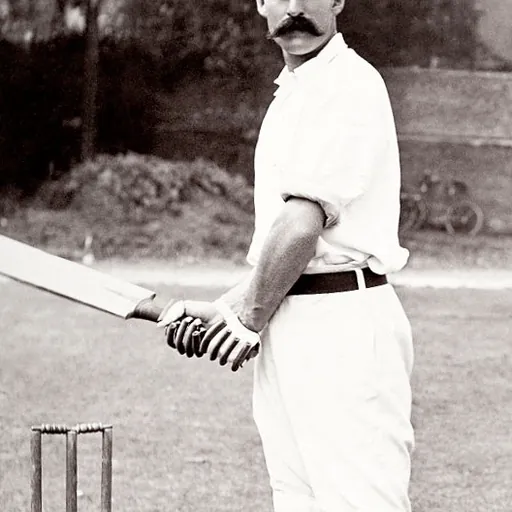
About Robert Poore
Lived 1866 – 1938 (aged 72). Robert Poore was a British cricketer and military officer.
Brigadier-General Robert Montagu Poore, (20 March 1866 – 14 July 1938) was an Anglo-Irish British Army officer and cricketer who, while serving in the British Transvaal Colony in 1896, played in three Test matches for the South African cricket team. He featured most prominently in first-class cricket playing county cricket in England for Hampshire between 1898 and 1906, where he gained a reputation as a batsman, having notable success in 1899 when he was the highest first-class run-scorer in England. Alongside playing for Hampshire, Poore also played first-class cricket in India for the Europeans in the Bombay Presidency Matches. An all-round sportsman, he was also a capable swordsman, and polo, tennis, racquets, and squash player, in addition to being a skilled marksman. Poore had success in the Royal Naval and Military Tournaments, being adjudged the best man-at-arms on four occasions.
Poore began his military service in the Militia with the 3rd (Royal Wiltshire Militia) Battalion of the Wiltshire Regiment in 1883, before gaining a regular commission in the British Army in 1886. From there, he transferred to the 7th Hussars in the same year and shortly after served in British India, where he was aide-de-camp to the Governor of Bombay. Poore served in the Second Matabele War in Southern Africa and later in the Second Boer War from 1899 to 1902, during which he was seconded to the Mounted Military Police and served as provost marshal at Army Headquarters Pretoria. In this role, he played an important part in investigating and recording the war–crimes trial and execution of Breaker Morant and Peter Handcock. Decorated with the Distinguished Service Order during the war, Poore later returned to the Hussars and served in the First World War between 1914 and 1918, commanding the Jhansi Brigade of the British Indian Army from 1915, for which he was made a Companion of the Order of the Indian Empire in 1918. He retired from active military service in 1921. In later life, he was a deputy lieutenant for Dorset.
Military career The son of Major Robert Poore Senior and his wife, Juliana Lowry-Corry (daughter of Rear-Admiral Armar Lowry-Corry), Poore was born at Dublin in March 1866. He was initially home educated, before attending Cheam School in England. His father wished for him to enter the British Army, but he consistently failed the entry exams for Sandhurst. Poore joined the Militia as a lieutenant with the 3rd (Royal Wiltshire Militia) Battalion of the Wiltshire Regiment in August 1883, before joining the 1st Battalion with a regular commission in the British Army in April 1886, having finally managed to pass the entry exams. In the same year, through the influence of his father, he obtained a transfer to the 7th Hussars. He served in British India until 1895, where he was aide-de-camp to the Governor of Bombay, Lord Harris, from 1892. While stationed in India, he saw no active combat. From India, he proceeded with the 7th Hussars to South Africa, where he served in the Second Matabele War in neighbouring Rhodesia from 1896 to 1897. before being promoted to brevet major in May 1898.
After a brief period in the United States procuring remounts for the army, Poore served in the Second Boer War in South Africa, being seconded for service with the Mounted Military Police in October 1899. He was appointed provost marshal at Army Headquarters Pretoria in November 1899. In this capacity, Poore commanded the military police and was responsible to the commander-in-chief, Lord Roberts, and his successor in 1902, Earl Kitchener. He was mentioned in despatches in March 1900, with Roberts praising Poore for his "care of prisoners" and conduct in "maintaining order in camp and on the line of march". He saw action in the Orange Free State, where he took part in the battles of Paardeberg, Poplar Grove, Driefontein, Vet River, and Zand River; he subsequently saw action in the Transvaal, where he took part in engagements at Pretoria and Diamond Hill, and later in August 1900 in Western Transvaal at Bergendal. He received the Distinguished Service Order in April 1901, in recognition of his war service. In February 1901, he was tasked by Kitchener with forming a Boer commando, the Bushveldt Mounted Rifles. This was made up of surrendered Boer combatants, whose task it was to loot cattle from enemy forces.
In August 1901, he gained the full rank of major, and was granted the local rank of lieutenant colonel in November 1901. As provost marshal, Poore was the lead investigator into the war–crimes allegations against Breaker Morant and Peter Handcock, which led to their trial and execution in February 1902. He published a diary, containing contemporary notes on the case. but would return to South Africa on military service in 1903 until his final departure in 1905.
Having returned to the 7th Hussars, he was promoted to lieutenant colonel in June 1911, before returning to India as commanding officer of the 7th Hussars. During the First World War, he was promoted to colonel in June 1915, and in August 1915 he was appointed commander of the Jhansi Brigade in the British Indian Army, an appointment he retained for the remainder of the war. He remained in India throughout the war and did not see combat. Poore was appointed a Companion of the Order of the Indian Empire in the 1918 Birthday Honours. He relinquished his command of the Jhansi Brigade in October 1919, nearly a year after the end of the war, and was subsequently placed on the half-pay list. Poore retired from active service in March 1921 and was granted the honorary rank of brigadier-general.
Cricket career India and South Africa Poore was not initially overly enamoured with cricket. He learnt the game through the perusal of textbooks, reputedly chiefly from the Badminton Volume of Cricket (1888), as opposed to the classical coaching method; his arrival in India as a subaltern with the 7th Hussars made him realise his love for the game. Styling his game on that of W. G. Grace, he subsequently made his debut in first-class cricket for the Europeans cricket team against the Parsees in August 1892 in the 1892–93 Bombay Presidency Match, and he played a second match against the same opponents the following month. In December of the same year, he played for Bombay against Lord Hawke's touring team. He was prolific while playing for Government House in minor matches, averaging 80 for the team. In his three Test appearances, he scored 76 runs at an average of 12.66, and took a single wicket. Wisden noted that he did not distinguish himself in what were heavy defeats for South Africa. While compiling his score, he shared in a partnership of 411 for the sixth wicket with fellow army officer Captain Wynyard (225) – as of this remains a Hampshire record for the sixth wicket. Poore's innings was described by the Southern Daily Echo as being "a remarkable feat of physical endurance" on "a sweltering July day". In 21 innings over the course of the entire season, Poore scored 1,551 runs at 91.23, He played two matches in the 1902 County Championship, in addition to playing for The Rest against a combined Kent and Sussex team at Hastings. It was hoped he would be available to play again in 1903, but he returned to South Africa that summer. When he returned to Hampshire in the middle of 1904 to great expectations, his form was disappointing. In the nine matches he played for Hampshire in the County Championship, Poore played in two matches in the 1906 County Championship, However, an injury to his leg ended his season and, as it turned out, his county career. For Hampshire, he made 36 first-class appearances, in which he scored 2,819 runs at an average of 47.77, with ten centuries.
Four years after his previous first-class appearance, Later, while serving in India in 1912 and 1913, he made two final appearances in first-class cricket for the Europeans, Described by Wisden as possessing one of the most powerful cover drives at the time, it was said that, with his height of and massive frame, when he struck a cover drive it would race over the turf with such speed that a fieldsman, no matter how placed, could not stop it. After the cessation of his first-class career, Poore remained a dangerous batsman in club games right up to his mid-fifties, scoring three consecutive fifties during an MCC tour of the West Country in 1923. and won the Matabeleland Tennis Championship at the Queens Sports Club while stationed in Rhodesia in April 1897. He also won several racquets and squash tournaments, He became a deputy lieutenant for Dorset in June 1932, and was also a justice of the peace within the county from 1933. Poore died at a nursing home in Boscombe on 14 July 1938,
Following his death, the Hampshire Advertiser described him as "one of Hampshire's most famous amateur cricketers". A year after his death, a memorial to him was erected at Salisbury Cathedral. Writing in an introduction to A. A. Thomson's Odd Men In: A Gallery Of Cricket Eccentrics (1985), Leo Cooper, referencing the unusual manner in which Poore took up cricket, wrote of him: "Of all the people in the history of the game [cricket], he seems to stand for the Eccentric Ideal."
Don’t just read it —
keep it.
Full-length biographies made to live with: read them, listen on the way to work, watch them tonight.
- E-book
- Audio
- Video
Instant download · yours to keep · every purchase keeps this site free
Important facts
People in Robert Poore's life
Named in this biography and alive at the same time


Related people
Same field, nearest in time


Contemporaries
People whose lives overlapped Robert Poore's



Frequently asked questions
Who was Robert Poore?
English officer and cricketer (1866-1938)
When was Robert Poore born?
Robert Poore was born on 20 March 1866 in Dublin.
When did Robert Poore die?
Robert Poore died on 14 July 1938 in Boscombe.
What was Robert Poore's occupation?
Robert Poore was a cricketer and military officer.
What nationality was Robert Poore?
Robert Poore was British.
Sources & further reading
Cite this page
APA: Biography.guide. (2026). Robert Poore. https://biography.guide/robert-poore/
MLA: "Robert Poore." Biography.guide, https://biography.guide/robert-poore/.
Chicago: "Robert Poore." Biography.guide. https://biography.guide/robert-poore/.
Data last updated: 2026-09-21 · Spot an error? Report a correction.
Portrait: Wikimedia Commons · author & licence
Page generated 2026-09-27 05:00 UTC