
About Robert Phillipson
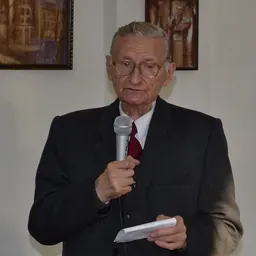
Born 1942. Robert Phillipson is a British linguist and university teacher.
Robert Henry Lawrence Phillipson (born 18 March 1942 in Gourock, Scotland) is Professor Emeritus in the Department of Management, Society and Communication at Copenhagen Business School in Denmark. He is best known for his seminal work on linguistic imperialism and language policy in Europe.
Education and career Phillipson was born in Scotland in 1942. He received his B.A. in 1964 and his M.A. in 1967, both in Modern Languages (French and German) and Law, from the University of Cambridge. He obtained his second M.A. in Linguistics and English Language Teaching from Leeds University in 1969. He earned his Ph.D., with distinction, in Education from the University of Amsterdam in 1990. He worked for the British Council from 1964 to 1973. He was associate professor in the Department of Languages and Culture at Roskilde University in Denmark from 1973 to 2000. He has been on the faculty of Copenhagen Business School since 2000. He also taught at the University of Copenhagen (1973-1984). He was Visiting Scholar at the Institute of Education at the University of London (1983), the University of Melbourne in Australia (1994), the Central Institute of Indian Languages in Mysore (1995), the University of Pecs in Hungary (1996) and the Center for Research in the Arts, Social Sciences and Humanities at the University of Cambridge (2005). He lived with his late wife, Tove Skutnabb-Kangas, in Sweden. He is the father of Danish actor Caspar Phillipson.
Recognition On 21 February 2010, Phillipson was awarded the Linguapax Prize along with Miquel Siguan i Soler. The Linguapax Institute describes them as "renowned advocates of multilingual education as a factor of peace and of linguistic rights against cultural and linguistic homogenization processes". Philipson also received the TESOL International Association's 2024 Presidential Award. The announcement letter stated: "A renowned scholar in the field of English language teaching, Dr. Phillipson has long been a proponent of building English language teaching into the fabric of local linguistic/cultural ecologies, developing supportive language policies to safeguard a sustainable balance between English and other languages, and advocating for linguistic human rights in cases where linguistic discrimination has occurred".
Linguistic imperialism In his 1992 book, Phillipson made the first serious and systematic attempt to theorize linguistic imperialism in relation to English language teaching. He offered the following working definition of English linguistic imperialism: “he dominance of English is asserted and maintained by the establishment and continuous reconstitution of structural and cultural inequalities between English and other languages”. In his 1997 article, Phillipson defined linguistic imperialism as "a theoretical construct, devised to account for linguistic hierarchisation, to address issues of why some languages come to be used more and others less, what structures and ideologies facilitate such processes, and the role of language professionals". He recently listed seven constitutive traits of linguistic imperialism: (1) interlocking, (2) exploitative, (3) structural, (4) ideological, (5) hegemonic, (6) subtractive, and (7) unequal.
From the theoretical perspective of linguistic imperialism, Phillipson problematized five fallacies of English language teaching: (1) the monolingual fallacy; (2) the native speaker fallacy; (3) the early start fallacy; (4) the maximum exposure fallacy; and (5) the subtractive fallacy. For the past three decades, he has continued to do research on linguistic imperialism. In the 2009 collection of his previously published essays, he explained the scope and significance of such research:
Books Phillipson, R. (1992). Linguistic imperialism. Oxford University Press. Phillipson, R. (Ed.). (2000). Rights to language: Equity, power and education. Lawrence Erlbaum Associates. Phillipson, R. (Ed.). (2003). English-only Europe? Challenging language policy. Routledge. Phillipson, R. (2009). Linguistic imperialism continued. Orient Blackswan. Skutnabb-Kangas, T., & Phillipson, R. (Eds.). (1994). Linguistic human rights: Overcoming linguistic discrimination. Mouton de Gruyter. Skutnabb-Kangas, T., & Phillipson, R. (Eds.). (2017). Language rights. Routledge. Skutnabb-Kangas, T., & Phillipson, R. (Eds.). (2023). The handbook of linguistic human rights. John Wiley & Sons.
Articles Phillipson, R. (1997). Realities and myths of linguistic imperialism. Journal of Multilingual and Multicultural Development, 18(3), 238–248. Phillipson, R. (1998). Globalizing English: Are linguistic human rights an alternative to linguistic imperialism? Language Sciences, 20(1), 101–112. Phillipson, R. (2001). English for globalization or for the world's people? International Review of Education, 47(3), 185–200. Phillipson, R. (2002). Global English and local language policies. In A. Kirkpatrick (Ed.), Englishes in Asia: Communication, identity, power and education (pp. 7–28). Melbourne, Australia: Language Australia. Phillipson, R. (2008). The linguistic imperialism of neoliberal empire. Critical Inquiry in Language Studies, 5(1), 1–43. Phillipson, R. (2017). Myths and realities of "global" English. Language Policy, 16(3), 313–331. Phillipson, R. (2022). A personal narrative of multilingual evolution. In R. Sachdeva & R. K. Agnihotri (Eds.), Being and becoming multilingual: Some narratives (pp. 63–83). Orient Blackswan. Phillipson, R., & Skutnabb-Kangas, T. (1996). English only worldwide or language ecology? TESOL Quarterly, 30(3), 429–452. Phillipson, R., & Skutnabb-Kangas, T. (2017). Linguistic imperialism and the consequences for language ecology. In A. F. Fill & H. Penz (Eds.), The Routledge handbook of ecolinguistics (pp. 121–134). Routledge. Phillipson, R., & Skutnabb-Kangas, T. (2022). Communicating in "global" English: Promoting linguistic human rights or complicit with linguicism and linguistic imperialism. In Y. Miike & J. Yin (Eds.), The handbook of global interventions in communication theory (pp. 425–439). Routledge.
Don’t just read it —
keep it.
Full-length biographies made to live with: read them, listen on the way to work, watch them tonight.
- E-book
- Audio
- Video
Instant download · yours to keep · every purchase keeps this site free
Important facts
People in Robert Phillipson's life
Named in this biography and alive at the same time





Related people
Same field, nearest in time



Contemporaries
People whose lives overlapped Robert Phillipson's






Frequently asked questions
Who is Robert Phillipson?
British linguist
When was Robert Phillipson born?
Robert Phillipson was born on 16 March 1942 in Gourock.
What is Robert Phillipson's occupation?
Robert Phillipson is a linguist and university teacher.
What nationality is Robert Phillipson?
Robert Phillipson is British.
Sources & further reading
· Wikipedia: Robert Phillipson
Cite this page
APA: Biography.guide. (2026). Robert Phillipson. https://biography.guide/robert-phillipson/
MLA: "Robert Phillipson." Biography.guide, https://biography.guide/robert-phillipson/.
Chicago: "Robert Phillipson." Biography.guide. https://biography.guide/robert-phillipson/.
Data last updated: 2026-09-26 · Spot an error? Report a correction.
Page generated 2026-09-27 05:16 UTC