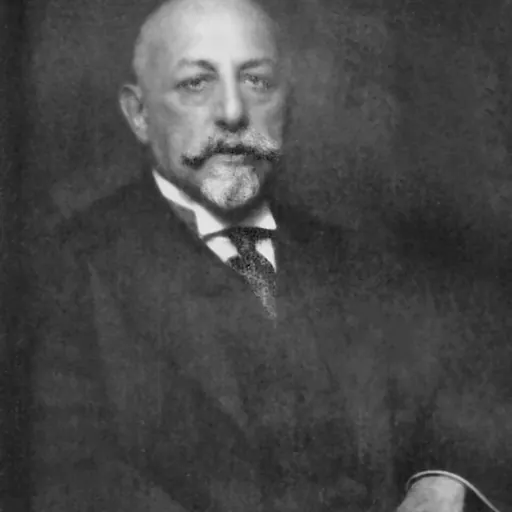
About Robert Mond
Lived 1867 – 1938 (aged 71). Robert Mond was a British anthropologist, archaeologist, chemist, art collector, patron of the arts and industrialist, known for Carbonyl.
Sir Robert Ludwig Mond, FRS, FRSE (9 September 1867 – 22 October 1938) was a British chemist and archaeologist.
Early life and education Mond was born at Farnworth, Widnes, Lancashire, the elder son of Ludwig Mond, a chemist and industrialist. He was educated at Cheltenham College, Peterhouse, Cambridge (BA 1888, MA 1892), Zurich Polytechnic, the University of Edinburgh and the University of Glasgow. At Glasgow he studied under William Thomson.
Chemistry Mond collaborated with his father in the discovery of the gaseous compound nickel carbonyl. He perfected the industrial production of iron carbonyl, and discovered the first derivative of a metallic carbonyl (cobalt nitroso-carbonyl) and a new ruthenium carbonyl. For a time he made trials of scientific farming. Following his father's heritage he became a director of Brunner Mond & Company and because of a connection with nickel mines in Canada he was a trustee of the Royal Ontario Museum in Toronto.
Mond was knighted in 1932. He received numerous honours including the honorary degrees of LL.D from the universities of Liverpool and Toronto, and D.Sc from the University of London. He was made president of the Faraday Society (1930–1932) and was awarded the Messel medal of the Society of Chemical Industry. He was elected Fellow of the Royal Society of Edinburgh and Fellow of the Royal Society. In France he became Chevalier of the Légion d’honneur and a member of the Académie des Inscriptions et Belles-Lettres, thereby joining the Institut de France. He was elected president of the Société de Chimie.
Personal life Robert Mond married twice. In 1898 he married Helen Levis and they had two daughters but Helen died in 1905, following the birth of their second daughter in 1901. In her memory Mond founded the Infants' Hospital in Vincent Square, London. In 1922 he married Marie-Louise Guggenheim (née Le Manac'h) of Belle-Île-en-Terre, Brittany and following this spent more of his life in France.
He died in Paris and was cremated at the Père Lachaise Crematorium and his ashes were buried at his home at Belle-Île-en-Terre in Brittany.
Don’t just read it —
keep it.
Full-length biographies made to live with: read them, listen on the way to work, watch them tonight.
- E-book
- Audio
- Video
Instant download · yours to keep · every purchase keeps this site free
Important facts
People in Robert Mond's life
Named in this biography and alive at the same time

Related people
Same field, nearest in time




Contemporaries
People whose lives overlapped Robert Mond's


Frequently asked questions
Who was Robert Mond?
British chemist and archaeologist (1867–1938)
When was Robert Mond born?
Robert Mond was born on 9 September 1867 in Farnworth.
When did Robert Mond die?
Robert Mond died on 22 October 1938 in Paris.
What was Robert Mond's occupation?
Robert Mond was an anthropologist, archaeologist, chemist, art collector, patron of the arts and industrialist.
What was Robert Mond known for?
Robert Mond was known for Carbonyl.
What nationality was Robert Mond?
Robert Mond was British.
Sources & further reading
Cite this page
APA: Biography.guide. (2026). Robert Mond. https://biography.guide/robert-mond/
MLA: "Robert Mond." Biography.guide, https://biography.guide/robert-mond/.
Chicago: "Robert Mond." Biography.guide. https://biography.guide/robert-mond/.
Data last updated: 2026-09-23 · Spot an error? Report a correction.
Portrait: Wikimedia Commons · author & licence
Page generated 2026-09-27 05:06 UTC