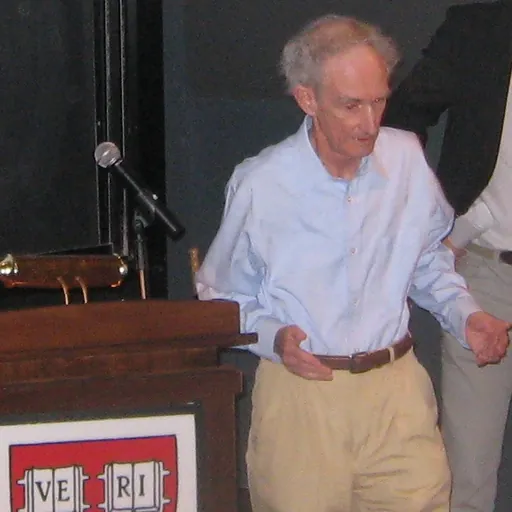
About Robert May, Baron May of Oxford
Lived 1936 – 2020 (aged 84). Robert May, Baron May of Oxford was a British and American physicist, engineer, zoologist, university teacher, ecologist and politician.
Early life and education May was born in Sydney on 8 January 1936, to lawyer Henry Wilkinson May and Kathleen Mitchell , who divorced when he was seven years old. His father was of prosperous middle-class Northern Irish origin, and his mother was the daughter of a Scottish engineer. May was educated at Sydney Boys High School. He was a patron of the Sydney High School Old Boys Union.
Career and research Career The logistic map, pictured here, was a seminal discovery by May that demonstrated how even a simple equation could result in chaos. Early in his career, May developed an interest in animal population dynamics and the relationship between complexity and stability in natural communities. He was able to make major advances in the field of population biology through the application of mathematical techniques. His work played a key role in the development of theoretical ecology through the 1970s and 1980s. He also applied these tools to the study of disease and to the study of biodiversity.
May was Gordon MacKay Lecturer in Applied Mathematics at Harvard University (1959–61) and returned to the University of Sydney (1962) as senior lecturer, reader, and professor (1969–72) in theoretical physics. From 1973 until 1988, he was Class of 1977 Professor of Zoology at Princeton University, serving as chairman of the University Research Board 197788. From 1988 until 1995, he held a Royal Society Research Professorship jointly at Imperial College London and the University of Oxford, where he became a fellow of Merton College and a Master of Arts. He was Chief Scientific Adviser to HM Government and head of the Office of Science and Technology (1995–2000), and president of the Royal Society (2000–2005).
Public life May held subsidiary appointments as executive trustee of the Nuffield Foundation, member of the board of the United Kingdom Sports Institute, foundation trustee of the Gates Trust (University of Cambridge), chairman of the board of trustees of the Natural History Museum, trustee of the Royal Botanic Gardens, Kew, independent member of the Joint Nature Conservation Committee, trustee of World Wildlife Fund-UK, president of the British Ecological Society, and member of the Committee on Climate Change.
In 1996, May asked Ig Nobel to stop awarding prizes to British scientists because this might lead the public to treat worthwhile research less seriously (see Criticism of Ig Nobel).
Climate change co-operation Although an atheist since his youth, May stated that religion may help society deal with climate change. While referring to what he believed to be a rigid structure of fundamentalist religion, he stated that the co-operational aspects of non-fundamentalist religion may in fact help with climate change. When asked if religious leaders should be doing more to persuade people to combat climate change, he stated that it was absolutely necessary.
Awards and honours May was appointed Knight Bachelor in 1996, and a Companion of the Order of Australia in 1998. In 2001, on the recommendation of the House of Lords Appointments Commission, he was created a life peer. He was one of the first fifteen peers to be elevated in this manner. After his initial preference for "Baron May of Woollahra" failed an objection from the Protocol Office of the Australian Prime Minister's Department, he chose the style and title Baron May of Oxford, of Oxford in the County of Oxfordshire. He was made a member of the Order of Merit in 2002.
He was elected to the American Academy of Arts and Sciences in 1977 and to the Fellowship of the Royal Society in 1979. He became a Corresponding Fellow of the Australian Academy of Science in 1991, a Foreign Member of the United States National Academy of Sciences in 1992, a member of the American Philosophical Society in 2001, a member of the Academia Europaea in 1994, and Fellow of the Royal Society of New South Wales in 2010.
In 2005 he was appointed an Honorary Fellow of the Royal Academy of Engineering. In 2009 Lord May became only the 7th ever Honorary Fellow of the Australian Institute of Building (HonFAIB). He received honorary degrees from universities including Uppsala (1990), Yale (1993), Sydney (1995), Princeton (1996), and the Eidgenössische Technische Hochschule Zürich (2003). He was awarded the Weldon Memorial Prize by the University of Oxford (1980), an Award by the MacArthur Foundation (1984), the Medal of the Linnean Society of London (1991), the Marsh Christian Prize (1992), the Frink Medal by the Zoological Society of London (1995), the Crafoord Prize (1996), the Balzan Prize (1998) for Biodiversity and the Copley Medal by the Royal Society (2007) and the Lord Lewis Prize by the Royal Society of Chemistry (2008).
Personal life During his postdoctoral research at the Division of Engineering and Applied Physics at Harvard University as Gordon MacKay Lecturer in Applied Mathematics, between 1959 and 1961, May met his wife, Judith Feiner, The Mays had a daughter, Naomi.
Don’t just read it —
keep it.
Full-length biographies made to live with: read them, listen on the way to work, watch them tonight.
- E-book
- Audio
- Video
Instant download · yours to keep · every purchase keeps this site free
Important facts
more
Bob MayPeople in Robert May, Baron May of Oxford's life
Named in this biography and alive at the same time


Related people
Same field, nearest in time


Contemporaries
People whose lives overlapped Robert May, Baron May of Oxford's
Frequently asked questions
Who was Robert May, Baron May of Oxford?
Australian scientist who has been Chief Scientific Adviser to the UK Government (1936-2020)
When was Robert May, Baron May of Oxford born?
Robert May, Baron May of Oxford was born on 8 January 1936 in Sydney.
When did Robert May, Baron May of Oxford die?
Robert May, Baron May of Oxford died on 28 April 2020 in Oxford.
What was Robert May, Baron May of Oxford's occupation?
Robert May, Baron May of Oxford was a physicist, engineer, zoologist, university teacher, ecologist and politician.
What nationality was Robert May, Baron May of Oxford?
Robert May, Baron May of Oxford was British and American.
Sources & further reading
· Wikipedia: Robert May, Baron May of Oxford
· DBpedia: Robert May, Baron May of Oxford
Cite this page
APA: Biography.guide. (2026). Robert May, Baron May of Oxford. https://biography.guide/robert-may-baron-may-of-oxford/
MLA: "Robert May, Baron May of Oxford." Biography.guide, https://biography.guide/robert-may-baron-may-of-oxford/.
Chicago: "Robert May, Baron May of Oxford." Biography.guide. https://biography.guide/robert-may-baron-may-of-oxford/.
Data last updated: 2026-09-28 · Spot an error? Report a correction.
Portrait: Wikimedia Commons · author & licence
Page generated 2026-10-04 13:03 UTC