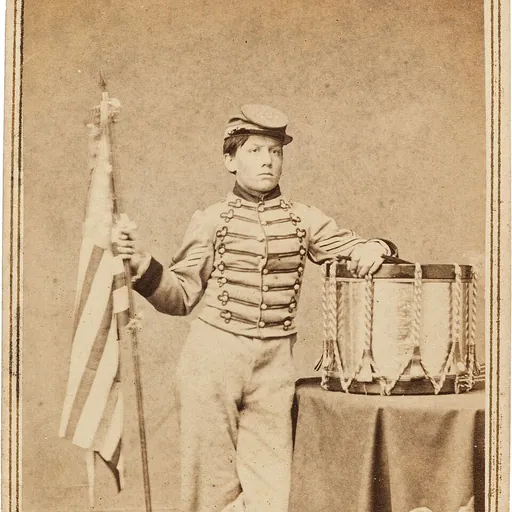
Robert Henry Hendershot
Drummer in the American Civil War
About Robert Henry Hendershot
Lived 1850 – 1925 (aged 74–75).
Robert Henry Hendershot (died December 26 1925), known as the Drummer Boy of the Rappahannock, was an American Civil War drummer boy known for his reputed heroics at the Battle of Fredericksburg, Virginia, in December 1862.
Biography
Hendershot was born somewhere between 1847 and 1851 in either New York or Michigan. In 1861 he was living with his widowed mother in Jackson, Michigan. That fall he began drilling with the Jackson County Rifles, a local volunteer unit. He accompanied them to Fort Wayne, outside Detroit, where the unit became Company C of the 9th Michigan Infantry. Hendershot did not enlist at this time, but accompanied the regiment to its first encampment at West Point, Kentucky, either as a stowaway or as a servant to Captain Charles V. DeLand, the company commander and erstwhile publisher of the Jackson American Citizen. Hendershot remained with Company C until March 1862, when he enlisted as a musician in Company B.
He was with Company B at the Murfreesboro, Tennessee courthouse when it was attacked by a Confederate cavalry brigade under command of Brigadier General Nathan Bedford Forrest on July 13, 1862, at the First Battle of Murfreesboro. Hendershot was captured with the rest of his regiment and paroled with the enlisted men. Shortly thereafter he was discharged for disability; he suffered frequent and severe epileptic seizures, an affliction he had endured since early childhood. Although this alone should have precluded any further military service, "an oath of honor" also obliged Hendershot "not to take up arms against the Confederacy until regularly exchanged." In spite of this, in early September, Hendershot appeared at a Detroit recruiting office and enlisted in the 8th Michigan Infantry Regiment. Because of his parole, he signed on with an alias, "Robert Henry Henderson." His critics later called this despicable, while others said it had been a common practice. Hendershot claimed he had done so at the urging of the recruiter, Lieutenant Michael Hogan,
The two traveled south to Taylor's assigned unit, the 8th Michigan Infantry. At the Washington depot Taylor rescued Hendershot when he suffered a seizure and fell in front of a locomotive. He suffered another seizure a few days later, while standing at dress parade. Hendershot then confessed to Taylor of his discharge from the 9th Infantry and his use of an alias. Hendershot began to have such frequent seizures that the acting regimental commander, Major Ralph Ely, ordered him off-duty and applied for his discharge.
Hendershot awaited discharge through the closing months of 1862. Freed of his military duties, he explored the Union encampment that contained the Army of the Potomac. The Army was waiting on the banks of the Rappahannock River, opposite the lightly defended city of Fredericksburg, Virginia, while bridges were built across the river. The delay enabled General Robert E. Lee to move his army into position. When the engineers arrived, they came under attack from rebel sharpshooters, so on 11 December 1862 the 7th Michigan Infantry volunteered to cross the river under enemy fire and drive the rebel sharpshooters from their nests.
Hendershot's wanderings had taken him to the riverbank that morning. He later claimed he helped push off the first boat and slipped when he tried to climb aboard, and made the voyage across clinging to the gunwale.
Reports of the episode appeared in the press. The young hero remained nameless until late December, when Hendershot visited the offices of the Detroit Free Press and Detroit Advertiser and Tribune, claiming to be the "Drummer Boy of the Rappahannock." Hendershot's story was repeated in national papers, including the New-York Tribune. Its publisher, Horace Greeley, presented Hendershot with a silver drum. For the next eight weeks Hendershot performed at the P. T. Barnum museum, and then spent a few weeks more in Poughkeepsie, New York, at the Eastman Business College, which had rewarded his heroism with a scholarship.
Hendershot was discharged from the 8th Michigan Infantry, for epilepsy, on 27 December 1862. In April 1864 he left Poughkeepsie and enlisted as a first class boy aboard the U.S.S. Fort Jackson at Hampton Roads, Virginia. From his naval service arose the story that he was a member of a shore party that destroyed a salt works near Fort Fisher. Only Hendershot's biographers offer evidence that Hendershot took part in the raid. He fell overboard while in a seizure and would have drowned had it not been for a watchful shipmate, Seaman Henry Harkins. Hendershot claimed that this incident prompted his discharge upon the ship's return to Norfolk on 26 June 1864. The ship's log listed him as a deserter.
Hendershot claimed that he spent the next few months on a grand tour of England, in service as a page with the Treasury Department, and on dangerous missions for General Grant as a spy operating behind enemy lines. By the end of the war Hendershot had collected a portfolio of endorsements from Generals Burnside, Meade, Logan, Parkhurst and others, recommending him for an appointment to West Point. The last endorsement came from President Lincoln, who wrote "I know of this boy, and believe he is very brave, manly and worthy." Hendershot claimed he had been denied admission to the Academy because of his wounds, or because of his inability to pass the entrance exams; however, no application exists in War Department records.
Post war After the war Hendershot returned to Poughkeepsie Business College for a brief time, marrying a fellow student. In 1867 he collaborated with writer William Sumner Dodge, who produced a 200-page biography, Robert Henry Hendershot; or the Brave Drummer Boy of the Rappahannock.
After his retirement as mail clerk in 1885, Hendershot took out his drum and began touring the country with his son, Cleveland, who played the fife. Although they principally performed at Grand Army of the Republic (GAR) functions and other patriotic gatherings, their tour also took them to Canada and the Kingdom of Hawaii, where they entertained Queen Lill'uokalani.
In July 1891 Hendershot posted a letter to the GAR newspaper, the National Tribune, restating his claim to the title "Drummer Boy of the Rappahannock," as well as that of "youngest soldier". He was by then one of the best known veteran drummer boys in the country. As such, he was invited to lead the Michigan Department during the GAR parade at the organization's annual national encampment, held in Detroit the first week of August.
There were old soldiers who were not pleased by the fame and honors Hendershot enjoyed. One of them was the Seventh Michigan's former drum major, Wilbur F. Dickerson of Grand Rapids, Michigan. In a letter to the encampment's organizers, Dickerson pronounced Hendershot a fake, and asked them to remove him from his place of honor. In other letters Dickerson asked members of the Seventh Michigan to help him spearhead an attack to discredit Hendershot. Several months later a number of Detroit citizens awarded Spillaine a gold medal, two inches in diameter, upon which was a raised figure of a drummer boy and the inscription "Drummer Boy of the Rappahannock." Spillaine readily accepted the title and proudly wore the medal for the rest of his life. Spillaine used the title as a springboard to commandership of the Michigan Department of the GAR in 1912. He appears with the medal in his official GAR portrait, and maintained a scrapbook of newspaper articles related to the Drummer Boy of the Rappahannock until his death.
Hendershot immediately mounted an appeal in the local press; however, the newspapers responded with rebuttals from Drum Major Dickerson and others. By the end of the conference Hendershot had been thoroughly discredited.
Robert H. Hendershot, about 1895, with GAR badges and "Drummer Boy" medal. Photograph from Gerry, H. E. Campfire Entertainment, 1903 During 1892 Hendershot traveled from coast to coast, visiting GAR posts and regimental reunions, winning back support of other old veterans. By the time of the national encampment of 1893, in Indianapolis, he had won his fight: the GAR reinstated his title and presented him with a diamond-studded solid gold medal inscribed "Robert H. Hendershot, Drummer Boy of the Rappahannock, from G.A.R. and W.R.C. comrades, Indianapolis, 1893." Soon after Hendershot strengthened his claim with another biography, Camp Fire Entertainment: The True Story of R. H. Hendershot, Drummer Boy of the Rappahannock. Although Spillaine also continued to claim the title and used it to gain commandership of the Michigan Department of the GAR in 1912, Hendershot apparently felt no further need to defend his title. He continued his career as a professional veteran drummer boy until at least 1914, when he performed during a reunion of the Iron Brigade, in Detroit, Michigan. Hendershot had one fight left, however.
Pension claims and death Hendershot had first filed for an invalid veteran's pension in 1890. The claim was based only on his service in the 9th Michigan Infantry. The Pension Bureau scheduled a medical examination for Hendershot, and three times he failed to appear. After that the Bureau moved his application to the inactive file. Hendershot let the matter rest for two more decades, while he and his son toured the country, entertaining at GAR gatherings and other patriotic functions.
Then, in 1912, he applied for a veteran's old age pension, based on his service in both the 8th and 9th Michigan Infantries. The Bureau could find no record of his service with the Eighth (probably due to his use of an alias), and requested additional information. Hendershot responded with an account of his naval service aboard the U.S.S. Fort Jackson. After checking with the Navy Department, which still listed Hendershot as a deserter-at-large, the Bureau summarily rejected his application. For the next ten years Hendershot gathered affidavits, hired lawyers, and exchanged letters with the Bureau, but failed to get the pension. In 1921 he modified his application, stating that he was an invalid, bedridden, suffering from Parkinson's disease, and in need of constant attention. Again, his naval service stood in the way. Finally, Hendershot appealed to Congress, which by a special act on 23 December 1924 granted him an old age pension of $50 per month.
Don’t just read it —
keep it.
Full-length biographies made to live with: read them, listen on the way to work, watch them tonight.
- E-book
- Audio
- Video
Instant download · yours to keep · every purchase keeps this site free
Important facts
People in Robert Henry Hendershot's life
Named in this biography and alive at the same time


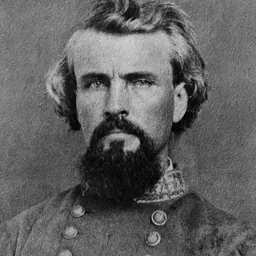

Contemporaries
People whose lives overlapped Robert Henry Hendershot's

Frequently asked questions
Who was Robert Henry Hendershot?
Drummer in the American Civil War
When was Robert Henry Hendershot born?
Robert Henry Hendershot was born in 1850.
When did Robert Henry Hendershot die?
Robert Henry Hendershot died on 26 December 1925.
Sources & further reading
· Wikipedia: Robert Henry Hendershot
· DBpedia: Robert Henry Hendershot
Cite this page
APA: Biography.guide. (2026). Robert Henry Hendershot. https://biography.guide/robert-henry-hendershot/
MLA: "Robert Henry Hendershot." Biography.guide, https://biography.guide/robert-henry-hendershot/.
Chicago: "Robert Henry Hendershot." Biography.guide. https://biography.guide/robert-henry-hendershot/.
Data last updated: 2026-09-23 · Spot an error? Report a correction.
Portrait: Wikimedia Commons · author & licence
Page generated 2026-09-27 05:08 UTC