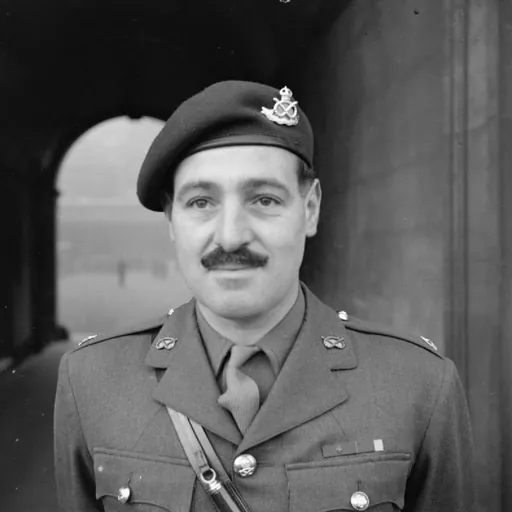
Robert Henry Cain
Manx recipient of the Victoria Cross
About Robert Henry Cain
Lived 1909 – 1974 (aged 65). Robert Henry Cain was a British military officer and royal Dutch Shell.
Major Robert Henry Cain VC TD (2 January 1909 – 2 May 1974) was a British Army officer who was a recipient of the Victoria Cross, the highest award for gallantry in the face of the enemy that can be awarded to British and Commonwealth forces.
Cain grew up on the Isle of Man and joined the Honourable Artillery Company in 1928. After working overseas he was granted an emergency commission into the Army in 1940. He transferred to the South Staffordshire Regiment in 1942, and joined their 2nd Battalion, part of the British 1st Airborne Division. He saw active service during the Allied Invasion of Sicily in 1943 and again during the Battle of Arnhem the following year. During the battle Major Cain's company was closely engaged with enemy tanks, self-propelled guns and infantry. Cain continually exposed himself to danger while leading his men and personally dispatched as much enemy armour as possible. Despite sustaining several injuries he refused medical attention and for his gallantry he was awarded the Victoria Cross.
Later in the war he took part in Operation Doomsday, where the 1st Airborne Division oversaw the German surrender in Norway. He left the army in late 1945 and returned to his pre-war job at Royal Dutch Shell. He died of cancer in 1974.
Early life Robert Henry Cain was born in Shanghai on 2 January 1909. His parents were Manx, and returned to the Isle of Man when he was young. He was educated at King William's College.
Second World War In April 1940, shortly after the start of the Second World War, Cain was granted an emergency commission into the Royal Northumberland Fusiliers as a second lieutenant. In 1942, he was seconded to the 2nd Battalion South Staffordshire Regiment before being temporarily promoted to the rank of major in April 1943—a position he retained until the rank was formally confirmed in 1945. Their presence added a substantial number of Panzergrenadiers, tanks and self-propelled guns to the German defences, and the Allies suffered heavily in the ensuing battle. Only a small force briefly held one end of the Arnhem road bridge before being overrun on the 21st. The rest of the division became trapped in a small pocket west of the bridge and had to be evacuated on the 25th. The Allies failed to cross the Rhine, which remained under German control until Allied offensives in March 1945.
Advance into Arnhem The Allies planned to fly British and Polish to Arnhem in three separate lifts over three days. Major General Roy Urquhart decided to deploy the 1st Airlanding Brigade first, as glider troops could assemble more quickly than parachute infantry, and secure the landing areas. Cain took off with the first lift along with two companies of the South Staffords, but only five minutes after departing from RAF Manston, the tow rope connecting the Albemarle tug to his Horsa glider pulled out of the leading aircraft. After landing safely, the glider's occupants were able to fly out the following day with the second lift.
Two Airborne soldiers demonstrate a P.I.A.T. antitank weapon. In Arnhem, the Allied plan quickly unravelled. Only a small group of the 1st Parachute Brigade, mainly elements of Lieutenant Colonel John Frost's 2nd Battalion, were able to reach the bridge. The 1st and 3rd Battalions were unable to penetrate the outer suburbs of the city, and their advance stalled, so in order to support them, the first lift of the South Staffords were sent forward on the morning of the 18th. When Cain arrived with the second lift, they too were sent forward, arriving at the outskirts of Arnhem on the night of the 18th. Lieutenant Colonel David Dobie of the 1st Battalion proposed a concentrated attack on a narrow front between the Lower Rhine and the Arnhem railway line. The South Staffords would advance toward the bridge, with the remnants of the 1st and 3rd Battalions on their right flank, while the 11th Parachute Battalion remained in reserve. The Staffords moved forward at 4.30am with D Company in the lead, followed by B and A Companies with C Company in reserve. In the area around St Elizabeth Hospital, the lead company met heavy resistance clearing houses. B Company then took the lead, getting as far as a dell near the Arnhem City Museum. Here, Cain and his men encountered enemy armour for the first time. The company was poorly equipped, relying solely on P.I.A.T.s and mortars. Despite their limited resources, Cain and several members of his company took up positions and opened fire on the advancing armoured vehicles. However, their efforts, though determined, were ineffective, and they were unable to inflict any significant damage or disable the enemy vehicles. By 11:30, they had run out of P.I.A.T. ammunition and the tanks now dominated the area. Cain fell back with several of his men, but few of them were able to escape, while the men of the other companies were forced to surrender.
As the surviving men fell back through the 11th Battalion's positions, Major Gilchrist (A Company, 11th Battalion) met Cain, who told him, "The tanks are coming, give me a P.I.A.T." Gilchrist was unable to oblige, and so the Staffords regrouped behind the 11th Battalion's positions with roughly 100 surviving men forming five small platoons under Cain’s command. Lieutenant Colonel George Lea, commander of the 11th Battalion, ordered them to capture a piece of wooded high ground known as Den Brink, to cover a fresh advance, and a bayonet charge quickly cleared the enemy there. Alarmed that the many retreating units would soon leave his own 75 Millimetre Howitzers undefended, he sought out Cain, the most senior officer, and ordered him to organise the men into a defensive screen ahead of the gun positions. The sector was designated 'Thompson Force', but was renamed 'Lonsdale Force' when Thompson was wounded the following day. To the north and west of Oosterbeek, other units fell back in the face of strong German resistance and over the next few days a thumb-shaped perimeter formed around the town, with the Rhine at its base.
Lonsdale Force's sector covered the southern end of the eastern perimeter, and Cain was one of three Majors defending this sector of the line. and sited himself in a laundry's garden, much to the chagrin of the Dutch owner. Over the coming days Cain was everywhere, dealing with armour and snipers and encouraging his men. On the afternoon of Thursday 21st, two tanks approached Cain's position. Guided by a colleague in a building above him, Cain waited in a trench until the first tank—actually a StuG III self-propelled gun (SPG) —was close enough to engage. The SPG fired at the building, killing Cain's colleague and showering him with masonry, but despite this, Cain kept his position. The British brought forward one of the Light Regiment's 75mm Pack Howitzers which destroyed the tank. He wanted to continue using the gun, but the recoil mechanism was destroyed. After successfully crossing the Rhine, this led Brigadier 'Pip' Hicks to comment "There's one officer, at least, who's shaved." Cain's reply was "I was well brought up, sir." Cain made sure all of his men were over the river by dawn, before he himself crossed in an old boat. As well as being the only survivor of the battle to receive the Victoria Cross, Cain was also the first — and, to date, only — Manxman to be awarded the medal. Posthumous VCs were announced later, including one for Lance Sergeant John Baskeyfield of the 2nd South Staffordshire Battalion's anti-tank platoon. The 2nd Battalion thus became the only British battalion to receive two VCs in one engagement during the Second World War.
There are some errors in Cain's citation. The action described as occurring on the 20th actually took place on the 21st, Additionally, the enemy vehicle identified as a Tiger tank was actually a StuG III self-propelled gun. In Operation Doomsday, Cain travelled to Oslo, Norway, with the 1st Airlanding Brigade on 11 May 1945. Working with Milorg (the Norwegian resistance), the British took the surrender of German troops in Norway without incident, before returning to the UK on 25 August 1945. Having remained in the service of the South Staffordshire Regiment, Cain officially relinquished his wartime commission on 28 December 1945 and was granted the honorary rank of major.
Later life Upon leaving the army, Cain went back to his pre-war occupation with Shell, living in East Asia and then West Africa. In 1951 he was elected to the Nigerian House of Representatives while working there. He returned to Britain in 1965 and settled in the Isle of Man upon his retirement.
Family Cain and his wife had four children. His daughter, Frances Catherine Cain, was married to television presenter Jeremy Clarkson from 1993 to 2014.
Death Cain died of cancer on 2 May 1974 in Crowborough, Sussex. He was cremated at Worth Crematorium, Crawley, and his ashes were interred in the family grave at Braddan Cemetery on the Isle of Man. His Victoria Cross, Denison smock, and the maroon beret he wore during the Battle of Arnhem are all held at the Staffordshire Regiment Museum. His daughter, Frances Cain, unveiled a set of commemorative coins honouring her father on the Isle of Man in 2006. She was married to British television and motoring journalist Jeremy Clarkson, who presented a BBC documentary, The Victoria Cross: For Valour on Cain and other VC recipients in 2003. Frances Cain was unaware of her father's VC until after he died because, according to Clarkson, "he'd never thought to mention it".
Medals and decorations
Don’t just read it —
keep it.
Full-length biographies made to live with: read them, listen on the way to work, watch them tonight.
- E-book
- Audio
- Video
Instant download · yours to keep · every purchase keeps this site free
Important facts
People in Robert Henry Cain's life
Named in this biography and alive at the same time





Related people
Same field, nearest in time


Contemporaries
People whose lives overlapped Robert Henry Cain's


Frequently asked questions
Who was Robert Henry Cain?
Manx recipient of the Victoria Cross (1909-1974)
When was Robert Henry Cain born?
Robert Henry Cain was born on 2 January 1909 in Shanghai.
When did Robert Henry Cain die?
Robert Henry Cain died on 2 May 1974 in Crowborough.
What was Robert Henry Cain's occupation?
Robert Henry Cain was a military officer and royal Dutch Shell.
What nationality was Robert Henry Cain?
Robert Henry Cain was British.
Sources & further reading
· Wikipedia: Robert Henry Cain
Cite this page
APA: Biography.guide. (2026). Robert Henry Cain. https://biography.guide/robert-henry-cain/
MLA: "Robert Henry Cain." Biography.guide, https://biography.guide/robert-henry-cain/.
Chicago: "Robert Henry Cain." Biography.guide. https://biography.guide/robert-henry-cain/.
Data last updated: 2026-09-22 · Spot an error? Report a correction.
Portrait: Wikimedia Commons · author & licence
Page generated 2026-09-27 05:04 UTC