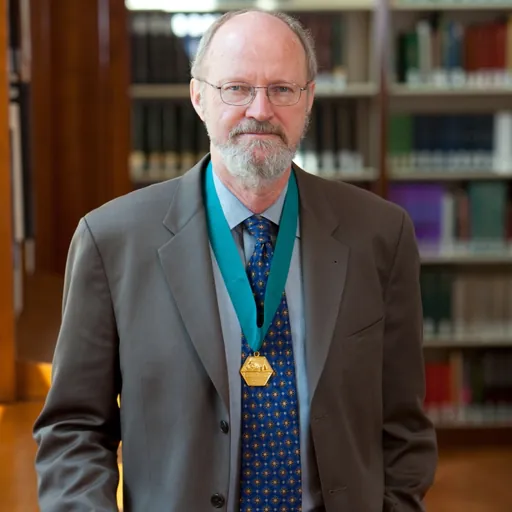
Robert H. Grubbs
Nobel prize winning American chemist
About Robert H. Grubbs
Lived 1942 – 2021 (aged 79). Robert H. Grubbs was an American chemist, autobiographer and university teacher.
notable_students = Post-docs: thesis_title = I. Cyclobutadiene Derivatives II. Studies of Cyclooctatetraene Iron Tricarbonyl Complexes thesis_url = https://www.proquest.com/docview/302317287 thesis_year = 1968 known_for = Catalysts for olefin metathesis in organic synthesis awards = spouse = Helen O'Kane website =
Robert Howard Grubbs ForMemRS (February 27, 1942 – December 19, 2021) was an American chemist and the Victor and Elizabeth Atkins Professor of Chemistry at the California Institute of Technology in Pasadena, California.
Grubbs was elected a member of the National Academy of Engineering in 2015 for developments in catalysts that have enabled commercial products.
He was a co-founder of Materia, a university spin-off startup to produce catalysts.
Early life and education Grubbs was born on February 27, 1942, on a farm in Marshall County, Kentucky, midway between Possum Trot and Calvert City. His parents were Howard and Faye (Atwood) Grubbs. Faye was a schoolteacher. After serving in World War II, the family moved to Paducah, Kentucky, where Howard trained as a diesel mechanic, and Robert attended Paducah Tilghman High School. However, he was convinced by professor Merle A. Battiste to switch to organic chemistry.
Next, Grubbs attended Columbia University, where he worked with Ronald Breslow on organometallic compounds which contain carbon-metal bonds. Grubbs received his Ph.D. in 1968. He received a Sloan Fellowship for 1974–1976. In 1975, he went to the Max Planck Institute for Coal Research in Mülheim, Germany, on a fellowship from the Alexander von Humboldt Foundation.
In 1978, Grubbs moved to California Institute of Technology as a professor of chemistry. As of 1990 he became the Victor and Elizabeth Atkins Professor of Chemistry. and of 137 according to Scopus.
Commercial activities Both first and second generation Grubbs catalysts were commercially available from Materia, a startup company that Grubbs co-founded with Mike Giardello in Pasadena, California, in 1998. Materia has been able to obtain exclusive rights to manufacture many of the known olefin catalysts. Under Giardello, Materia was able to sell their catalysts through Sigma-Aldrichs chemicals catalogue. Sigma-Aldrich became their exclusive worldwide provider. In 2008, Materia partnered with Cargill to form Elevance Renewable Sciences to produce specialty chemicals from renewable oils, including biofuels. In 2017, Materia sold its catalyst business to Umicore. In 2021, Materia was acquired by ExxonMobil.
Grubbs was a member of the Reliance Innovation Council formed by Reliance Industries Limited, India.
Grubbs was a member of the USA Science and Engineering Festival's advisory board.
Research Grubbs's main research interests were in organometallic chemistry and synthetic chemistry, particularly the development of novel catalysts for olefin metathesis. In olefin metathesis, a catalyst is used to break the bonds of carbon molecules, which can then re-form to create chemical bonds in new ways, producing new compounds with unique properties. The basic technique can be used for creation of polymers, pharmaceuticals and petrochemicals cross-metathesis reaction (CMR), and ring-opening metathesis polymerization (ROMP) with cyclic olefins such as norbornene. He also contributed to the development of "living polymerization", in which the termination ability of a polymerization reaction is removed. The polymer will continue to replicate until a quenching agent is presented.
The Grubbs group successfully polymerized the 7-oxo norbornene derivative using ruthenium trichloride, osmium trichloride as well as tungsten alkylidenes. They identified a Ru(II) carbene as an effective metal center and in 1992 published the first well-defined, ruthenium-based olefin metathesis catalyst, (PPh3)2Cl2Ru=CHCH=CPh2. This work culminated in the now commercially available first-generation Grubbs catalyst in 1995. Second generation catalysts were developed as well.
Ruthenium is stable in air and has higher selectivity and lower reactivity than molybdenum, the most promising of the previously discovered catalysts. In addition, Grubbs took a green chemistry approach to catalysis that reduced the potential to create hazardous waste. The Grubbs catalyst has become a standard for general metathesis applications in ordinary laboratories.
By controlling the catalyst used, it became possible to synthesize polymers with specialized structures and functional capabilities, including cyclic olefins, alternating copolymers, and multiblock copolymers. At the time of his death, he was being treated for lymphoma. He has received a number of other awards and honors, including the following:
1989: National Academy of Sciences 1994: American Academy of Arts and Sciences 2000: Benjamin Franklin Medal in Chemistry from the Franklin Institute 2000: ACS Herman F. Mark Polymer Chemistry Award 2001: ACS Herbert C. Brown Award for Creative Research in Synthetic Methods 2002: Tolman Medal 2002: Arthur C. Cope Award 2003: Tetrahedron Prize for Creativity in Organic Chemistry & BioMedicinal Chemistry (with Dieter Seebach) 2005: Nobel Prize in Chemistry (with Richard R. Schrock and Yves Chauvin) 2005: Paul Karrer Gold Medal 2006: Golden Plate Award of the American Academy of Achievement 2009: Fellow of the American Chemical Society 2010: American Institute of Chemists Gold Medal 2015: Inducted into the Florida Inventors Hall of Fame 2013: National Academy of Inventors 2015: National Academy of Engineering 2015: Chinese Academy of Sciences (foreign academician) 2017: Ira Remsen Award 2017: Elected a Foreign Member of the Royal Society
Publications
Don’t just read it —
keep it.
Full-length biographies made to live with: read them, listen on the way to work, watch them tonight.
- E-book
- Audio
- Video
Instant download · yours to keep · every purchase keeps this site free
Important facts
People in Robert H. Grubbs's life
Named in this biography and alive at the same time




Related people
Same field, nearest in time



Contemporaries
People whose lives overlapped Robert H. Grubbs's



Frequently asked questions
Who was Robert H. Grubbs?
Nobel prize winning American chemist (1942-2021)
When was Robert H. Grubbs born?
Robert H. Grubbs was born on 27 February 1942 in Possum Trot.
When did Robert H. Grubbs die?
Robert H. Grubbs died on 19 December 2021 in Duarte.
What was Robert H. Grubbs's occupation?
Robert H. Grubbs was a chemist, autobiographer and university teacher.
What nationality was Robert H. Grubbs?
Robert H. Grubbs was American.
Sources & further reading
Cite this page
APA: Biography.guide. (2026). Robert H. Grubbs. https://biography.guide/robert-h-grubbs/
MLA: "Robert H. Grubbs." Biography.guide, https://biography.guide/robert-h-grubbs/.
Chicago: "Robert H. Grubbs." Biography.guide. https://biography.guide/robert-h-grubbs/.
Data last updated: 2026-09-21 · Spot an error? Report a correction.
Portrait: Wikimedia Commons · author & licence
Page generated 2026-09-27 05:00 UTC