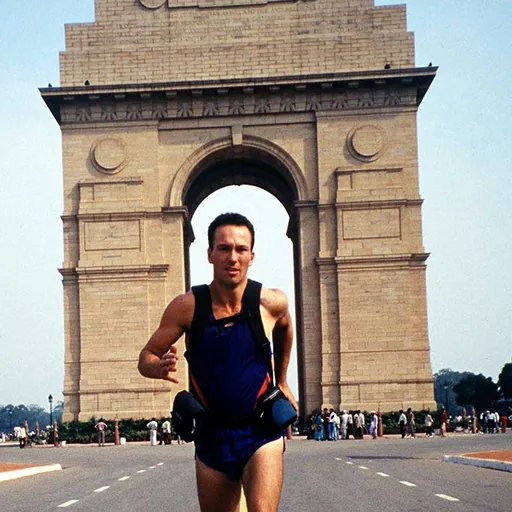
Robert Garside
British athlete, first person to run around the world
About Robert Garside
Born 1967. Robert Garside is a British explorer and athletics competitor.
Robert Garside (born 6 January 1967), calling himself The Runningman, is a British runner who is credited by Guinness World Records as the first person to run around the world. Garside began his record-setting run following two aborted attempts from Cape Town, South Africa and London, England. Garside set off from New Delhi, India on 20 October 1997, completing his run back at the same point on 13 June 2003.
While his run has been challenged by some ultra distance runners and some members of the press, subsequent publications clarified a number of the points raised, such as anomalies in his online diary, and his running of the Nullarbor plain without a support crew – a feat believed impossible according to classic ultrarunning methodologies but achieved using lateral thinking and relying upon passing traffic and local people to drop off water for him instead – and highlighted the clashes of personality, running approach, and actions, that had engendered the concerns.
In assessing his feat, Trailrunner senior editor Monique Cole stated he had clearly run more of the world than anyone else, where he was an all-round sportsman and captain of the soccer team, and noticed that there was a record listed for walking the world, but not for running it. He decided to attempt to set a record as the first person to run around the world, an extreme ultramarathon feat.
He credited as part of his motive, his mother's happiness at leaving his father to return to her native country, Slovakia, following their divorce, when he was a teenager, and also finding that the state of mind he reached when running as an adult brought back some of his "best times" from childhood, where he ran and played in the "huge forests" near his house. It's not something you want to rush. You want to go the long way. You want to see stuff. This is the world... — — Robert Garside
1997 – 2003 world run During his run, Garside updated his website with a portable computer, He met with considerable assistance, as he was offered lodgings around the globe in such diverse settings as five-star hotels and private homes to prison cells and police stations. In addition to corporate sponsorship of £50,000, he indicated he received £120,000 in donations from individuals. Along the way, Garside also met his future wife, then Endrina Perez, in Venezuela.
Garside indicated in 2001 that it was his habit to jog seven to eight hours a day, covering an average of forty miles a day when running on flat ground, outfitted with a video camera to record his journey and a fifteen-pound backpack. On his third run, he used his video camera every 20 minutes while running to take a four-minute clip of his location, and routinely requested signed, dated documents from local officials. Near the end of his run, Garside indicated that the worst experiences he'd encountered were three days spent running without any food and five days spent in jail in China because he lacked proper documentation. and political unrest related to guerilla conflicts to turn back to Venezuela and fly to the next country, Panama; then resumes running north through Central America to Mexico Flies north-west across Gulf of California to the Mexican state of Baja California Sur, then runs north to the Mexico-USA borderThis flight, while in the rules, was one of those seized on by critics.
The 9/11 attacks in New York City cause the border to be closed when Garside reaches it, forcing a change of plans for Africa. Instead of running the continent, Garside notifies Guinness, and flies to Rabat Morocco, leaving the rest of Africa for a later stage.(In the event he has only limited success in his desire to run the full length of Africa; his world run does not cover the entire length of Africa. Of note, the rules do not require him to do so, nor have other recognised pedestrian circumnavigators always done it.He does traverse Africa laterally to a limited extent, although not at its maximum width, by running from Cape Town on the Atlantic coast to Mozambique on the Indian Ocean coast) Runs north along the coast to the Straits of Gibraltar, then crossing the straits by ferry, enters Gibraltar and Spain. Continues running parallel to the South East coast of Spain into mainland Europe Continues running along Southern Europe via the length of Italy, crossing to Greece and then again to inland Turkey, finally reaching Antalya Turkey. Ferries taken at places, notably the Adriatic Sea (Southern Italy-Greece), and Aegean Sea (Greece-Turkey)
Two attempts failed at running Africa: one along the length of the Nile in Egypt, the other retracing back to north Egypt and going via Saudi Arabia and flight to Eritrea, and then south along the coast. Both failed. Garside abandons his hope of running the north–south length of Africa, when he was in Central America. Koeppel states that Garside ran with around 15 pounds (6.8 kg) of equipment in a backpack, and started with around £20 ($30) of money; a music player or music playing phone,
He also commented on the experience of running itself: "It's difficult to describe, but you get into the rhythm, and your focus is heightened. It becomes really, really clear, [...] That's why I've always run alone, for my own pleasure. Running with other people, my attention is divided. I can't get into that altered state. I don't understand the desire to train for three years just to run a 2-1/2-hour marathon with a lot of other people."
Other controversies highlighted on his verified run mainly related to flights omitted from his online diary – one of which made Garside appear to have run at world record speeds in Mexico – and being found in locations which contradicted his online information. Garside commented on these that he had not always updated his online diary promptly, and at times had made repeated or unplanned brief air trips which were not reflected in the online record. but were seized on by an already skeptical audience. Garside – often running thousands of miles away or in isolated places, poorly disposed towards much of the broader running community, solitary, secretive about adverse events affecting his progress, and at times abrasive in his responses a former ally was quoted in the same article as opining that Garside was being "destroyed" before he had finished the run, by his "readiness to deceive". Blaikie also cited the lack of any support team or helpers to help him carry food and water and his lack of experience with ultramarathons as reasons to doubt Garside's claims. As well as hiding his 1997 restart, Garside had also apparently admitted to shortening his route by 1300 km by taking an airplane from Mexico City to the United States border; his diary left the impression of 10 days to run 1300 km, a world record if true. They stated that Guinness did not require running where roads did not exist, or unreasonable feats, but noted that his undisclosed use of air flight at times – notably in parts of Central and South America – led to "the British press... ripping into him". Reuters described the award as "a major vindication for Garside".
Dan Koeppel's apologia: Redemption of the Runningman In August 2012's Runner's World, journalist and runner Dan Koeppel published a lengthy apologia over his role in helping discredit Garside's world run, for which he felt great remorse. Titled Redemption of the Runningman
(Note that there is some conflict of sources or error of calculation involved in either the distances and continents Guinness states to be required, or in their past records, since Guinness World Records also report that the first verified walk around the globe totaled far less than this minimum, at only 14,452 miles, and omitted South America. )
According to 2009's Getting into Guinness, Guinness permits rest days and ship or plane travel across bodies of water in epic journeys, and according to Canada's The Globe and Mail an average speed of no less than 10 km/h (6.25 mph) is required when running, to avoid being classified as 'walking'.
Authentication by Guinness World records Guinness World Records began considering evidence of Garside's record, evaluating the journey that began in New Delhi on 20 October 1997, after his detour to spend time in the UK with his girlfriend, including China, Japan, Australia, South America, North America, Africa, southern Europe, and the Middle East. In 2007, Guinness authenticated and recognized Garside's run, formally listing him as the first person to run around the world,
The record was officially observed on 27 March 2007 at a ceremony in Piccadilly Circus, where representatives of Guinness endorsed the record.
Subsequent activities In 2003, Garside indicated his intention to follow up his record-setting run by running across the Antarctic and swimming around the globe, Garside married his girlfriend in London in 2004, having met her in Venezuela in 2000.
Don’t just read it —
keep it.
Full-length biographies made to live with: read them, listen on the way to work, watch them tonight.
- E-book
- Audio
- Video
Instant download · yours to keep · every purchase keeps this site free
Important facts
People in Robert Garside's life
Named in this biography and alive at the same time

Related people
Same field, nearest in time



Contemporaries
People whose lives overlapped Robert Garside's


Frequently asked questions
Who is Robert Garside?
British athlete, first person to run around the world
When was Robert Garside born?
Robert Garside was born on 6 January 1967 in Stockport.
What is Robert Garside's occupation?
Robert Garside is an explorer and athletics competitor.
What nationality is Robert Garside?
Robert Garside is British.
Sources & further reading
Cite this page
APA: Biography.guide. (2026). Robert Garside. https://biography.guide/robert-garside/
MLA: "Robert Garside." Biography.guide, https://biography.guide/robert-garside/.
Chicago: "Robert Garside." Biography.guide. https://biography.guide/robert-garside/.
Data last updated: 2026-09-20 · Spot an error? Report a correction.
Portrait: Wikimedia Commons · author & licence
Page generated 2026-09-27 04:58 UTC