
About Robert Corbet
Lived 1383 – 1420 (aged 36). Robert Corbet was a politician.
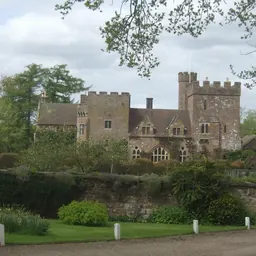
Arms of the Corbet baronets of Moreton Corbet, based on the arms of the medieval Corbets. The raven was used by most branches of the Corbet family, whose name means "little crow." Part of the medieval keep at Moreton Corbet. The castle was a serious fortification for a dynasty of Marcher Lords but was turned into a more comfortable family home by Sir Andrew Corbet in the 16th century.
Robert Corbet (1383–1420) of Moreton Corbet, Shropshire, was an English soldier, politician and landowner who represented Shropshire twice in the House of Commons of England. A retainer of Thomas FitzAlan, 12th Earl of Arundel, and implicated in his alleged misrule in Shropshire, he accompanied his patron to the Siege of Harfleur and suffered a temporary eclipse after his death.
Background and early life Robert Corbet was the eldest son of:
Sir Roger Corbet of Moreton Corbet. The Corbet family had been important in the Welsh Marches since the Norman Conquest. With the extinction of the Corbet line at Caus Castle in 1347, its properties had passed to Ralph de Stafford, 1st Earl of Stafford, leaving the cadet branch, at Moreton Corbet Castle, the leading branch of the family in Shropshire. As a third son, Sir Roger had been compelled to fight a series of legal actions to prevent his family property slipping away. Margaret Erdington, daughter of Sir Giles Erdington of Erdington, Warwickshire. The marriage of Roger Corbet and Margaret Erdington was one part of a double link between the families, as Margaret Corbet and Sir Thomas Erdington, their siblings, also married. The Erdingtons also became embroiled in the Corbets' property disputes.
Robert Corbet was born on 8 December 1383 at Moreton Corbet. His father and mother died within a few months of each other, still fairly young, in 1395. Robert was not yet 12 – well below the age of majority. The most powerful magnate in the county was Richard FitzAlan, 11th Earl of Arundel and he would normally have had a strong claim to Corbet's wardship. However, Arundel was one of the Lords Appellant, who had opposed Richard II's policies and favourites. As Corbet's wardship became available, the king was moving against Arundel and his allies, and he was arrested on 12 July 1397, to face attainder and execution on 21 September. In October 1397 Corbet's marriage and wardship were granted to Thomas Percy, 1st Earl of Worcester. Although he had been ennobled by Richard II, Percy was one of those nobles who helped depose him in 1399, installing as king Henry IV. However, Henry was particularly dependent on support from the Arundels, particularly the executed earl's brother, Thomas Arundel, the Archbishop of Canterbury, and his son, Thomas FitzAlan, 12th Earl of Arundel. Thus he compelled Worcester to cede the wardship of Corbet to John Burley, a Shropshire MP and a retainer of the young earl. to entail the manor of Shawbury. He obtained royal permission to enfeoff Burley and a group of associates with the estate, entailing it on himself, his wife, Margaret, and their descendants. For reasons which remain mysterious, he disposed of his ancestral estates as soon as he had fully inherited them, apparently settling for those he had acquired by his own efforts and through inheritance by his wife, Cecily Young.
Political and military career
Robert Corbet and his younger brother, Roger, enlisted in the service of the Earl of Arundel in 1405. who was married to Corbet's cousin, This marked the zenith of Arundel's dominance in Shropshire, which largely excluded representation of other magnates. but the matter seems to have gone no further. However, he was removed from the Shropshire bench in 1416. He was still under a cloud early in 1419, when he was ordered to appear before the king's council, if required, under threat of a £100 fine. However, he was never summoned.
Corbet seems to have crept back into favour, although the precise reasons are unknown; possibly his offences were fading from memory. He was elected to the Commons again later in 1419. He was second to William Burley, with his son and heir, Thomas, predeceasing him. This accords quite well with the date given in the heraldic visitation: 17 Henry VI. daughter of William Mallory, whom Corbet associates with a landowner prominent in Rutland and Cambridgeshire. It now seems that Corbet's identification of William was correct, but he was actually Margaret's second husband. Their son is a still more curious figure, qualified by his name, at least, as a candidate for identification with the poet Thomas Malory, author of Le Morte d'Arthur. A letter from A.T. Martin making just such an identification appeared in the Athenaeum in September 1897 and was taken seriously for some time by editors of Malory, including the very scholarly Alfred W. Pollard.
Footnotes
Don’t just read it —
keep it.
Full-length biographies made to live with: read them, listen on the way to work, watch them tonight.
- E-book
- Audio
- Video
Instant download · yours to keep · every purchase keeps this site free
Important facts
People in Robert Corbet's life
Named in this biography and alive at the same time


Related people
Same field, nearest in time

Contemporaries
People whose lives overlapped Robert Corbet's



Frequently asked questions
Who was Robert Corbet?
English soldier, politician, landowner
When was Robert Corbet born?
Robert Corbet was born on 8 December 1383.
When did Robert Corbet die?
Robert Corbet died on 12 August 1420.
What was Robert Corbet's occupation?
Robert Corbet was a politician.
Sources & further reading
· DBpedia: Robert Corbet (died 1420)
Cite this page
APA: Biography.guide. (2026). Robert Corbet. https://biography.guide/robert-corbet-politician/
MLA: "Robert Corbet." Biography.guide, https://biography.guide/robert-corbet-politician/.
Chicago: "Robert Corbet." Biography.guide. https://biography.guide/robert-corbet-politician/.
Data last updated: 2026-09-20 · Spot an error? Report a correction.
Page generated 2026-09-27 05:26 UTC