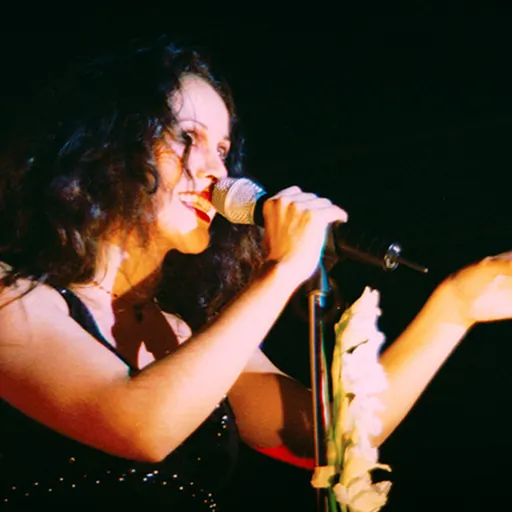
Rita Guerrero
Mexican artist, singer, actress, composer and artistic director
About Rita Guerrero
Lived 1964 – 2011 (aged 46). Rita Guerrero was a Mexican artist, singer, stage actor, film actor, actor and art director.
Rita Guerrero (May 22, 1964 – March 11, 2011) was a Mexican artist active in various fields, mainly music and theater. She was vocalist of the rock band Santa Sabina, of which she was the most visible figure. After leaving the group, she was part of Ensamble Galileo, a project dedicated to the interpretation of Baroque music. Guerrero also hosted some television programs and supported various social movements in Mexico, such as the Zapatista Army of National Liberation and the country's electoral left.
Early years Rita Guerrero was born in Guadalajara, Jalisco on May 22, 1964, the youngest of 11 siblings. She characterized her mother as a "big" and "traditional" woman, while her father was a trumpeter who taught her some guitar and awakened her love of the arts. One of her brothers bought her a piano so she could learn to play. Rita's father died when she was nine years old.
At age 10 she began her instruction in the children's music workshop of the University of Guadalajara's Department of Fine Arts. Years later at the same house of studies she began her training as a pianist, but did not finish because, she later said, she was in her adolescence and was in "rebellion". She tried to leave the family home at age 17, but returned due to pressure from her mother. At age 20, she moved to Mexico City alone to enter the (CUT) at the National Autonomous University of Mexico (UNAM), where she studied Acting. In 1987, she took part in the UNAM student strike and met Los Psicotrópicos, an experimental jazz group. Guerrero participated in some activities with them, such as concerts to support the university strikers.
Acting career
Guerrero's acting training concluded in 1987, but she had already appeared in the telenovela Martín Garatuza, produced by Televisa in 1986, playing the character Blanca. She decided not to participate in further telenovelas, because she believed that they "pigeonhole the actors". In 1989 she starred in the medium-length film Samuel for the CCC, a still image from which was used as the cover of Santa Sabina's first self-titled album. In 1990 she appeared in one of the ten stories that make up , a left-leaning film directed by Alberto Cortés. In the film – scored by the group formed by Santa Sabina, Saúl Hernández, and El Sax from Maldita Vecindad – Guerrero plays Marisela, a young woman who has such a liberal mother that she is allowed to have sex with her boyfriend in her bedroom.
In 1990 she also hosted the program Águila o rock on Channel 11, where she presented the most significant Mexican rock bands.
In 1991 she starred in Daniel Gruener's debut short film Amazona alongside and .
In 1996 she appeared as a lead host in a scientific outreach project for Channel 22 entitled La materia de los sueños. The main theme song was "Ajusco Nevado", played by Santa Sabina. She also hosted the Channel 22 youth interest program Cultura en línea.
In 2001–2002 she acted in the play La Noche que raptaron a Epifania directed by Ana Francis Mor. In 2002, she also performed and sang alongside actress Ofelia Medina in the show Una tertulia Musical en el Convento under the direction of Alejandro Reza.
In 2009 she directed and performed the show Llivre Vermell with the . In 2010 she directed and performed the show Música Divina Humanas Letras, a theatrical play around the carols of Sor Juana, with the Chorus of the University of the Cloister and Ensamble Galileo.
Santa Sabina
Rita Guerrero met the jazz group Los Psicotrópicos in 1988 while they were providing music for a play in which she performed. It was made up of the keyboardist Jacobo Lieberman, bassist Alfonso Figueroa, guitarist Pablo Valero, and drummer Patricio Iglesias; Guerrero was added as vocalist. Lieberman left the group in 1991 and his place was taken by Juan Sebastián Lach, who was key in shaping the musical style of Santa Sabina, a combination of dark wave and gothic rock influences with underground tendencies. The band was one of the most emblematic of the Mexican rock scene during the 1990s, which it entered in 1992 with the release of its album Santa Sabina on Discos Culebra, a BMG label.
Rita Guerrero worked mainly as the band's vocalist, however she was involved in the composition and arrangements, and wrote some of their songs, although most were written by and .
Illness and death In February 2010, Rita Guerrero began treatment for breast cancer at the General Hospital of Mexico. Covered by but faced with difficulties involved in the procedures of this care system, she opted to be treated in another establishment that included the use of alternative medicine. Úrsula Pruneda, Mariana Rodríguez, Juan Sebastián Lach, Aldo Max, Alfonso Figueroa, and Alejandro Otaola announced publicly on October 19, 2010, that Guerrero was suffering from cancer and that they would organize a collection to pay for her medical expenses. The next day, the singer and actress wrote on her Facebook page that the situation was not "as critical" as had been assumed from the statements of her friends, who were worried about her physical and emotional health and wanted to support her. Despite the illness, Rita Guerrero continued with her musical projects, including Ensamble Galileo and the direction of the Chorus of the University of the Cloister of Sor Juana.
On November 30, 2010, several rockers and musician friends of Guerrero announced that they would hold a concert for her benefit on December 6. The participants were Los Jaigüey, , Jorge Fratta, and José María Arreola, Monocordio, Alejandro Otaola, and Daniel Zlotnik, La Maldita Vecindad, La Lupita, Los músicos de José, of Hello Seahorse! with some members of Zoé, Natalia Lafourcade, Julieta Venegas, Rubén Albarrán and Meme from Café Tacvba, El jardín de las delicias, and the reunited Santa Sabina, including an appearance by Guerrero. The concert was titled Rita en el corazón and took place at the Teatro de la Ciudad.
Rita Guerrero died on March 11, 2011, at age 46 as a result of breast cancer at the National Cancer Institute of Mexico, located in Tlalpan. The University of the Cloister of Sor Juana, whose chorus she directed, held a viewing of her remains and a posthumous tribute in her memory.
Tributes The Chorus of the Cloister of Sor Juana changed its name to Coro Virreinal Rita Guerrero in honor of the artist.
In 2018, Rita, el documental was released, a feature film documentary that recounts her life in Guadalajara, her arrival in Mexico City and studies at the CUT, her career with Santa Sabina, and her work at the Cloister. It was produced by Arturo Díaz Santana and Aldo Max Rodríguez with support from IMCINE and CUEC, and includes testimonies of Guerrero's family, friends, and collaborators. It premiered at the 33rd Guadalajara International Film Festival.
Acting and hosting credits Television
Films
Radionovelas
Plays
Discography With Santa Sabina Studio
Live
With Ensamble Galileo
As director
Guest appearances
Don’t just read it —
keep it.
Full-length biographies made to live with: read them, listen on the way to work, watch them tonight.
- E-book
- Audio
- Video
Instant download · yours to keep · every purchase keeps this site free
Important facts
People in Rita Guerrero's life
Named in this biography and alive at the same time






Related people
Same field, nearest in time




Contemporaries
People whose lives overlapped Rita Guerrero's




Frequently asked questions
Who was Rita Guerrero?
Mexican artist, singer, actress, composer and artistic director (1964-2011)
When was Rita Guerrero born?
Rita Guerrero was born on 22 May 1964 in Guadalajara.
When did Rita Guerrero die?
Rita Guerrero died on 11 March 2011 in Mexico City.
What was Rita Guerrero's occupation?
Rita Guerrero was an artist, singer, stage actor, film actor, actor and art director.
What nationality was Rita Guerrero?
Rita Guerrero was Mexican.
Sources & further reading
Cite this page
APA: Biography.guide. (2026). Rita Guerrero. https://biography.guide/rita-guerrero/
MLA: "Rita Guerrero." Biography.guide, https://biography.guide/rita-guerrero/.
Chicago: "Rita Guerrero." Biography.guide. https://biography.guide/rita-guerrero/.
Data last updated: 2026-09-22 · Spot an error? Report a correction.
Portrait: Wikimedia Commons · author & licence
Page generated 2026-09-27 05:03 UTC