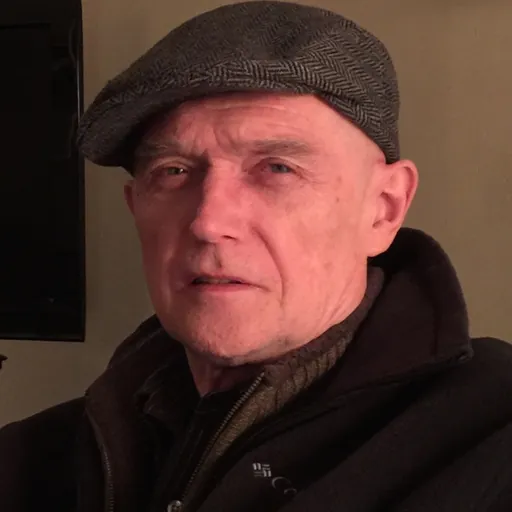
About Richard Wetzel
Born 1943. Richard Wetzel is an American painter and sculptor.
Richard Wetzel (born October 23, 1943) is an American artist. He is best known for his oil paintings but also has exhibited collages and sculpture. In 1969 and 1970, Wetzel exhibited with the Chicago Imagists, a grouping of Chicago artists who were ascendant in the late 1960s and early 1970s.
Biography
Born in Elmhurst, Illinois, Wetzel was the second of three boys (with brothers David and Douglas). Both Wetzel's parents were artists. Wetzel's father, Wilbert, was a photoengraver. His mother, Elfreda, was a commercial artist. The family eventually settled in Arlington Heights, Illinois.
Wetzel's interest in art developed at an early age, but he was also a three-time gymnastics individual medalist (pommel horse) on the Arlington High School (AHS) team that won two successive Illinois State Gymnastics Championships: 1958–59 and 1959–60.
At age 17, two significant events influenced Wetzel's future direction. The first was the arrival of artist James F. Walker as an art teacher at Arlington High School. Walker arrived from his teaching position at the School of the Art Institute of Chicago (SAIC) during Wetzel's senior year, 1960–61. Walker was an artist who created mixed-media surrealist images. The influence of these two artists would shape Wetzel's vision for decades to come.
After graduation, Wetzel enrolled in SAIC in fall 1961, where he studied with Vera Berdich, Whitney Halstead, Thomas Kapsalis, and Sonia Sheridan. While at SAIC, Wetzel met classmate and fellow artist Janice Anderson. They married after Janice's graduation in 1965.
Prior to his marriage, Wetzel moved to Chicago's Old Town, a neighborhood known for the arts, its bars and nightlife, and 1960s hippie counterculture. In 1962, Wetzel opened the Sedgwick Street Gallery with AHS classmate Dennis Rice on North Avenue at the Sedgwick L Stop. The gallery was located up the street from the Mole Hole, home of the counterculture newspaper the Chicago Seed, and walking distance from Cabrini Green, a low-income, high-rise complex known for high poverty and crime. At the gallery, Wetzel and Rice exhibited the works of Karl Wirsum, Barry Malloy, Luis Ortiz, William Nichols, Bill Arsenault, Ed Paschke, and Wetzel's mentor, James F. Walker, as well as his own work.
In 1968, Wetzel graduated with honors from SAIC with a BFA. The Institute awarded him a Foreign Travelling Fellowship, which he would later use to travel and study abroad. After graduating from SAIC, he continued his studies at Northern Illinois University, earning an MA in 1969. In the fall of 1970, Richard and his wife, Janice, traveled throughout Europe for eight months on his fellowship, studying art and architecture. After returning to Chicago, they both assumed teaching positions in city and suburban art departments, where they continued teaching until retirement, Janice in the Chicago Public Schools, and Richard in Niles Township High Schools. They lived, worked, and traveled together until Janice's death in 2014.
The Chicago Imagists
The Chicago Imagists According to Robin Dluzen, the Imagists were “mainly white but with an unusually large percentage of female members … 7 women amongst 11 men …”
These events were organized by Don Baum, exhibitions director at HPAC, and a participant in one of the nine shows.
James Yood offered a concise definition of the Imagist aesthetic:
… funky and irreverent subject matter (often with sexual and/or violent overtones, with imaginative fantasies dealing with the figure under extreme physical or psychological stress), a predilection for narrative themes drawn from vernacular sources, a decided openness to influences from self-taught artists and from sources outside the mainstream of Western art history, a taste for garish and obsessively busy small-scale compositions driven by a concern for symmetry and a linear approach to the figure, surrealistic whimsy and ironic and caustic humor undercutting the “serious” status of the art object, high-keyed color, scrupulous and fastidious craftspersonship [sic] tending toward the suppression of evidence of the experiential residue of the artist's hand, and iconic independence and idiosyncratic mannerism of the most manic sort.
Franz Schultze in ARTNews 1971 described a cliquishness in the various groups.
They cluster in small groups and—rather like the secret kids' clubs that flourished in the days of radio serials and the Sunday funnies—they even assume corporate names, like The Hairy Who ([Jim] Nutt, [Gladys] Nilsson, [Karl] Wirsum, Suellen Rocca, Art Green, James Falconer), The Nonplussed Some ([Ed] Flood, [Ed] Paschke, Sara Canright, Richard Wetzel, Don Baum), the False Image (Roger Brown, Phil Hanson, Christina Ramberg, Eleanor Dube).
Peter Schjeldahl in Art in America observed that from the first HPAC exhibition in 1966 the alignments among the artists morphed almost continually.
The groups miscegenated briskly in a series of Hyde Park shows that, with themes and costumes, were also theatrical events: “Marriage Chicago Style,” for instance, solemnized the joining of members of the Who and the Some, plus Barbara Rossi.
From 1962, Wetzel has exhibited his work in both solo and group exhibitions. Sue Taylor in the Chicago Sun-Times observed in 1985 that
Like others associated with [The Chicago Imagists], now internationally renowned, Wetzel has intensified the individual aspects of his style in the 15 years since the inception of Imagism.
Wetzel continues to live in Chicago, where he works in collaboration with DAKOtravail.
From the critics
Whitney Halstead, Artforum, 1968
The juxtapositions typical of collage are blended to achieve a lyrical (and here, dreamlike) mood in Richard Wetzel's transfer images on glass. Black Eyed Susan's Circle typifies his achievement in synthesizing disparate elements in a quiet, understated tone.
Franz Schultze, Chicago Daily News, 1968
Wetzel makes dreamy, low-key collages with ectoplasmic faces …
Franz Schultze, Chicago Daily News, 1969
… Wetzel's complicated surrealist symbolism …
Harold Haydon, Chicago Sun-Times, 1981
Rapacious flowers and other vegetation, painted large—as if from an insect's point of view—loom large against dark pastoral landscapes in Richard D. Wetzel's exhibition …
In Wetzel's world, precisely painted plants, fierce in fang and claw, can be as prosaic as green beans or as fantastic as root systems. Their victims usually are eggs, whose fate is to be seized and devoured. Only one escapes, in the painting titled “Deliverance,” borne aloft by a monarch butterfly and by its coloration, obviously an egg of the monarch clan.
If all this imagery is taken as a paradigm of earthly existence, Wetzel's view must be quite on the mark.
Jeff Abell, New Art Examiner, 1984
The paintings make use of intensely bright colors, most often to delineate shapes against the generally darker background colors. For example, a strange claw-like shape is outlined in a very hot yellow-orange against a purple background, so that the figure glows against its ground.
Sue Taylor, Chicago Sun-Times, 1985
… the brilliant radiating colors and mysterious, iconic images that have long distinguished Wetzel's art are still his major concerns. Each image is set against a monochromatic background of the deepest blue, purple or green, which may be read as an infinite spatial recession, indicative of the vague realm of imagination.
G. Jurek Polanski, Jumpin' Backflash: Original Imagist Artwork, 1966–1969, 2000
There are images which linger long after viewing. A prime example is Death-Breath, a 1966 serigraph on paper among the works by Richard Wetzel. Both in spirit and execution, it implies affinities with such German expressionists as Georg Grosz, but for Wetzel, allied with the “Nonplussed Some,” Vietnam, not Dachau, more likely supplied the inspirational matrix.
Collections
Art Institute of Chicago University of Illinois–Urbana Northern Illinois University–Dekalb Kemper Art Collection Illinois State Museum–Springfield Loyola University–Chicago Minneapolis Institute of Art
Solo exhibitions
1963 Sedgwick Street Gallery, Chicago 1983 Zaks Gallery, Chicago 1984 One Illinois Center, Chicago 1985 Zaks Gallery, Chicago 1993 Zaks Gallery, Chicago 1994 Loyola University, Chicago 1997 Sonia Zaks Gallery, Chicago 2000 Sonia Zaks Gallery, Chicago 2004 Sonia Zaks Gallery, Chicago 2007 O. K. Harris Works of Art, New York 2020 Corbett vs. Dempsey, Chicago 2024 Corbett vs. Dempsey, Chicago
Group exhibitions
1962 Sixty-Fifth Annual Exhibition by Artists of Chicago and Vicinity. The Art Institute of Chicago, May 4–June 3, 1962. 1966 Sixty-Ninth Annual Exhibition by Artists of Chicago and Vicinity. The Art Institute of Chicago, April 1–May 1, 1966. 1968 Nonplussed Some. Hyde Park Art Center, Chicago. 1969 Thirty Works by Thirty Artists to Celebrate the Thirtieth Year of the Hyde Park Art Center, Chicago. 1993 Genius Loci of Old Town. Gallery 1756, Chicago. 2000 Jumpin' Back Flash: Original Imagist Art. Chicago Cultural Center.
Awards and honors
School of the Art Institute of Chicago, Foreign Travelling Fellowship, 1968. New Horizons Award, North Shore Art League, Chicago, 1972. Illinois State Museum Purchase Award, 1981.
Gallery
Don’t just read it —
keep it.
Full-length biographies made to live with: read them, listen on the way to work, watch them tonight.
- E-book
- Audio
- Video
Instant download · yours to keep · every purchase keeps this site free
Important facts
People in Richard Wetzel's life
Named in this biography and alive at the same time





Related people
Same field, nearest in time



Contemporaries
People whose lives overlapped Richard Wetzel's



Frequently asked questions
Who is Richard Wetzel?
American artist
When was Richard Wetzel born?
Richard Wetzel was born on 23 October 1943 in Elmhurst.
What is Richard Wetzel's occupation?
Richard Wetzel is a painter and sculptor.
What nationality is Richard Wetzel?
Richard Wetzel is American.
Sources & further reading
Cite this page
APA: Biography.guide. (2026). Richard Wetzel. https://biography.guide/richard-wetzel/
MLA: "Richard Wetzel." Biography.guide, https://biography.guide/richard-wetzel/.
Chicago: "Richard Wetzel." Biography.guide. https://biography.guide/richard-wetzel/.
Data last updated: 2026-09-23 · Spot an error? Report a correction.
Portrait: Wikimedia Commons · author & licence
Page generated 2026-09-27 05:06 UTC