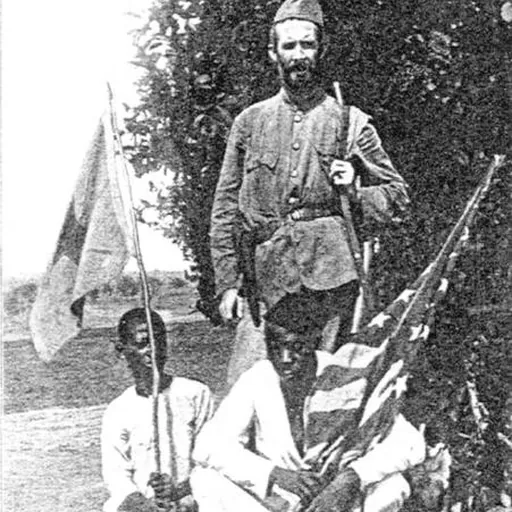
About Richard Mohun
Lived 1864 – 1915 (aged 51). Richard Mohun was an American explorer, diplomat and mercenary.
Richard Dorsey Loraine Mohun (April 12, 1864 – July 13, 1915) was an American explorer, diplomat, mineral prospector and mercenary. Mohun worked for the United States government as a commercial agent in Angola and the Congo Free State. During his time as commercial agent, he volunteered to command a unit of Belgian artillery in a campaign to force Arab slavers from the colony.
Mohun remained in the service of the US government during this time and was subsequently posted as consul to Zanzibar. In this capacity, he was called upon to act as an intermediary between the combatants in the Anglo-Zanzibar War. Following the conclusion of his three-year posting, Mohun returned to the Congo to prospect for minerals, and later worked with the Belgian authorities.
His most ambitious undertaking was a three-year expedition, beginning in 1898, that laid a telegraph line from Lake Tanganyika to Stanley Falls. He then spent some time prospecting in South Africa before returning to the Congo to reform the Abir Congo Company on behalf of Leopold II of Belgium.
Early life
Richard Dorsey Mohun was born in Washington, D.C., on April 12, 1864. Mohun's family had a long association with Africa - his grandfather, William McKenny, had been a prominent figure during the colonisation of the continent and built up a comprehensive collection of photographs during his time there. Mohun was appointed Assistant Paymaster in 1885 and served with the United States Department of the Navy upon his return from the cruise. He was promoted to the rank of lieutenant in 1889, the same year he resigned his navy commission to join the United States Department of State. Louis had been on survey expeditions with the company since 1888 and construction works began at Corinto in 1890. Richard secured a position as an auditor with the company's transportation division by 1891 but the project was hit by tropical disease and the Mohuns returned home to Washington by January 1892.
United States agent in the Congo
The well-connected Anna Hanson Dorsey was close friends with the mother of the American Secretary of State James Blaine and Blaine and Dorsey shared ties with Notre Dame University. Dorsey was able to use this influence to arrange the appointment of Mohun as US commercial agent to the Congo Free State on 22 January 1892, filling a vacancy caused by the death-in-post of US Navy Lieutenant Emory Taunt the previous year. The US had maintained an agent in the Congo ever since it had been formally recognised and the commercial agent also acted as the nation's diplomatic representative to the Free State. The post came with a $5,000 annual budget and a remit to investigate the commercial potential of Congo and to promote trade between the two countries, which previously had been almost non-existent.
Mohun left America for Genoa, Italy with Louis and their sister, Laura. The three travelled in Europe for 2–3 months before Mohun reported to Brussels to meet with King Leopold II who, in spite of his callous reputation, impressed him with his apparent ambition to bring peace and western civilization to the Congo. Mohun then journeyed to the Congo with Louis, who was to act as his sub-agent. In July 1892 he assisted US citizen Warren C. Unckless in establishing a rubber factory on the Sankuru River near Lusambo for the Société anonyme belge pour le commerce du Haut-Congo. Unckless, a plantation manager in Costa Rica, had imported experienced rubber cutters from South America to begin the enterprise but came under attack from tribesmen and a Belgian force had to be dispatched to provide security. Mohun spent much of his time in exploration of the country's interior, visiting several areas where no white man had ever ventured and making a survey of the quality of the agricultural land and the crops grown by the native population.
Mohun frequently came into conflict with the native tribesmen. When his mail bag and personal papers were stolen and a local chief refused to return them he proceeded to wage war on the chief accompanied by four gunmen and a steamboat. Mohun attacked and burnt at least ten villages before he captured the chief's son whom he threatened to hang. In return for his son's life the chief returned the mail bag, alongside a second that Mohun had not noticed was missing. On another occasion he witnessed the funeral of a local chief who had four of his wives and 10 slaves buried alive with him. Mohun was unable to intervene, in spite of his horror at the situation, as he had only a small escort and was heavily outnumbered. The slavers, who originated from the East coast of Africa, were in conflict with the heavily outnumbered Belgian authorities in the Congo Arab War.
Chaltin Expedition
In 1893 Mohun was appointed commander of the artillery attached to a Belgian expedition, commanded by Louis Napoléon Chaltin, sent against the slavers led by Rumaliza. Just prior to his joining the expedition had destroyed entirely the 1,200-house village of Tchari. Mohun was with a force of 150 men sent over the stream to Riba Riba with the intention of reaching the town before the retreating slavers could give warning. Once again they encountered a deserted town, except for two hands nailed to a flagstaff taken from the corpses of two European men killed the week before. Mohun accompanied a force sent to investigate the slavers town of Romie and discovered it to already be in the hands of Congo State forces. He hoped in the process to intercept a slave caravan that had been fleeing eastwards from the expedition loaded with slaves, ivory and gold.
Instead Mohun, recognised for the leading role he played in many of the engagements, was in March 1894 appointed by Dhanis to be second-in-command of an expedition to determine whether there was a navigable watercourse between Lake Tanganyika and the upper Lualaba River. The expedition encountered difficulties in traversing the terrain and waterways of the country and with hostile natives. Mohun discovered the confluence of the Luabala and Lumbridgi rivers and was able to disprove the existence of Lake Lanchi, which had been marked on many maps at this location. The river itself proved to be highly variable ranging from 2500m to just 90m in width, contained in gorges up to 1,200m deep and with one 110 km stretch proving entirely unnavigable by canoe. Mohun recorded that the soil in the valley was highly fertile, the local Barua people quite numerous and named two new peaks Mount Dhanis and Mount Cleveland. Hinde's abscess, which could not be treated as there was no other doctor nearer than Basoko, successfully resolved itself by bursting during travel and saved his life.
In April 1894 whilst at Kasongo Mohun's sergeant Omari bo Hamise, who had been Stanley's chief sergeant in the Emin Pasha Relief Expedition, identified two men who had murdered Emin Pasha on the orders of the slaver Kibonge. During his time in the Congo Mohun also took part in big-game hunting killing 20 elephants and 50 leopards within two years.
In this role Mohun was given responsibility for the government of some five million natives and tasked with improving internal markets in the country.
Mohun continued his work to eradicate the slave trade, made several surveying expeditions, established new trade markets, and assisted in the suppression of cannibalism. Mohun's work in the Congo has been described as the last "spectacular contribution" by an American in opening up the country. The record he kept of this expedition was used by Belgian author and cartographer AJ Wauters to compose a map of the Lomami River, which was published in 1901.
Mohun had remained US commercial agent throughout this time, and insisted on drawing no pay from the Belgian government for his services, though he did receive $5000 from the Société Anonyme Belge pour le commerce du Haut-Congo. In 1894, he was awarded honorary membership of the Société Royale Belge de Géographie (Royal Belgian Geographical Society), and Leopold I appointed him a chevalier of the Royal Order of the Lion for his accomplishments in the slaver war. Mohun also received decorations from the United Kingdom and France for his work in the Congo. He also claimed that the popular image of Belgian brutality in the region was a lie spread by missionaries—a statement contradicted by evidence of unnecessary cruelty by Belgian troops. Mohun also recounts the case of Nyangwe, a town of 3,000 houses and up to 45,000 inhabitants that he encountered, within a year of a Free State army post being established there the town had been completely destroyed. In 1896 he noted that one of the Belgian generals had encouraged the cruelty and that the situation improved after he was recalled by King Leopold.
Zanzibar The front cover of Mohun's photographic portfolio of the Anglo-Zanzibar War. Due to the frequent expeditions Mohun carried out in the Congo, Mohun was unable to spend much time on his duties as commercial agent. The US State Department was, perhaps surprisingly, pleased with Mohun's undiplomatic conduct in assisting the Belgians. His appointment, which he then held until November 22, 1897, may have been a reward for his work in the Free State. Mohun arranged a period of five minutes between his resignation as commercial agent and acceptance of the post of consul so that he could accept his Order of the Lion without contravening the US constitutions Title of Nobility Clause that prohibits those holding public office from accepting gifts from foreign powers. Harriette accompanied Mohun to Zanzibar and, on April 18, 1896, gave birth to their first son, Reginald Dorsey Mohun.
During his time on the island, he became involved in the Anglo-Zanzibar War of 27 August 1896, as an intermediary between the Sultan of Zanzibar and the British authorities. In return for his services and conduct during the engagement, he was decorated by the new Sultan. On 6 July 1897 he informed his superiors of an outbreak of smallpox on the island among the Indian and native population and that an English missionary had been attacked for carrying a victim around in his arms. Mohun was concerned that the outbreak might spread to the white population and noted that vaccination doses had been ordered from Marseilles for the native population.
During his time in Africa Mohun had acquired a leopard cub after killing its mother, who was attacking the livestock of a native village. He named the young male Dijini ("Devil") and raised him in his house. During a visit to Europe Dijini accompanied his master in his carriage. After terrifying the staff and residents of a hotel in Antwerp Mohun was forced to cage the leopard. Despite receiving several bids from menagerie-owners Mohun made a gift of the animal to the Washington Zoo and arranged to have him shipped to his hometown. Mohun returned to Washington six months layer, upon completion of his posting in Zanzibar, and visited his former pet. Mohun amazed staff at the zoo by jumping the railings and passing his hand between the bars of Dijini's enclosure to allow the animal to lick his hand.
Tanganyika-Nile telegraph expedition
Mohun's appointment at Zazibar ended in November 1897 and he returned to Belgium with Harriette, purchasing a house in Brussels. Mohun accepted the position despite, just months before, condemning the region as a "wretched country in the heart of Africa". Mohun left Antwerp, Belgium for Africa at the end of August 1898.
The overhead telegraph may have been intended as a link in the proposed line from the Cape to Cairo, it was to be supported by 7m-high poles at 150m spacings and had been allocated a budget of three million francs. Mohun was allowed free rein to choose his own staff and set out with five electricians/engineers (including some from Britain and France), Dr. Raan Horace Castellote as medical officer and a military escort commanded by Belgian Captain Verhellen. From these, he selected one hundred men to accompany him, twenty of whom had served with him in the Congo expedition of 1894. His diary also notes that spectacles, Arab-made incense and American-made cloth were popular, and that he used the latter to pay his Askari escort. In addition to laying the telegraph Mohun was instructed by Dhanis to use his askaris against parties of Batetela mutineers that still plagued the region in the aftermath of the rebellion of 1897-8. The expedition then proceeded to the settlement of Fort Johnston at the southern tip of Lake Nyasa where they replenished their food stocks with fish from the Shire River. Mohun's party then proceeded along the western bank of the lake to the settlement of Karonga in North-Eastern Rhodesia.
Mohun's group then began laying the telegraph line (starting at Albertville), heading north along the western bank of the Lake and entering the Congo Free State before turning west to meet the River Congo at Kasongo. Mohun was said to have contributed much to the party's defence with his Winchester rifle and was reinforced part way through the engagement by three companies of native infantry sent by Dhanis. The cannibals subsequently fled towards Lake Tanganyika. Castellote died on the expedition on 26 September. In December 1900 Mohun's family contacted the US ambassador to Belgium, Lawrence Townsend, to ask him to investigate rumours of his death which had been announced at a lecture in Washington.
Mohun's party followed the river north to Stanley Falls where, after three years, the expedition completed the line some distance short of the Nile. The telegraph was some long and enabled the transmission of messages across the African interior for the first time. As a result, Mohun claimed to be known amongst the indigenous peoples along the route as "Big master of the telephone". Mohun's claim may have been due to knowing Stanley was a naturalised American citizen born in Wales. His second son, Cecil Peabody Mohun, who later became a stockbroker, was born in Brussels on March 27, 1904. Not wishing to embark upon another long appointment in Africa, Mohun wrote a request for employment to former US State Department official Thomas W. Cridler, commissioner for the 1904 Louisiana Purchase Exposition. He is believed to have written to Roger Casement during this time in an attempt to counter the accounts of Belgian abuses in the Congo that Casement was then compiling for publication in his 1905 Casement Report.
In December 1905, on the recommendation of King Leopold, he was appointed director of the Abir Congo Company. The Abir Rubber Company was the only company mentioned by name in a Congo Commission report, which reported: "the imprisonment of women as hostages, flogging to excess, and various acts of brutality are not contested. It is the black spot on the history of Central African settlement." Mohun was appointed to institute reforms addressing these practices.
Mohun was selected, in May 1907, by Thomas Fortune Ryan and Daniel Guggenheim, founders of the Forminière company to undertake a prospecting operation on the Uele River in the Kasai and Maniema regions. The result was the 1908 Ryan-Guggenheim Expedition, a rubber and mineral prospecting party funded by American capital and accompanied by a member of the US Geological Service. The expedition was also tasked with capturing a live specimen of the Okapi for which a wealthy resident of Paris had offered a $5,000 reward. The incident became locally known as the "Battle of Ball's Run". A further attack in January 1908 was more successful, causing the party to flee the area. Mohun's men eventually reached safety at Kamgamyka in March.
The expedition ended in 1909, by which time it had uncovered valuable diamond deposits at Tshikapa, the first such to be located in the country, and recommended the mineral-rich Kasai region to Forminière for further investigation
Later life and legacy Grave of Richard and Harriette Mohun in Oak Hill Cemetery, Washington, D.C. In August 1911 Mohun returned to his home at Royal Oak, Maryland, to recover from wounds he had received during his twenty years service in Africa. He served as paymaster for the American Red Cross expedition aboard SS Red Cross (former SS Hamburg) sent in 1914 under command of Admiral Aaron Ward to Belgium carrying first aid supplies to assist those wounded during World War I. Aged 50 and without any prior signs of illness, he died of a fever on July 13, 1915. Although he was alone when he fell ill at two o'clock in the morning a non-Catholic woman made a journey to fetch a priest to conduct the Last Rites. During his postings in Africa he had returned to the USA only three times. A sizeable collection of ethnographic information and objects that Mohun collected in Africa is now held in the collection of the Smithsonian Museum and many of his papers are held by the Belgian Royal Museum for Central Africa and the US National Archives and Records Administration. Harriette Mohun died on October 6, 1942, in Stamford, Connecticut and was buried alongside her husband.
Don’t just read it —
keep it.
Full-length biographies made to live with: read them, listen on the way to work, watch them tonight.
- E-book
- Audio
- Video
Instant download · yours to keep · every purchase keeps this site free
Important facts
People in Richard Mohun's life
Named in this biography and alive at the same time



Related people
Same field, nearest in time


Contemporaries
People whose lives overlapped Richard Mohun's




Frequently asked questions
Who was Richard Mohun?
American explorer and diplomat, born 1864 (1864–1915)
When was Richard Mohun born?
Richard Mohun was born on 12 April 1864 in Washington, D.C..
When did Richard Mohun die?
Richard Mohun died on 13 July 1915 in Royal Oak.
What was Richard Mohun's occupation?
Richard Mohun was an explorer, diplomat and mercenary.
What nationality was Richard Mohun?
Richard Mohun was American.
Sources & further reading
Cite this page
APA: Biography.guide. (2026). Richard Mohun. https://biography.guide/richard-mohun/
MLA: "Richard Mohun." Biography.guide, https://biography.guide/richard-mohun/.
Chicago: "Richard Mohun." Biography.guide. https://biography.guide/richard-mohun/.
Data last updated: 2026-09-22 · Spot an error? Report a correction.
Page generated 2026-09-27 05:10 UTC