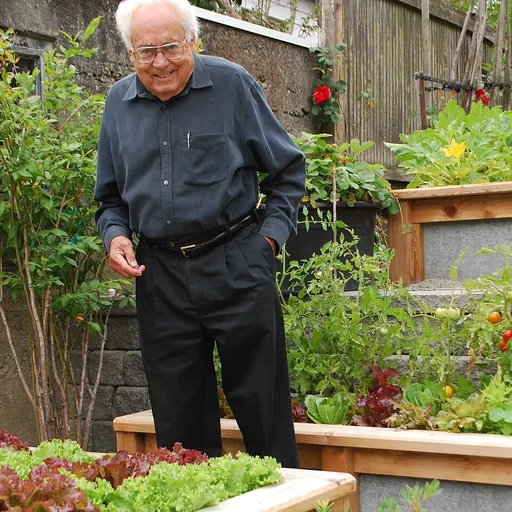
About Richard Haag
Lived 1923 – 2018 (aged 94). Richard Haag was an American landscape architect.
Richard Haag (October 23, 1923 – May 9, 2018) was an American landscape architect who was known for his role in Gas Works Park in Seattle, Washington and on the Bloedel Reserve on Bainbridge Island. Richard Haag's modernist and minimalist ideals also set the tone for Northwestern landscape design.
Early life and career Richard Haag was born and raised in Louisville, Kentucky. He attended the University of Illinois, the University of California and received his bachelor's degree in Landscape Architecture (B.L.A.) from the University of California, Berkeley, and his master's degree in Landscape Architecture (M.L.A.) from the Harvard Graduate School of Design.
In 1958, Richard Haag joined the University of Washington faculty in Seattle, Washington and founded its Landscape Architecture Program.
While at the university, he was also the lead designer at Richard Haag Associates which he founded in 1968, before closing on June 30, 2016. Through his position at Richard Haag Associates, he worked on over 500 designing and planning projects. He died in May 2018 at the age of 94.
Notable designs
Gas Works Park - Seattle "Sequence of Gardens" at Bloedel Reserve - Bainbridge Island, Washington Battelle Research Center - Seattle Victor Steinbrueck Park - Seattle Jordan Park - Everett, Washington North Waterfront Park - Berkeley, California U.S. Courthouse Plaza - Spokane, Washington Washington Pass Overlook & Visiting Center - Winthrop, Washington Merrill Court Townhomes - Harvard-Belmont Historic District, Seattle Okanogan–Wenatchee National Forest - Winthrop, Washington Gilman Village - Issaquah, Washington
Gas Works Park Haag leading a tour of the "forbidden zone" of Gas Works Park, 2007. In 1906, on a peninsula on the northern shore of Lake Union, the Seattle Gas Company constructed a coal gas plant. By 1956, this plant was shut down and left behind old refinery towers. Upon the City of Seattle's purchase of the land in 1970, Haag was the lone person who was asked to develop a park design for the site. While most planners had expected the demolition of the refinery towers, Haag decided to keep them. However, he did not incorporate them into the design for historic purposes, but rather to visually enhance the design of the park.
While convincing city government to accept this radical plan was challenging, Haag's development of a design which integrated bioremediation methods in order to detoxify the soil without transporting and replacing it amplified the issue. Haag and his colleagues suggested using oil-degrading enzymes and organic material to stimulate growth of microorganisms and breakdown toxic materials that were still present in the soil left behind by the ancient industrial processes of the plant.
Before Richard Haag was asked to develop this design, he submitted the site as a design problem to a national undergraduate design competition. All 130 designs submitted removed any indication that a gas plant ever existed in that site. Through this, Haag took the environmentalist ideal to another level and acknowledged the potential aesthetics of industrial structures without causing harm to the environment. His design for Gas Works Park brought Haag his first American Society of Landscape Architects (ASLA) President's Award for Design Excellence.
Bloedel Reserve
Haag received his second ASLA award for his design titled "Sequence of Gardens" at Bloedel Reserved located on Bainbridge Island. The Bloedel Reserve, deeded to the University of Washington in 1970, was again sold in 1986 to the Arbor Fund. This non-profit corporation hired Haag as head designer for the site in order to maintain the company's dedication to "...developing, maintaining, and managing the reserve for public and educational purposes".
Haag split the land into four main garden quadrants where each 'room' had a specific theme while maintaining their unique qualities that fluidly connected these spaces together. These gardens are described as having been created in pairs—garden one and three; garden two and four.
Garden one and three are noted for their geometric-based designs. The first garden, also known as the Garden of Planes, is described as being the most abstract of the four gardens. Garden 3 is the Reflection Garden which incorporated the use of free-standing walls of yew and the introduction of a pool that used reflection to enhance visual aesthetics. This garden poses as the opposite of the Anteroom through its use of dark and still waters. Resident at the American Academy in Rome Principal of Richard Haag and Associates Founded U.W. Landscape Architecture Department Speaker in the Spotlight on Design Lecture Series at the National Building Museum 2001
Don’t just read it —
keep it.
Full-length biographies made to live with: read them, listen on the way to work, watch them tonight.
- E-book
- Audio
- Video
Instant download · yours to keep · every purchase keeps this site free
Important facts
People in Richard Haag's life
Named in this biography and alive at the same time

Related people
Same field, nearest in time




Contemporaries
People whose lives overlapped Richard Haag's


Frequently asked questions
Who was Richard Haag?
American landscape architect (1923–2018)
When was Richard Haag born?
Richard Haag was born on 23 October 1923.
When did Richard Haag die?
Richard Haag died on 9 May 2018.
What was Richard Haag's occupation?
Richard Haag was a landscape architect.
What nationality was Richard Haag?
Richard Haag was American.
Sources & further reading
Cite this page
APA: Biography.guide. (2026). Richard Haag. https://biography.guide/richard-haag/
MLA: "Richard Haag." Biography.guide, https://biography.guide/richard-haag/.
Chicago: "Richard Haag." Biography.guide. https://biography.guide/richard-haag/.
Data last updated: 2026-09-23 · Spot an error? Report a correction.
Portrait: Wikimedia Commons · author & licence
Page generated 2026-09-27 05:07 UTC