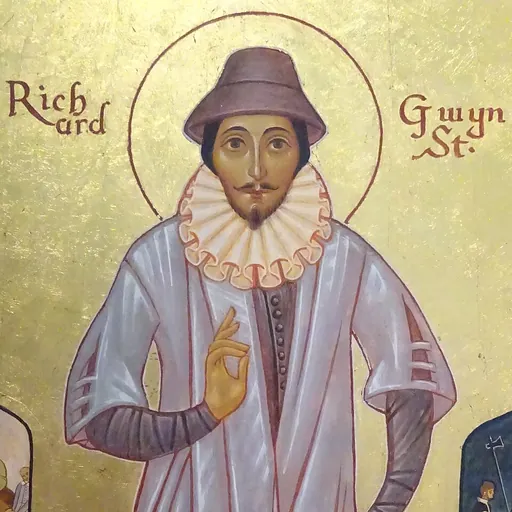
About Richard Gwyn
Lived 1537 – 1584 (aged 46–47). Richard Gwyn was a Welsh poet.
Richard Gwyn (ca. 1537 – 15 October 1584), also known by his anglicized name, Richard White, was a Welsh teacher at illegal and underground schools and a bard who wrote both Christian and satirical poetry in the Welsh language. A Roman Catholic during the reign of Queen Elizabeth I of England, Gwyn was martyred by being hanged, drawn and quartered for high treason at Wrexham in 1584. He was canonized by Pope Paul VI in 1970 as one of the Forty Martyrs of England and Wales. Since its creation in 1987, St. Richard Gwyn has been the Patron Saint of the Roman Catholic Diocese of Wrexham. Along with fellow lay martyr St. Margaret Clitherow, Gwyn is the co-patron of the Latin Mass Society of England and Wales.
Early life While little is known of Richard Gwyn's early life, it is known that he was born about 1537 in Llanidloes, Montgomeryshire, Wales and, reportedly, "descended of honest parentage, bearing the surname of Gwin (sic)."
Only at the age of 20, "he did frame his mind to like of good letters", and did not complete a degree. He then went to St John's College, Cambridge, "where he lived on the charity of the College", During his time at University, Gwyn's fellow students began calling him by the alias of "Richard White", while continuing his studies of the liberal arts, theology, and history.
Gwyn married Catherine, a young woman from Overton-on-Dee. They had six children, three of whom survived him.
Despite repeated threats of both fines and imprisonment, Gwyn made every effort to avoid attending Anglican Sunday Services and taking the Oath of Supremacy. As a recusant in a small village, Gwyn's adherence to the old faith was common knowledge. Gwyn also made no effort to hide his opinions and openly exhorted his neighbours who had conformed to return to the Catholic Church.
At the time, Bishops of the Established Church were under considerable pressure from Queen Elizabeth I to arrest recusants, especially schoolmasters, who exercised great influence and Welsh bards, who, like Richard Gwyn, were acting as secret messengers on behalf of Roman Catholic priests and recusants within the Welsh nobility and commons. In this way, the Bards of Wales were highly important within the Welsh Catholic underground and were how news was spread about secret Masses and pilgrimages.
For these reasons, William Downham, a former Roman Catholic priest of the Augustinian Brothers of Penitence who had conformed to Anglicanism and been appointed by the Queen as Bishop of Chester, and his officers, "began to molest", Gwyn, "for refusing to receive at their communion table". and never again violate his conscience by attending services at a Protestant church.
Incensed by Gwyn's return to Catholicism, Bishop Downham and the Protestants of Overton made Gwyn's life so unbearable that the schoolmaster and his family fled the Diocese of Chester on foot. After crossing the River Dee and finding a new home in Erbistock, Gwyn set up the Welsh equivalent to an Irish hedge school inside a deserted barn, where he secretly taught the children of local Catholic families.
David Edwards brought Gwyn into his own house, and kept him there in heavy bolts and chains while the magistrates were summoned. After the magistrates took charge of him, Gwyn was taken to Wrexham prison and lodged in an underground dungeon known as "The Black Chamber"
After laying on the cold ground in the Black Chamber for two days, Gwyn was brought before the Justice of the Peace, Robert Puleston, who ordered that Gwyn be sent to Ruthin Castle and, "very straitly guarded as being vehemently suspected of high treason." For this reason, Gwyn spent his first three months in Ruthin Castle wearing, "strong handbolts on his arms, and a huge pair of bolts on both heels, which were so placed that he could not lie on his side, but, whenever he would sleep, must needs lie on his back or his belly." By this time, however, Gwyn's jailer, "understanding that he had merely a prisoner for religion to deal with, remitted some part of his former rigour towards him."
When brought before the next Assizes, Gwyn again refused to conform. (£140).
In September 1581, Gwyn was moved to Denbigh Castle and was again brought before Sir George Bromley. Gwyn was fined £280 for refusing to attend Anglican Sunday Services under the penal statute setting the fine for that offence at £20 per month. This fine was in addition to Gwyn's previous fine of £140 for "brawling during divine service".
Three recusants
At that same assizes, Gwyn was soon joined at Denbigh Castle by two other Catholic prisoners, John Hughes and Robert Morris. In the spring of 1582, they were returned to Wrexham and brought before the Assizes. Instead of being charged or tried with an offence, the judge had ordered that the three recusants were to hear a sermon by an Anglican clergyman, whose name does not survive, but who is described as a Zwinglian and as the illegitimate son of a Roman Catholic priest. "Their complaint to the judges proving vain", all three prisoners started to heckle the minister (one in Welsh, the second in Latin, and the third in English) until the whole exercise had to be abandoned. alias Edward ap Thomas, for showing allegedly excessive leniency towards the three recusant prisoners. In response, a committee of four overseers was appointed, which included both Hugh Soulley and David Edwards, "in order to see to it that no one had access to the prisoners except their wives, and that no relief was given them."
Torture
In May 1583 an order was given for the removal of Gwyn, Hughes, and Morris to the jurisdiction of the Council of Wales and the Marches along with the Roman Catholic priest John Bennett and the layman Henry Pugh. The following November, all five suffered torture at Bewdley and at Bridgnorth Castle by being, "laid to the manacles (a kind of torture at the Council, not inferior to the rack at the Tower of London)."
At about seven or eight on the morning of 27 November 1583, Gwyn was interrogated by Richard Atkyns, the Attorney-General of Wales and the Marches, at the latter's own home. In particular, Atkyns demanded to know Gwyn's opinion of the 1570 papal bull Regnans in Excelsis, in which Pope Pius V had declared Queen Elizabeth I excommunicated and deposed for both heresy and religious persecution of the Catholic Church in England and Wales as well as in Ireland. Gwyn replied, "Notwithstanding that Bull (the which I never saw), I believe and confirm that she is our lawful Queen." Sir George Bromley responded in a rage, "There is no more pity to be had on thee than a mad dog! Wretches like you should all be hanged!"
Gwyn replied, "I pray you put me to death... and therein you shall do me greater pleasure than to kill me continually with torments." On Friday 9 October 1584, Richard Gwyn, John Hughes, and Robert Morris were arraigned at Wrexham before a panel of judges headed by the Chief Justice of Chester, Sir George Bromley, as well as Simon Thelwall, Piers Owen, Dr. Ellis Price, Roger Puleston, Jevan Lloyd of the Yale, and Owen Brereton. Upon coming before the court, Gwyn made the Sign of the Cross, "for which he was mocked and derided by a young man named Francis Bromley, a relative of the Chief Justice."
As the indictment was read aloud by the clerk of court, all three prisoners learned that they stood accused of high treason under the Act of Supremacy 1558 and the Religion Act 1580. Like all other British subjects tried for the same offence prior to the Treason Act 1695, Richard Gwyn, John Hughes, and Robert Morris were forbidden the services of a defence counsel and forced to act as their own attorneys.
When the prisoners were asked by the court how they wished to be tried, Gwyn responded, "We will be tried by you, who are the justices of the bench; for you are wise and learned, and better able to discern the equity of our cause than the simple people of our own country, altogether unacquainted in such matters."
Testimony Lewis Gronow deposed "that the said three prisoners were in hand with him on a Sunday in July an. Dom. 1582, to become a Papist; secondly that he had heard them also to acknowledge", Pope Pius V, "to be the Supreme Head of the Church; thirdly, that he had heard" Richard Gwyn "in plain terms to affirm the Pope now living to have the same authority which Christ gave to Peter."
Howell David, the cousin of Gwyn's codefendant John Hughes, deposed against Gwyn, "that he had heard him complain of this world; and secondly, that it would not last long, thirdly, that he hoped to see a better world; and, fourthly, that he confessed the Pope's supremacy." The same witness also gave evidence against his own kinsman John Hughes and, very likely for this reason, Howell David "had managed to secure his property."
The three prisoners then pointed out that Lewis Gronow, witness for the prosecution, had previously been upon the pillory for procuring the perjured testimony of Mr. Tudor Robert in another case.
After an hour of deliberation, however, two members of the jury "were sent for to confer with the judges, to know of them, whom they should acquit, and whom they should find guilty."
At 8:00 AM on Saturday 10 October 1584, the jury returned with a verdict. Richard Gwyn and John Hughes were found guilty of high treason. Robert Morris "was acquitted to his great sorrow"
Gwyn replied to the verdict by saying in Ecclesiastical Latin, Non audent aliter dicere propter metum Judeorum ("They dare not say otherwise for fear of the Jews"),
As Judge Thelwall proceeded to admonish both women not to follow their husbands' example, Catherine Gwyn angrily replied, "If you lack blood, you may take my life as well as my husband's; and if you will give the witnesses a little bribe, you may call them; they will bear evidence against me as well as they did against him." Mrs. Hughes spoke similarly, and both women were accordingly imprisoned for contempt of court, but soon afterwards were released on bail.
Death Last days On Tuesday 13 October 1584 Richard Gwyn was visited in Wrexham Jail by "a gentleman", who, "in the Sheriff's name offered to discharge him of all his troubles, if he would acknowledge the Queen Supreme Head of the Church within her own dominions; but the man, being constant, refused to purchase his own liberty so dear." On the same day Gwyn, "sent his signet or seal of brass off his finger to a gentleman, his very familiar friend."
On Wednesday 14 October 1584 Catherine Gwyn visited her husband, who blessed and kissed twenty-four silk laces, which were coloured white as a pun regarding his surname. Gwyn instructed his wife to give twelve of the laces as gifts in his name to twelve underground Roman Catholic priests. Gwyn then instructed his wife to give the other dozen laces as gifts to twelve members of the local Welsh nobility, "to whom he was greatly beholden.
Gwyn then bent a single penny, which he blessed and instructed his wife to deliver to his spiritual director. Gwyn also "caused his garters to be given [to] two priests of his very familiar acquaintance."
Despite this, however, when he learned of the reason for Mrs. Coytmore's weeping, Gwyn said to his wife, "I pray thee, Catherine, go and comfort her." all of the prisoners, among whom were "diverse children", were weeping over Gwyn's execution. Gwyn laid his hands upon the head of each prisoner and, "prayed God to bless them". Gwyn then beheld a large number of people outside the jail, who had also come to say goodbye to him. Reaching his hands through the window, Gwyn grasped each person by the hand and took leave of them one by one. One local member of the Welsh nobility who had been Gwyn's pupil, especially "made great lamentations", but Gwyn told him, "Weep not for me, for I do but pay the rent before the rent-day."
Soon after, the Sheriff, Piers Owen, came in to tell Gwyn to prepare for death. Gwyn kissed his wife and Mrs. John Hughes goodbye and blessed his infant son, who was only one month old, by making the Sign of the Cross upon his forehead.
Sheriff Piers Owen then asked Gwyn, "whether he repented of his treasons and asked the Queen's forgiveness". Gwyn replied, "I never committed any treasons against her any more than your father or grandfather did, unless it be treason to fast and pray."
The Sheriff then ordered Coytmore to proceed and all those present fell to their knees to pray for Gwyn. Coytmore allowed Gwyn to continue exhorting all those present to reconcile themselves to the Catholic Church. Coytmore again asked Gwyn's forgiveness and Gwyn replied by kissing the executioner's hand and saying, "I do forgive thee with all my heart; God and our Blessed Lady and St. Michael forgive thee; it is all one to me that thou do this deed as another."
Just before the ladder was turned from under him and Gwyn was hanged, he turned to the crowd and also said, "I have been a jesting fellow, and if I have offended any that way, or by my songs, I beseech them for God's sake to forgive me."
Gwyn then said in Ecclesiastical Latin, "Deus propitius esto mihi peccatori!" ("God, be merciful to me a sinner!"), a quote of Luke 18:13. And the ladder was turned out from under him. For some time he hung silently, beating his breast with both hands. Meanwhile, Mr. Coytmore pulled upon Gwyn's shackles, in which he had been hanged, in the hope of putting him out of his pain. As the inexperienced Mr. Coytmore made a mess of disembowelling the prisoner At last, Gwyn raised his head, looked down at his own mangled torso, and cried out in Middle Welsh, "O Duw gwyn pybeth y diw hun?!" ("Holy God, what is this?!")
M. Coytmore answered, "It is the execution of the Queen's Majesty."
Within seven months of Richard Gwyn's execution, Lewis Gronow confessed to having committed perjury in return for a bribe. The Elizabethan English account of the case alleges that, shortly afterwards, Sir George Bromley lost the use of his reason and, "became an idiot". Simon Thelwall died soon afterwards, as did most of the members of the jury. Furthermore, the Puritan cloth merchant David Edwards allegedly "died a fearful death" during Lent of 1585. Mr. Christopherson, the crier of the court, also lost the use of his reason and was left catatonic. The anonymous author of the account "sees in all these events the finger of Providence."
Bard
When he began working as a village schoolmaster, Richard Gwyn was reportedly fascinated by the Welsh folklore and poetry of the Wrexham area. Richard Gwyn, however, chose to compose poetry anyway. According to an anonymous writer from the Elizabethan era, "As for his knowledge of the Welsh tongue, he was inferior to none in his country, whereto he hath left to posterity some precedent in writing, eternal monuments of his wit, zeal, virtue, and learning."
Catholic Record Society founder John Hungerford Pollen wrote that the Richard Gwyn poems discovered by John Hobson Matthews, "fully justify the biographer's praise. 'Wit, zeal, virtue, and learning' are all clearly there."
Prosecution witness Edward Erles had testified that Gwyn was composing anti-Protestant poetry in the Welsh language. Richard Gwyn, similarly to other recusants bards of the era such as Robert Gwin, Catrin ferch Gruffudd ap Hywel, William Davies, and Gruffydd Robert, was using both his education and his literary talents to spread the theology of what would later be dubbed the Counter-Reformation through the means of Welsh poetry.
In a poem which Hobson Mathews and Pollen dubbed "Carol I" ("The Church of God is One") and which begins Gwrando gyngor gwr oth wlad ("Hear the counsel of a man of thy nation"), Gwyn argued that, just as there was only one Garden of Eden and one Ark to save Noah from the Great Flood, there is also only One True Church, the government of which was give by Jesus Christ to St. Peter and to St. Peter's spiritual children. Gwyn then said that the Church is as clearly seen as the sun in the sky and is dowered beyond price, even though smoke is mounting from Satan's pit between the eyes of the blind man and the sky. Gwyn then denounced Martin Luther as a, glafer glec ("cunning flatterer"). Gwyn added that if two Protestants have ever agreed without arguing about points of new doctrine, then Richard Gwyn himself would willingly praise them and become the third member of their denomination. Gwyn continued by accusing Protestants of denying the Christian Bible, Gidai mean gelwydde ("with their mean lies"), as well as the Saints and Doctors of the Church. Gwyn urged his listeners to beware of Protestant ministers and to seek the Catholic Faith, lest, "when night shades fall", they will have to give an account upon the highest hill of why they did not. Gwyn ended the poem by describing himself as a man under the protection of Jesus and who implored God every day to return the Catholic Faith to Wales.
In "Carol II", which begins, Duw a ro yr awen i brudydd o Bryden ("May God send the Muse to a poet of Britain"), Gwyn argued in favour of both having devotion to the Blessed Virgin and of regularly reciting all fifteen decades of the Rosary. In what may have been a subtle dig at the exclusive use of John Calvin's Genevan Psalter in Reformed worship throughout Europe, Gwyn dubbed the rosary, Pllaswyr Fair ("The Psalter of Mary").
In "Carol III", which begins, Gwrandewch ddatcan, meddwl maith ("Hear a song, a great thought,"), Gwyn both summarized and versified Jesuit priest Robert Persons's 1580 samizdat work, A brief discovrs contayning certayne reasons why Catholiques refuse to goe to Church. All the reasons given by Persons for Catholics to avoid attending Anglican services were listed by Richard Gwyn, "but of course only in brief poetic way."
In "Carol IV", which begins Adda ag Efa ar Neidir fraeth ("Adam and Eve and the smooth-tongued serpent"), Gwyn denounced the theology of the Protestant Reformation and the greed, gluttony, and hedonism of those whom he said preached it. Gwyn alleged that tithe money given to Anglican Vicars went solely to support their luxurious lifestyle. Gwyn also urged his listeners to pay no attention to anyone who preached against devotion to the Blessed Virgin, the Saints, or against the Catholic doctrine of Transubstantiation. At the end of his poem, Gwyn argued that he preferred to have his own head cut off rather than believe in Protestant theology.
In "Carol V", which begins Angau su yn y Sessiwn Mawr ("The Grim Reaper is in the Great Session"), Gwyn began by briefly describing the famous aftermath to the 5 July 1577 trial of printer and bookseller Roland Jenks before the Oxford Assizes for illegally selling Catholic books. Within just a few hours of Jenks being convicted and sentenced to have both of his ears cut off, an epidemic took the lives of the judge, half the members of the Bar present, and large numbers of the bystanders. Taking these events as a springboard, Gwyn argued in favour of a life spent in penance and willing acceptance of martyrdom, so that death will not find each soul unprepared to meet its Maker. Gwyn accused Protestant royalty, nobles, and ministers of spiritual blindness and inability to lead anyone to salvation. He said that if coughing was good for an old crone, if a fish-hook was good for a fish, of if a hard frost was good at midsummer, than such people had a good conscience. Gwyn concluded by saying that, although he lived under imprisonment, he yet lived in hope.
An 11th-century Statute alleged to be by King Gruffydd ap Cynan of the House of Aberffraw in Gwynedd had been used as the basis for the 1523 Caerwys eisteddfod and all those that have since followed it. Among many other things,
Despite this fact, the sixth Richard Gwyn poem, which was found by John Hobson Matthews at the Cardiff Free Library, is titled Cowydd Marwnadd yn llawn cabledd ir prins o Orens ("Funeral Ode, full of reproach of the Prince of Orange"). The poet is a satirical eulogy and a work of praise poetry in Cywydd-form. It was composed at Wrexham Jail after Balthasar Gérard's 10 July 1584 assassination at Delft of William the Silent, the Calvinist Prince of Orange-Nassau and the English-backed leader of the Dutch Revolt against the rule of King Philip II of Spain.
In 1931, Welsh Bard T.H. Parry-Williams, who at the 1912 National Eisteddfod of Wales at Wrexham had achieved for the first time the almost unheard of feat of winning both the Bardic Chair and the Crown at the same Eisteddfod and who had since become Professor of Welsh at the University of Wales, Aberystwyth, published his own scholarly edition of the complete poems of Richard Gwyn, along with original source material about his life in Middle Welsh, Elizabethan English, and Renaissance Latin.
Investigation, canonization, and feast day A first class relic of St. Richard Gwyn displayed for veneration at Wrexham Cathedral. In 1588, a detailed account of Richard Gwyn's martyrdom written by John Bridgewater in Renaissance Latin was published at Trier, as part of the book Concertatio Ecclesiae Anglicanae. provides a detailed account of Richard Gwyn's life and martyrdom. The contents of the manuscript, which is held in the archives of St. Beuno's College in Tremeirchion, Denbighshire, Wales, were first published in The Rambler in 1860 by John Henry Newman of the Birmingham Oratory. When checked against other period sources, this Elizabethan English account has been found far more reliable than Bridgewater's account in Latin, including for the dates of Gwyn's trial
Writing in 1971, historian D. Aneurin Thomas credited the writing of this second account, as well as the similar biography of Welsh Catholic Martyr William Davies (d.1593), to Welsh secular priest and future Jesuit John Bennett (c.1550 - 1625). Bennett had not only been an underground priest in active ministry in North Wales at the same time, but had known Richard Gwyn as a fellow "prisoner for religion" in the custody of the Council of Wales and the Marches and torture victim at Bewdley and Bridgnorth Castle.
Cardinal William Godfrey of the Roman Catholic Diocese of Westminster, submitted 24 potentially miraculous cures to the Sacred Congregation for the Causes of Saints. Out of the candidate cases for recognition as answered prayers, the alleged cure of a young mother from a malignant tumor was selected as the clearest case. In light of the fact that Saints Thomas More and John Fisher, who belonged to the same group of Martyrs, had been canonized in 1935 with a dispensation from miracles, Pope Paul VI, after discussions with the Sacred Congregation, decided that it was permissible under the Code of Canon Law to proceed with multiple Canonizations on the basis of one miracle.
In response, Pope Paul VI granted permission for the whole group of 40 names to be recognized as saints on the basis of this one miracle cure. The canonization ceremony for St. Richard Gwyn took place as part of that for the Forty Martyrs of England and Wales at Rome on 25 October 1970.
Like the other 39 martyrs Canonized with him, St. Richard Gwyn was originally commemorated by the Catholic Church in England with a feast day on 25 October, which is also the feast of Saints Crispin and Crispinian, but he is now venerated together with all the 284 canonized and beatified martyrs of the English Reformation on 4 May.
The Catholic Church in Wales celebrates the feast day of the Six Welsh Martyrs: priests Philip Evans and John Lloyd, John Jones, David Lewis, John Roberts, the layman Richard Gwyn, and their companions, every year on 25 October. The Roman Martyrology places St Richard's feast on 17 October.
Relics of St. Richard Gwyn are available to be venerated at the Gothic revival Church of Our Lady of Sorrows, which began being construction in 1857 and is now the Cathedral Church of the Roman Catholic Diocese of Wrexham. Every year, St. Richard Gwyn is honoured by the Catholics of Wrexham by a religious procession to the site of his execution in the former Beast Market of the city. Along with St. Margaret Clitherow, Gwyn is also the co-patron of the Latin Mass Society of England and Wales, which since 2015 has sponsored an annual pilgrimage to Wrexham and Tridentine Missa Cantata on the closest Sunday to the anniversary of Gwyn's martyrdom.
Commemoration In 1954, Blessed Richard Gwyn Roman Catholic High School was founded in Flint, Flintshire. Its name was altered slightly following Gwyn's Canonization in 1970. St Richard Gwyn Catholic High School in the Vale of Glamorgan, which was originally named St Cadoc's, was renamed in honour of St Richard Gwyn in 1987.
Quote From Carol IV: Nid wrth fwyta cig yn ffêst A llenwi'r gêst Wenere A throi meddwl gida'r gwynt, Yr aethon gynt yn Saintie.
"Not by eating flesh speadily And filling the paunch on Fridays And turning one's opinion with the wind Were folk made Saints of old."
Don’t just read it —
keep it.
Full-length biographies made to live with: read them, listen on the way to work, watch them tonight.
- E-book
- Audio
- Video
Instant download · yours to keep · every purchase keeps this site free
Important facts
People in Richard Gwyn's life
Named in this biography and alive at the same time


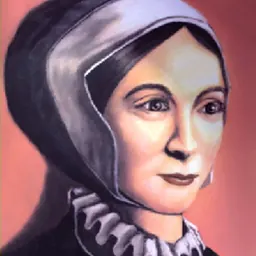


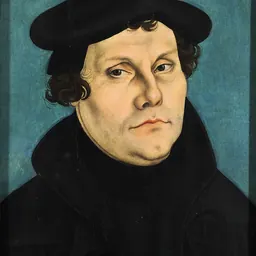

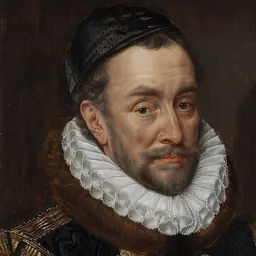
Related people
Same field, nearest in time

Contemporaries
People whose lives overlapped Richard Gwyn's


Frequently asked questions
Who was Richard Gwyn?
Welsh Catholic martyr and bard
When was Richard Gwyn born?
Richard Gwyn was born in 1537 in Llanidloes.
When did Richard Gwyn die?
Richard Gwyn died on 15 October 1584 in Wrexham.
What was Richard Gwyn's occupation?
Richard Gwyn was a poet.
What nationality was Richard Gwyn?
Richard Gwyn was Welsh.
Sources & further reading
Cite this page
APA: Biography.guide. (2026). Richard Gwyn. https://biography.guide/richard-gwyn-poet/
MLA: "Richard Gwyn." Biography.guide, https://biography.guide/richard-gwyn-poet/.
Chicago: "Richard Gwyn." Biography.guide. https://biography.guide/richard-gwyn-poet/.
Data last updated: 2026-09-20 · Spot an error? Report a correction.
Page generated 2026-09-27 05:09 UTC