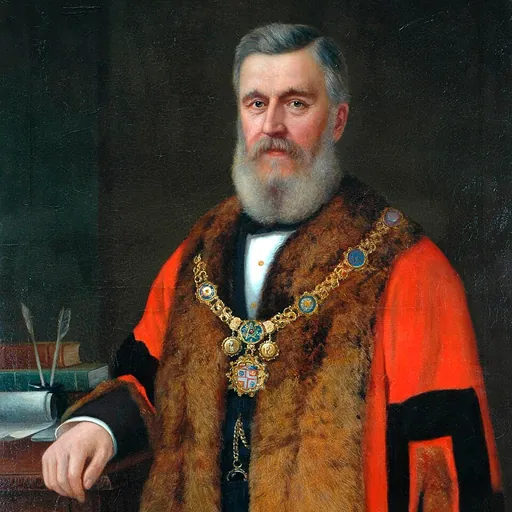
Richard Ellis
19th-century English builder and alderman
About Richard Ellis
Lived 1820 – 1895 (aged 74–75). Richard Ellis was a master builder, alderman, benefactor and real estate developer.
Richard Ellis (November 1820 – 21 August 1895) was an English builder, property developer, alderman, mayor, and a public benefactor to his town. The son of a blacksmith, he was a self-made man who started as a joiner and became a rich developer who joined High and Low Harrogate into a single town, helped obtain a Charter of Corporation, and promoted the erection of civic buildings appropriate for a spa town. Thus he became known as the Bismarck of Harrogate, his achievement in joining two villages to create a single town having been wittily compared in the 19th century with Bismarck's unification of Germany.
Ellis was a benefactor to Ashville College and Harrogate Royal Infirmary, and paid for the town's Jubilee Memorial and the land on which it stands. While the present centre of Harrogate was yet under construction, he negotiated with the Duchy of Lancaster to exchange land so that the existing railway line could be diverted to High Harrogate, and Harrogate railway station built. Historian Malcolm Neesam said, "Ellis' devotion to Harrogate must be classed as outstanding".
Background Ellis' was a self-made man, and his modest, artisanal origins were known to the citizens of Harrogate. His parents survived, living locally, until he was 51 years old, and his father shared his name; thus he was known as "Richard Ellis junior" for most of his working life. Richard Ellis senior (1794 – 7 September 1871), the father of Richard Ellis, was a Harrogate-born blacksmith and farrier from High Harrogate. By 1871, Richard Ellis senior had retired and was living in Albert Terrace with his wife Ann, who died in Harrogate aged 80 on 12 February 1872.
Richard Ellis junior was born in Harrogate in November 1820, He had a twin brother, John Ellis (1820 – 28 March 1876), who was a smith like their father and their brother Thomas (born ). In 1841 there were three other brothers, joiner Samuel ( – 14 August 1898), James (born ) and George (born ), and a sister Margaret (born ), living with them at Smythy Hill (which no longer exists) next to Strawberry Dale, Harrogate. Richard Ellis junior was a cabinetmaker at that time, possibly in the final year of his apprenticeship. daughter of James Bates, a wool sorter of Halifax. By 1861, Ellis and his wife were living in York Place, Harrogate, and Ellis was describing himself as a joiner and cabinetmaker, and a master employing 33 men and boys. In 1871, Richard and Mary Jane Ellis were living in Southfield House, South Station Parade. At the age of 50, Ellis was describing himself as a retired contractor. In 1881, the couple were still at Southfield House, and Ellis was describing himself as a magistrate. The 1891 Census finds the couple at Southfield House, where Mary Jane has a companion and nurse, and Ellis is still practising as a West Riding magistrate at the age of 70 years.
In spite of what the Census states, Ellis built and lived in Wetherby House, 9 Queen's Parade, Harrogate, facing the east end of Victoria Avenue, for many years, possibly concurrently with Southfield House for some of the time. Southfield house, which Ellis built for himself on the corner of Station Parade and York Place, was demolished, and was replaced with a modern office block, which retains the house name. Wetherby House now displays a brown plaque dedicated to him by Harrogate Civic Society.
"Ellis himself made the wooden display cabinet for the town's mineral waters shown at the Crystal Palace Exhibition in 1851". Ellis had won a design competition for this piece, and the prize was £30 15s .
Ellis' first build was The New Inn (later renamed The Dragon) on Skipton Road, Harrogate. His business grew, and in due course he was building "extensively on Queen Parade, York Place, Station Parade and James Street, his buildings being of high structural quality and architectural excellence". The building was to be Harrogate Corporation's "own suite of treatment rooms and bathing pools", for public use, and "constituted the commencement of the history of Harrogate as a first class bathing resort". on 21 August 1895, aged 74 years.
Ellis' funeral was held on 24 August 1895. A long procession carried "wreaths and floral tributes ... very numerous and of an exquisite description", in dedicated carriages, between houses and shops with blinds respectfully drawn. Men following the coffin represented numerous local institutions with which Ellis had been involved: the Borough Police, the Fire Brigade, West Riding County Council, Harrogate Corporation including the mayor and borough officials, the borough justices, solicitors and barristers from the Borough Court, Harrogate Gas Company, Bradford Old Bank, Bath and Cottage Hospital, West Riding Magistrates, Knaresborough Board of Guardians including the workhouse master and relieving officer, Harrogate Liberal Club, Harrogate Steam Laundry Company, the People's Hotel Company, the Harrogate Hydropathic Company, Harrogate Horticultural Society, and the medical profession. From Southfield House, the cortège processed via Station Parade (where Ellis had built) via James Street (where Ellis had also built) to James Street Methodist Free Church for the funeral service.which was conducted by six ministers including the general missionary secretary from Leeds.
Ellis bequeathed to Harrogate Corporation, following the decease of his wife, the marble busts of his wife Mary Jane and himself by William John Seward Webber. They were presented to Ellis in 1888,
Obituaries As one of Harrogate's first mayors, and as the developer who had joined two small villages to make the town of Harrogate, Richard Ellis was appreciated in his home town: "Ellis was mild and softly spoken, given to humorous or kindly asides, and seems to have seldom been rattled by his opponents' hositility or malice". An address that was presented to Ellis in 1887 said, "Your labours [have] been so unremitting as often to cause anxiety to your friends". Historian Malcolm Neesam said, "Even in an age notable for the number of public benefactors, Ellis' devotion to Harrogate must be classed as outstanding".
Unusually for a working-class, self-made man in that time and place, Ellis had social skills which were noticed: "[Ellis] was greatly respected alike as citizen and magistrate, and also for his shrewd character, great experience, and judicious advice ... His many ... acts will long remain in the memory of the people of Harrogate, for which town he had done so much". It is possible that the driving force, behind the dedication to the town of Ellis and his wife, was that they had no children for whom to build up their business for the family future. Whatever the reason, they devoted themselves entirely to the benefit of the town. Solicitor Edwin Raworth said that Ellis was a "man whose generosity was such a powerful factor for good", and that his wife Mary Jane was, "an amiable lady who did everything she could to help her husband in his endeavours".
What is notable in Harrogate's obituaries of its late Alderman, is the extent to which Ellis was admired and liked. Harrogate mayor J.H. Wilson said of Ellis:
Amongst all the men who were pioneers of the success of Harrogate, the name of Ellis ... must be cherished as one of the foremost and most capable men ... [One] could not but be struck by the marvellous business capacity and the true endeavours to do what he could for the good of the town. He was a man who thoroughly realised the capabilities of the place. He never saw things with a wild excitement, but with a calm and business perception that could not but be admired, and he was always willing to go forward with anything that would further the progress of the town. Even in his later days, when it often happened that men became more timid, they always found him to the very fore in urging on a bold, progressive policy for the borough of Harrogate ... While Mr Ellis had a thorough desire to economise, he always desired a thing to be well done. Mrs Ellis ... all knew her as a mayoress, and how courteous, and with what modesty she fulfilled her duties.
Wilson summarised the importance of the couple to Harrogate, saying that Ellis was "one of the most respected men that ever took part in the government of Harrogate", and that Mrs Ellis was, "a woman who, in [an] enthusiastic manner won the hearts of everybody ... She was a perfect helpmeet to Mr Ellis during his career".
Don’t just read it —
keep it.
Full-length biographies made to live with: read them, listen on the way to work, watch them tonight.
- E-book
- Audio
- Video
Instant download · yours to keep · every purchase keeps this site free
Important facts
People in Richard Ellis's life
Named in this biography and alive at the same time




Related people
Same field, nearest in time

Contemporaries
People whose lives overlapped Richard Ellis's






Frequently asked questions
Who was Richard Ellis?
19th-century English builder and alderman
When was Richard Ellis born?
Richard Ellis was born in 1820 in Harrogate.
When did Richard Ellis die?
Richard Ellis died on 21 August 1895 in Harrogate.
What was Richard Ellis's occupation?
Richard Ellis was a master builder, alderman, benefactor and real estate developer.
Sources & further reading
· DBpedia: Richard Ellis (mayor)
Cite this page
APA: Biography.guide. (2026). Richard Ellis. https://biography.guide/richard-ellis-master-builder/
MLA: "Richard Ellis." Biography.guide, https://biography.guide/richard-ellis-master-builder/.
Chicago: "Richard Ellis." Biography.guide. https://biography.guide/richard-ellis-master-builder/.
Data last updated: 2026-09-21 · Spot an error? Report a correction.
Portrait: Wikimedia Commons · author & licence
Page generated 2026-09-27 05:00 UTC