
Richard A. Teague
American automotive designer
About Richard A. Teague
Lived 1923 – 1991 (aged 67). Richard A. Teague was an American car designer.
Richard Arthur Teague (December 26, 1923 – May 5, 1991) was an American industrial designer in the North American automotive industry. He held automotive design positions at General Motors, Packard, and Chrysler before becoming Vice President of Design for American Motors Corporation (AMC).
Teague designed several notable show cars and production vehicles, including the Packard Executive, many AMC models, such as the Pacer, Gremlin, and Hornet, as well as the Jeep Cherokee XJ. After Chrysler acquired American Motors in 1987, he also designed or assisted in styling later automobiles, such as the Jeep Grand Cherokee ZJ and the Neon.
Early life Teague's mother worked in the motion picture industry during the silent movie era. At five years of age, Teague appeared in five episodes of Our Gang, playing the role of Dixie Duval, a girl. When he was six, he was seriously injured in a car accident near Pasadena, California, which a drunk driver caused. He lost several teeth and suffered a broken jaw, as well as sight in his right eye (leaving him without depth perception or stereoscopic vision), while his mother was left an invalid. A year later, his father was killed in another automobile accident, also caused by a drunk driver.
While attending grade school in Los Angeles during the 1930s, Teague built model airplanes before turning to hot rods, since his schoolmates included Ed Iskenderian, a hot-rodder and later automotive entrepreneur, and land speed racer Stuart Hilborn, as well as other car enthusiasts. He participated in time trials on a dry lake northeast of Los Angeles and was fond of saying that he "had a little gasoline in his blood." Teague described how GM stylists made two sets of overlay designs for Harley Earl to choose from. Both chrome trim sets had been put on one Oldsmobile prototype by mistake. Earl saw it and ordered it produced that way, although the stylists were horrified. These included the 1953 Balboa (whose canopied reverse-slant and lowering for ventilation rear window later appeared on the 1957 Mercury Turnpike Cruiser, 1958–1960 Lincoln Continental, and several Mercury models), and the 1954 Packard Panther. The 1957 Packard Clipper, popularly derided as "a Studebaker wearing Packard makeup", was designed mainly by Teague, and was intended as a temporary stopgap to keep the brand going until the company's fortunes improved and a "real" Packard model could again be made.
By 1957, the entire Packard styling team had moved to Chrysler Corporation and Teague became chief stylist. However, there was an acrimonious battle between the director of design, William Schmidt, and vice-president Virgil Exner, that made working difficult for Teague. He would later reflect in a Road & Track magazine story: "It was the worst 18 months of my life." Teague's first assignment, according to designer James W. (Jim) Alexander, was to re-do the front sheet metal on the 1961 Ambassador. The first cars influenced by Teague's styling were the 1963 Rambler Classic and Ambassador, AMC's first all-new models since 1956.
After Anderson left AMC in 1961, Teague was named the director of styling. His first significant project was the Rambler Tarpon, a compact fastback that could have "conceivably matched Ford's forthcoming Mustang for pace and style" if AMC's president Roy Abernethy had approved it.
Although he worked within tight budget restrictions at AMC, Teague sometimes referred to his time there as "Camelot". Designing several different cars from existing AMC stampings, he worked "relative miracles" compared to the spending norms in this industry. With little money to work with, he reconfigured the existing cars and parts in new ways. For example, he incorporated the doors from AMC's large-sized automobiles into his design for the new 1964 compact Rambler American.
The AMC Cavalier was one of the "Project IV" concept cars in the mid-1960s that demonstrated advanced techniques of interchangeable body panels and design symmetry. The right front and left rear fenders were identical, as well as the panels for doors, hood, and deck lid, all interchanged. The automobile platforms designed by Teague featured numerous interchangeable door skins, glass, and more. For example, the front and rear bumpers on the 1970 AMC Hornet were made from the same stamping. This design talent yielded significant cost savings for the company.
Teague's work on the 1967 through 1969 AMC Ambassador proved that he "could do more with less than most any other car designer around—usually because he had to." While the 1965 models were reskinned and rode on a longer wheelbase, Teague "came through handsomely with crisp, angular lines" that helped the Ambassador achieve record sales. Teague developed production models that featured "excitement," such as the Javelin. This design evolved from two AMX prototypes that were part of the "Project IV" concept cars during the 1966 automobile show circuit. Other top executives, such as Robert B. Evans, wanted Teague's two-seat AMX design to be brought to the market "very quickly." The new models' offerings reflected AMC's strategy to shed its "economy car" image and appeal to a more youthful, performance-oriented market.
In 1971, Teague proposed an innovative economy car incorporating a lightweight materials with front-wheel drive utilizing a compact Wankel engine. It was also the first 'wide-small' automobile that "gave drivers the impression they were driving a conventional large American." Its "styling was different and appealing in an offbeat sort of way" featuring large amounts of glass. The company "produced some wonderfully creative and original designs". According to the authors of the book, Yesterday's Tomorrows: Past Visions of the American Future, Teague was one of the people that "helped to transport us into the future." While serving as the chief stylist, Teague was called by Popular Mechanics to predict the design trends for automobiles in the 1960s. Together with Brooks Stevens, Teague presented ideas about future cars and vehicle technologies at the 1963 SAE congress in Detroit. Teague, "who is generally considered to have been a bit of a maverick" predicted an evolutionary process for automobiles that turned out to be correct. Teague knew that the automaker was just not willing to spend the millions of dollars needed for all-new tooling; his design team made imaginative use of existing tooling and devised spin-offs from existing products. He developed the Gremlin, Pacer, Matador coupe, Rambler American, AMC Javelin, and AMX and Hornet. Subsequently, he adapted AMC's compact platform for the Concord, Spirit, and Eagle models. Teague was also responsible for many concept cars and lobbied for the production of several, including the compact Tarpon, which ultimately led to the development of the large Marlin. He also lobbied company executives to continue the two-seat AMX models after the 1970 model year.
The 1968 AMX GT was one of the Teague-designed concept cars with some design elements incorporated into production models. For this short-wheelbase coupe, he styled a truncated kammback tail, which was then used on the 1970 Gremlin. Teague also designed the "Concept 80" series of show cars, built on variations of existing AMC platforms as ideas for possible future models. The AMX/3 was among the most unusual cars to come out of Detroit in the late 1960s, with internationally sourced components and a top speed of ; its closest competitor was arguably the Ford Pantera. Teague was instrumental in bringing the car toward production at a reasonable cost, but forthcoming U.S. bumper regulations and other issues would have inflated its price beyond the point of commercial viability.
Teague was responsible for the Jeep Cherokee (XJ) that was launched in the United States in 1983. He described the practical and utilitarian appearance of the new SUV: "We didn't want to lose the flavor of the older Jeeps ... We wanted it to look like something you'd want to take into the rough country." The design was unchanged and remained in production through 2001 and in China to 2005. The Cherokee XJ was described by one automotive magazine in 2009 as "possibly the best SUV shape of all time", and was the last Teague design to go into production. Automotive journalist Robert Cumberford, writing for Automobile, called the Jeep XJ one of the 20 greatest cars of all time—for its design, and "possibly the best SUV shape of all time, it is the paradigmatic model to which other designers have since aspired."
Starting in 1982, Teague worked on the first large cars sold by AMC since 1978, the front-drive sedan code-named X-58, for introduction in late 1986. and a companion code-named X-59, which was to debut for the 1988 model year. He achieved a roomy interior in an aerodynamic design. The two-door version was to have featured hidden headlamps, At retirement, he mentioned that he had owned "400 or 500" cars.
Awards Chilton's Automotive Industries magazine named Teague the 1976 "Man of the Year" for his designs and work on the AMC Pacer. In the award's 12-year history, this was the first time an automotive stylist was so honored. Teague was honored with the EyesOn Design 1999 "Lifetime Design Achievement Award" for his accomplishments as an automotive designer. Teague was inducted posthumously to the AMC Hall of Fame as the 2012 "Person of American Motors", an award established in 2002 on the "AMC Forum" recognizing an executive or employee of AMC or a subsidiary company that was instrumental to the company's success.
Family Teague married his wife Marian A. Rose (Johnson, 1927–2025) in 1950. He had three children: Richard B. ("Rick", 1953–2002), Jeff (1956–2016), and daughter Lisa (Scarpelli). Jeff Teague was also an industrial designer and established two automotive and product design services firms: "Teague Design" and "JTDNA Design". Jeff was quoted as saying that he did not "long for the vehicles of his father's days", but had sketched updated versions of his father's designs including the AMX/3.
Death Teague died on 5 May 1991 after suffering a long illness.
Don’t just read it —
keep it.
Full-length biographies made to live with: read them, listen on the way to work, watch them tonight.
- E-book
- Audio
- Video
Instant download · yours to keep · every purchase keeps this site free
Important facts
People in Richard A. Teague's life
Named in this biography and alive at the same time
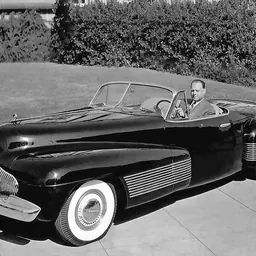







Related people
Same field, nearest in time

Contemporaries
People whose lives overlapped Richard A. Teague's


Frequently asked questions
Who was Richard A. Teague?
American automotive designer (1923-1991)
When was Richard A. Teague born?
Richard A. Teague was born on 23 December 1923 in Los Angeles.
When did Richard A. Teague die?
Richard A. Teague died on 5 May 1991 in San Diego.
What was Richard A. Teague's occupation?
Richard A. Teague was a car designer.
What nationality was Richard A. Teague?
Richard A. Teague was American.
Sources & further reading
· Wikipedia: Richard A. Teague
Cite this page
APA: Biography.guide. (2026). Richard A. Teague. https://biography.guide/richard-a-teague/
MLA: "Richard A. Teague." Biography.guide, https://biography.guide/richard-a-teague/.
Chicago: "Richard A. Teague." Biography.guide. https://biography.guide/richard-a-teague/.
Data last updated: 2026-09-22 · Spot an error? Report a correction.
Page generated 2026-09-27 05:20 UTC