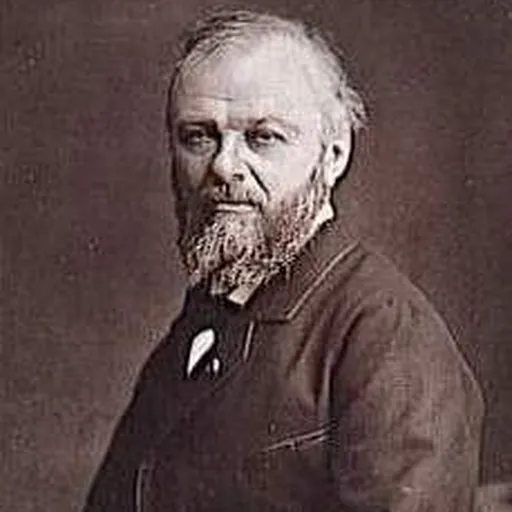
About René Dagron
Lived 1819 – 1900 (aged 81). René Dagron was a French chemist and photographer.
René Prudent Patrice Dagron (17 March 1817 – 13 June 1900) was a French photographer and inventor. He was born in Aillières-Beauvoir, Sarthe, France. On 21 June 1859, Dagron was granted the first microfilm patent in history. Dagron is also considered the inventor of the miniature photographic jewels known as Stanhopes because a modified Stanhope lens is used to view the microscopic picture attached to the lens. He is buried at Ivry Cemetery, Ivry-sur-Seine.
Early life
He grew up in rural France but he left for Paris at an early age. In Paris he distinguished himself in the study of Physics and Chemistry. As a chemistry student Dagron became interested in Daguerrotypes when the process of producing them was announced on 19 August 1839.
In 1862, Dagron exhibited his miniature Stanhope viewers during the 1862 International Exhibition in London.
Rampont, the man in charge of the carrier pigeon program, agreed and a contract was signed on 11 November. According to the contract Dagron was to be paid 15 francs per 1000 characters photographed. A clause in the contract, signed by an official named Picard, gave Dagron the title of "chief of the photomicroscopic correspondence postal service" mentioning in French: "M. Dagron a le titre de chef de service des correspondences postales photomicroscopiques. Il relève directement du Directeur Général des Postes," ( which translates as "Mr. Dagron has the title of the chief of the photomicroscopic correspondence postal service. He reports directly to the Director General of the Post Office").
After a period of difficulties and through hardships brought on by the war and the lack of equipment, Dagron finally achieved a photographic reduction of more than 40 diameters. The microfilms so produced weighed approximately 0.05 grams each and a pigeon was able to carry up to 20 at a time. Up to that point a page of a message could be copied in a microfilm approximately measuring 37 mm by 23 mm but Dagron was able to reduce this to a size of approximately 11 mm by 6 mm which was a significant reduction in the area of the microphotograph.
Dagron photographed pages of newspapers in their entirety which he then converted into miniature photographs. He subsequently removed the collodion film from the glass base and rolled it tightly into a cylindrical shape which he then inserted into miniature tubes that were transported fastened to the tail feathers of the pigeons. Upon receipt the microphotograph was reattached to a glass frame and was then projected by magic lantern on the wall. The message contained in the microfilm could then be transcribed or copied.
By 28 January 1871, when Paris and the Government of National Defense surrendered, Dagron had delivered 115,000 messages to Paris by carrier pigeon.
Don’t just read it —
keep it.
Full-length biographies made to live with: read them, listen on the way to work, watch them tonight.
- E-book
- Audio
- Video
Instant download · yours to keep · every purchase keeps this site free
Important facts
more
Prudent-Rene-Patrice DagronRelated people
Same field, nearest in time


Contemporaries
People whose lives overlapped René Dagron's




Frequently asked questions
Who was René Dagron?
French photographer and inventor (1819–1900)
When was René Dagron born?
René Dagron was born on 17 March 1819 in Aillières-Beauvoir.
When did René Dagron die?
René Dagron died on 13 June 1900 in Paris.
What was René Dagron's occupation?
René Dagron was a chemist and photographer.
What nationality was René Dagron?
René Dagron was French.
Sources & further reading
Cite this page
APA: Biography.guide. (2026). René Dagron. https://biography.guide/rene-dagron/
MLA: "René Dagron." Biography.guide, https://biography.guide/rene-dagron/.
Chicago: "René Dagron." Biography.guide. https://biography.guide/rene-dagron/.
Data last updated: 2026-09-20 · Spot an error? Report a correction.
Page generated 2026-09-27 05:10 UTC