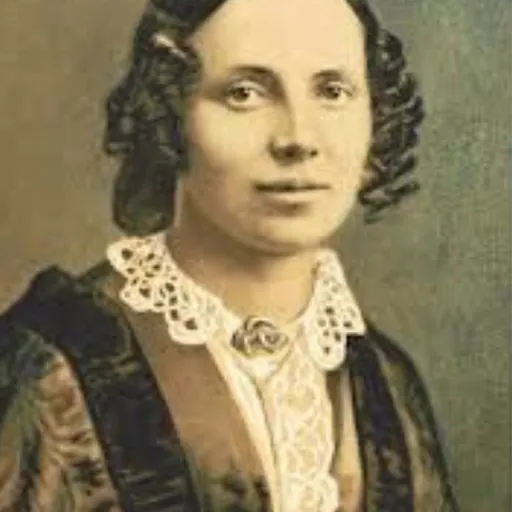
Regine Olsen
Søren Kierkegaard's fiancée
About Regine Olsen
Lived 1822 – 1904 (aged 82). Regine Olsen was a Danish.
Regine Schlegel (née Olsen; 23 January 1822 – 18 March 1904) was a Danish woman who was engaged to the philosopher and theologian Søren Kierkegaard from September 1840 to October 1841.
Biography
Early years and engagement to Kierkegaard
Olsen was born on 23 January 1822 in Frederiksberg, a district of Copenhagen, Denmark. Her parents were Terkild Olsen, councilor of state and department head in the Finance Ministry, and Regine Frederikke Malling Olsen. Her family home was located in Børsgade, near Knippelsbro. A mutual infatuation developed between the two while Olsen was being tutored by Johan Frederik Schlegel, her future husband.
They would then meet again at a gathering held by Lyngbye. By this point Olsen had made a strong impression on Kierkegaard, who would describe her in letters as pure, blissful and with a halo around her head. Until the eventual dissolution of their engagement, they lived quite happily, as Kierkegaard relied on Regine as a confidant. Each week, for instance, she would listen to Kierkegaard reading aloud to her a sermon from Bishop Jacob Mynster of Copenhagen.
Kierkegaard's letters were very reminiscent of Abelard's letter to Philintus where Abelard wrote:
End of engagement
On 11 August 1841 Kierkegaard broke off the engagement believing it would be torturous for Olsen to be his companion because there was "something spectral about me, something no one can endure who has to see me every day and have a real relationship with me". He sent Olsen a farewell letter along with his engagement ring. Olsen, heartbroken, immediately went to Kierkegaard's house; he was not there, but she left a note pleading for him not to leave her. Olsen did not want the engagement to end, fearing it would strengthen Kierkegaard's growing melancholy and depression although to envision Kierkegaard as a husband was foreign to her thoughts. In her conversations with Hanne Mourier in her later life, she stated that:Quotation|Kierkegaard's motivation for the break was his conception of his religious task; he dared not bind himself to anyone on earth in order not to be obstructed from his calling. He had to sacrifice the very best thing he owned in order to work as God demanded of him: therefore he sacrificed love … for the sake of his writing. Kierkegaard attempted to quell her interest, he later wrote, "there was nothing else for me to do but to venture to the uttermost, to support her, if possible, by means of deception, to do everything to repel her from me to rekindle her pride." He wrote her cold, calculated letters to make it seem that he no longer loved her, but Olsen clung to the hope that they would get back together, desperately pleading to him to take her back. On 11 October 1841 Kierkegaard met with her and again broke off the engagement in person. Her father tried to persuade him to reconsider after assessing Olsen's desperate condition, claiming that "It will be the death of her; she is in total despair".
Olsen was crushed by the whole affair, soon falling ill as a result. Kierkegaard was equally distraught, being described as spending his nights crying in his bed without her.
Kierkegaard was so concerned that Olsen might actually destroy herself because she said she could not live without him that he tried to give her advice in his Fourth Upbuilding Discourse of 1844. He wanted her to be able to stand on her own with or without him. He asked her:
Kierkegaard mentioned the concern that awoke his conscience in this Upbuilding Discourses and came to the conclusion that the power of forgiveness is a good and perfect gift from God. (See: Four Upbuilding Discourses, 1843, and: Love Will Hide a Multitude of Sins (See: Three Upbuilding Discourses, 1843.)
He wanted one thing from Regine that she would not give, forgiveness. If one cannot forgive another, how does one forgive himself or herself or expect forgiveness from God? He wrote the following in 1845:
Sometime after the dissolution of the engagement and Olsen's marriage, Kierkegaard considered writing to her in order to explain his behaviour but decided not to, believing it would damage his relationship with God, which he saw as his first and foremost calling in life. In 1849 Kierkegaard sent a letter to Olsen expressing his sorrow and pleading for forgiveness.
Quotation|That I was cruel is true; that I, committed to a higher relationship, not simply for the sake of my virtue, had to be so because of love is a certainty; that you have suffered indescribably I realize; but I was to suffer more, I believe and know.—Nevertheless, I am ready to ask your forgiveness—provided you understand it as follows, provided you harbor no other explanation of our relationship than the fabrication, provided and forced upon you by my solicitude, that I was a black-hearted villain who broke a sacred obligation out of self-love, cruelly deceiving a lovely young girl who with all the righteousness of innocence on her side, with almost worshipful admiration and almost childlike devotion, entrusted herself to him. Provided you understand the matter in that way, then let me remain in the character of that pious deception: I am a villain, but now I come as a suffering penitent and beg forgiveness|title=(Letter 235, p. 322f.)
Effect of breakup on Kierkegaard Sören Kierkegaard's relation to his fianceeKierkegaard never fully recovered from his failed relationship with Olsen, remaining forever smitten with her, writing in a letter addressed to Olsen he said: For a time in between their break-up and her marriage to Schlegel, they had polite and civil contact during daily walks and in church. These were mostly non-verbal on Kierkegaard's part and caused him great anxiety, although he still was able to find joy in the interactions, writing in his journal, “As often happens to me of late, I can’t help but smile when I see her". For example on his 39th birthday, Olsen appeared to him at his house in Østerbro, Kierkegaard returned the greeting and they both went their separate ways. It was during this time that Kierkegaard was formulating his own philosophy, as well as his first book, Either/Or. It seems by the time of his death he still held his feelings of love to Olsen as she was the only person listed in his will, whom Kierkegaard, for all intents and purposes, considered himself married to. Olsen ultimately rejected the will.
Later years and marriage to Johan Frederik Schlegel
On 16 April 1843 Kierkegaard was leaving Vor Frue Church when he saw Olsen who nodded to him which Kierkegaard understood to mean she had forgiven him. This was an important interaction for them which would signify that Olsen had moved on. Kierkegaard would later write in his journal: Quotation|At Vespers on Easter Sunday in Frue Kirke (during Mynster's sermon), she nodded to me. I do not know if it was pleadingly or forgivingly, but in any case very affectionately. I had sat down in a place apart, but she discovered it. Would to God that she had not done so. Now a year and a half of suffering and all the enormous pains I took are wasted; she does not believe that I was a deceiver, she has faith in me. What ordeals now lie ahead of her. The next will be that I am a hypocrite. The higher we go, the more dreadful it is. That a man of my inwardness, of my religiousness, could act in such a way. And yet I can no longer live solely for her, cannot expose myself to the contempt of men in order to lose my honor—that I have done. Shall I in sheer madness go ahead and become a villain just to get her to believe it—ah, what help is that. She will still believe that I was not that before.|source=|title=(Journals, IV A 97). The marriage was happy and stable. The two even read aloud to each other passages from Kierkegaard's writings, which were then getting much attention in Denmark.
On a number of occasions in 1849, Olsen and Kierkegaard crossed each other's paths, beginning with dispersing from church after Mass, and later on the routes for afternoon walks both of them took. On 19 November 1849 Frederik Schlegel received a letter from Kierkegaard entreating him to allow him to speak to Olsen. Schlegel did not respond to the letter and denied Kierkegaard further requests to talk with Olsen. On the 10th of September 1852, the twelfth anniversary of their engagement, they met once again but neither engaged in conversation, just admiration, which Kierkegaard found agonizing. On Christmas day of that year, they met once again; however Kierkegaard noted that it seemed as if she was waiting for him or someone at least. Kierkegaard found the exchange to be odd and deeply personal and even afterwards he felt as if she was "searching me with her eyes". In 1898 she decided to dictate to, among others, the librarian Raphael Meyer the story of her engagement to Kierkegaard. This account was published after Olsen's death in 1904 as Kierkegaardian Papers: The Engagement; Published on Behalf of Mrs. Regine Schlegel, but in general scholars concede that it offers little information that was not already known through Kierkegaard and other sources. Olsen is buried in Assistens Cemetery in Copenhagen, along with both Kierkegaard and Frederik Schlegel. In his commentary about her, Robert Neiiendam wrote that "she knew 'that he took her with him into history.' And this thought made up for what she had suffered."
In her final years, childhood friend Raphael Meyer said that: Stages on Life's Way contains an analysis of the three "spheres of existence" — the aesthetic, the ethical, and the religious. As the ethical corresponds to dedicating one's life to another – to marriage – the religious corresponds to dedicating one's self to God. It seems to have been this decision – this "either/or" – which consumed Kierkegaard during the years of his engagement, and he felt that he could not reconcile his marriage with his religious calling.
Fear and Trembling has frequently been seen as analogous for Kierkegaard and Olsen's relationship mirroring the tale of Abraham sacrificing Isaac. Biographer and writer of 'Philosopher of the Heart: The Restless Life of Søren Kierkegaard' Clare Carlisle said that Kierkegaard "feels he has sacrificed a life with Regine, and with it his own honour and his family’s good name, for the sake of something that is difficult to explain".
The first full-length biography of Olsen is Joakim Garff's ("Regine's Riddle: The Story of Kierkegaard's Fiancee and Schlegel's Wife") (Copenhagen: Gads, 2013), subsequently translated as Kierkegaard's Muse: The Mystery of Regine Olsen (trans. Alastair Hannay, Princeton University Press, 2017).
In popular culture British author David Lodge delves extensively into the love story between Kierkegaard and Olsen in his 1995 novel Therapy, as the protagonist Tubby Passmore goes through a mid-life crisis and becomes obsessed with Kierkegaard's writings and especially the story of his love for Olsen, visiting Copenhagen and Kierkegaard's study. Italian post-rock band port-royal has a song titled "Regine Olsen." US indie pop band, The Receptionists, have a song titled "Søren Loved Regina". There is a Russian synthpop duo called Regine Ollsenn [sic].
Don’t just read it —
keep it.
Full-length biographies made to live with: read them, listen on the way to work, watch them tonight.
- E-book
- Audio
- Video
Instant download · yours to keep · every purchase keeps this site free
Important facts
People in Regine Olsen's life
Named in this biography and alive at the same time

Contemporaries
People whose lives overlapped Regine Olsen's





Frequently asked questions
Who was Regine Olsen?
Søren Kierkegaard's fiancée (1822–1904)
When was Regine Olsen born?
Regine Olsen was born on 23 January 1822 in Frederiksberg.
When did Regine Olsen die?
Regine Olsen died on 18 March 1904 in Frederiksberg.
What nationality was Regine Olsen?
Regine Olsen was Danish.
Sources & further reading
Cite this page
APA: Biography.guide. (2026). Regine Olsen. https://biography.guide/regine-olsen/
MLA: "Regine Olsen." Biography.guide, https://biography.guide/regine-olsen/.
Chicago: "Regine Olsen." Biography.guide. https://biography.guide/regine-olsen/.
Data last updated: 2026-09-23 · Spot an error? Report a correction.
Portrait: Wikimedia Commons · author & licence
Page generated 2026-09-27 05:06 UTC