
About Raymond H. Littge
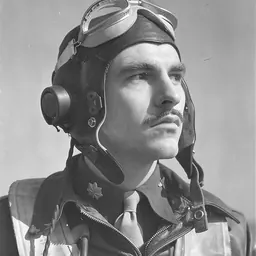
Lived 1923 – 1949 (aged 25–26). Raymond H. Littge was an aircraft pilot and military personnel.
Raymond Henry Littge (October 18, 1923 – May 20, 1949) was an American flying ace in the 352nd Fighter Group during World War II, who was credited with 23.5 aerial and ground victories.
Early life Littge was born on 1923 to Henry and Martha Ahner Littge. After his father died when he was at age 4, Littge, six brothers and a sister were raised by their mother. In 1939, he gained interest in flying and worked in a farm to pay for his flying lessons. He attended Altenberg High School for two years, but graduated from Perryville High School in 1942.
Military career After graduation from high school, Littge enlisted in the Aviation Cadet Program of the U.S. Army Air Forces on July 1, 1942, and was not inducted until January 19, 1943, at Jefferson Barracks, Missouri. Littge was commissioned a second lieutenant and awarded his pilot wings at Dale Mabry Field in Florida, on December 5, 1943.
World War II
After completing training in the P-51 Mustang, Littge was assigned to the 487th Fighter Squadron of the 352nd Fighter Group. Based at RAF Bodney in Norfolk, England, he flew his first combat mission on July 1, 1944. On his 46th mission, Littge scored his first aerial victories, when he shot down two Messerschmitt Bf 109s on November 27, 1944. He finally became a flying ace, when he shot down three Focke-Wulf Fw 190s on December 27, bringing his total to five aerial victories. On a fighter sweep later in the year over France, he was shot down, but managed to bail out his aircraft. With the help of French Resistance, he escaped capture and managed to return to England within 12 days.
On April 17, 1945, Littge led his flight in attacking a German aerodrome in Plattling. Of the fourteen aircraft destroyed in the attack by the flight, Littge was personally credited in destroying six aircraft in the attack, while carrying out seven strafing attacks against the aerodrome despite his aircraft sustaining severe damage from anti-aircraft fire. For his heroism in the mission, he was awarded Distinguished Service Cross – the second only to Medal of Honor.
Post war After the end of World War II, Littge returned to the United States in May 1945 and was assigned to Wright Patterson Air Force Base in Ohio, where he was part of the team evaluating captured German aircraft. During this time, he test flew a captured Me 262 and wrote an evaluation report for it.
Littge left active duty on December 19, 1946, and joined the United States Air Force Reserve. He returned to active duty on March 17, 1947, for jet training and was assigned as an operations officer for the 83d Fighter Squadron at Hamilton Air Force Base in California.
Littge was buried at the Trinity Lutheran Church Cemetery in Altenburg, Missouri.
Aerial victory credits SOURCES: Air Force Historical Study 85: USAF Credits for the Destruction of Enemy Aircraft, World War II
Personal life Littge married to Helen Susan, née Fischer, in 1945. The couple had two sons: Raymond Littge II and George Preddy Littge. Following Littge's death in 1949, Helen Littge remarried to James R. Starnes, a P-51 Mustang World War II flying ace in the 339th Fighter Group and later a colonel in the U.S. Air Force.
Littge's P-51D 44–72216, nicknamed "Miss Helen" was sold to the Swedish Air Force, where it served at Swedish air bases in Östersund and Uppsala. After five years of service in Sweden, the aircraft was sold to the Israel Defense Forces in 1953. During its time in the Israeli Air Force, the aircraft was fitted with rocket rails and likely flew combat missions during the 1956 Sinai Campaign. After being retired from combat service, the aircraft remained in a children's playground at kibbutz Ein Gedi, where it was bought by Robert Lamplough, an English warbird collector. It was returned to England, where it was re-fitted with wings from P-51D 44–72770, and made airworthy. The aircraft was painted in the original 352nd Fighter Group colors and re-registered as G-BIXL. It is currently flown at air shows in the United Kingdom and is believed to be the only original 352nd FG P-51 that exists to this day.
Littge's exploits during Operation Bodenplatte on January 1, 1945, was featured in the "Death of the Luftwaffe", which was the sixteenth episode of the second season of the History Channel series Dogfights, which recreated historical air combat campaigns using modern computer graphics.
Don’t just read it —
keep it.
Full-length biographies made to live with: read them, listen on the way to work, watch them tonight.
- E-book
- Audio
- Video
Instant download · yours to keep · every purchase keeps this site free
Important facts
People in Raymond H. Littge's life
Named in this biography and alive at the same time


Related people
Same field, nearest in time




Contemporaries
People whose lives overlapped Raymond H. Littge's



Frequently asked questions
Who was Raymond H. Littge?
American flying ace (1923–1949)
When was Raymond H. Littge born?
Raymond H. Littge was born in 1923.
When did Raymond H. Littge die?
Raymond H. Littge died on 20 May 1949.
What was Raymond H. Littge's occupation?
Raymond H. Littge was an aircraft pilot and military personnel.
Sources & further reading
· Wikipedia: Raymond H. Littge
Cite this page
APA: Biography.guide. (2026). Raymond H. Littge. https://biography.guide/raymond-h-littge/
MLA: "Raymond H. Littge." Biography.guide, https://biography.guide/raymond-h-littge/.
Chicago: "Raymond H. Littge." Biography.guide. https://biography.guide/raymond-h-littge/.
Data last updated: 2026-09-20 · Spot an error? Report a correction.
Page generated 2026-09-27 05:20 UTC