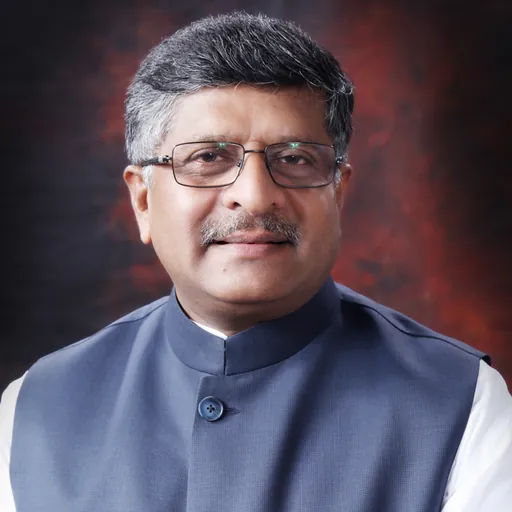
About Ravi Shankar Prasad
Born 1954. Ravi Shankar Prasad is an Indian politician and lawyer.
Ravi Shankar Prasad (born 30 August 1954) is an Indian politician and lawyer who served as 1st Minister of Electronics and Information Technology from 2016 to 2019 and 2019 to 2021. He is the member of Bharatiya Janata Party and Member of Parliament since 2000, first in the Rajya Sabha (2000–2019) and then in the Lok Sabha (since 2019), Prasad has served as Union Minister multiple times: As Minister of State, he served in the ministries of Coal (2001–2003), Law and Justice (2002–2003), and Information and Broadcasting (2003–2004) under Atal Bihari Vajpayee's premiership; as Cabinet Minister, he held the Law and Justice (2014, 2016–2021), Communications (2014–2016, 2019–2021) portfolios under Narendra Modi's premiership.
His term as Union Minister was marked with the repeal of 1500 archaic laws, handling of litigation over the purchase of Rafale fighter planes, and digitization of 15000 trial courts. On the other hand, his tenure also saw controversy over the proposed National Judicial Appointments Commission, constant friction between the judiciary and the executive, and rows with social media platforms Twitter and Facebook over local rules.
Early life and education He was born in Patna, Bihar. His father Thakur Prasad was a senior advocate at the Patna High Court and one of the leading founders of the Jan Sangh, the predecessor of the Bharatiya Janata Party. He became a member of the Akhil Bharatiya Vidyarthi Parishad in 1969. Prasad participated in the student movement in Bihar led by Jayaprakash Narayan, and was imprisoned during the Emergency.
Law career Prasad has been practising at the Patna High Court (HC) since 1980. He was designated Senior Advocate at the Patna HC in 1999 and Senior Advocate at the Supreme Court of India in 2000. He was General Secretary of the People's Union for Civil Liberties in Bihar. He defended Lal Krishna Advani in court when the latter was arrested in Bihar during his Rath Yatra in 1990. He was also the main lawyer arguing the PIL against former Bihar Chief Minister Lalu Prasad in the fodder scam that led to the jailing of several politicians and officials, including Lalu Yadav. Prasad rose to become part of the Narendra Modi Cabinet. He was appointed as Minister of Law and Justice and Minister for Communications and Information Technology on 27 May 2014. He would go on to serve three terms as Law Minister: 27 May to 9 November 2014; 5 July 2016 to 25 May 2019; and 30 May 2019 to 7 July 2021; a tenure of more than 5 years that was second only to that of Ashoke Sen. Prasad was Minister of Communications and IT till the ministry's bifurcation on 5 July 2016 into a Ministry of Communications and a Ministry of Electronics and Information Technology, following which he took charge of the latter. He was on the job till 25 May 2019, and again from 30 May 2019 to 7 July 2021. During the latter period, he also held the Communications portfolio. Following this landmark verdict, the NDA government tabled The Muslim Women (Protection of Rights on Marriage) Bill in the Lok Sabha in December 2017, seeking to introduce a 3-year jail term for offenders. The opposition criticised the bill for attempting to criminalise a civil wrong, with Law Minister Prasad countering the charges. While the original bill lapsed due to lack of support in the Rajya Sabha, it was passed by both Houses of Parliament on reintroduction in 2019, becoming an Act after receiving Presidential assent on 1 August 2019. The passage of the bill despite the ruling NDA not having a majority in the Rajya Sabha was seen as a victory for Prasad and the government.
Digital India
As Minister for Electronics and Information Technology, Prasad spearheaded the NDA government's flagship Digital India programme. The UK-based NGO Apolitical adjudged him as one of the top twenty leaders in the list of 100 most influential people in Digital Government in 2018.
Start-up India Initiatives Prasad took the lead in advancing India's startup ecosystem and pioneered the organization of groundbreaking townhall meetings. These meetings provided a platform for assessing the distinctive requirements of the startup community, and Prasad played a pivotal role in shaping government policies and initiatives designed to bolster the support for startups in the nation.
Comments on Indian economy In October 2019, Prasad tried to defend the condition of the Indian economy by commenting that "the holiday of October 2 saw earning of over Rs 120 crore by three movies – War, Joker and Sye Raa", indicating that "he economy is sound". He also claimed that an NSSO report on unemployment was false. The comment came on the back of industrial output figures released by the government showing how factory output had shrunk by 1.1% in August, recording the poorest performance in seven years. The World Bank had also pointed out the country's widening current account deficit and predicted a further slowdown in economic growth. After coming under sharp criticism from the opposition Congress and CPIM, Prasad withdrew the comment, stating it had been taken out of context.
Clashes with 'Big Tech' Prasad has openly supported the cause of net neutrality, insisting that internet access "is not negotiable" and “walled gardens cannot be allowed”. As Minister for Communications and IT, Prasad had denied Facebook permission for its Free Basics platform in India in 2016, saying it provided access to only a host of websites and services, while excluding the broader internet from its purview. seeking to regulate social media intermediaries and to tackle misuse of social media. However, Prasad and his Ministry were soon drawn into a bitter spat with Big Tech companies, especially Twitter, over the implementation of these local laws. The tussle escalated as the government removed Twitter's legal protection in India as an "intermediary" on 16 June over its failure to comply with the new IT rules, while Twitter temporarily locked Prasad's official handle on its platform due to a copyright violation.
In Lok Sabha 2024 Ravi Shankar Prasad has won in Patna Sahib Lok Sabha constituency. He has defeated Dr. Anshul Avijit by about 1.5 lakh votes.
Personal life On 3 February 1982, Prasad married Maya Shankar, who is a Historian and Professor of History at Patna University.
Don’t just read it —
keep it.
Full-length biographies made to live with: read them, listen on the way to work, watch them tonight.
- E-book
- Audio
- Video
Instant download · yours to keep · every purchase keeps this site free
Important facts
People in Ravi Shankar Prasad's life
Named in this biography and alive at the same time



Related people
Same field, nearest in time




Contemporaries
People whose lives overlapped Ravi Shankar Prasad's



Frequently asked questions
Who is Ravi Shankar Prasad?
Indian politician
When was Ravi Shankar Prasad born?
Ravi Shankar Prasad was born on 30 August 1954 in Patna.
What is Ravi Shankar Prasad's occupation?
Ravi Shankar Prasad is a politician and lawyer.
What nationality is Ravi Shankar Prasad?
Ravi Shankar Prasad is Indian.
Sources & further reading
· Wikipedia: Ravi Shankar Prasad
· DBpedia: Ravi Shankar Prasad
Cite this page
APA: Biography.guide. (2026). Ravi Shankar Prasad. https://biography.guide/ravi-shankar-prasad/
MLA: "Ravi Shankar Prasad." Biography.guide, https://biography.guide/ravi-shankar-prasad/.
Chicago: "Ravi Shankar Prasad." Biography.guide. https://biography.guide/ravi-shankar-prasad/.
Data last updated: 2026-09-21 · Spot an error? Report a correction.
Portrait: Wikimedia Commons · author & licence
Page generated 2026-09-27 05:00 UTC