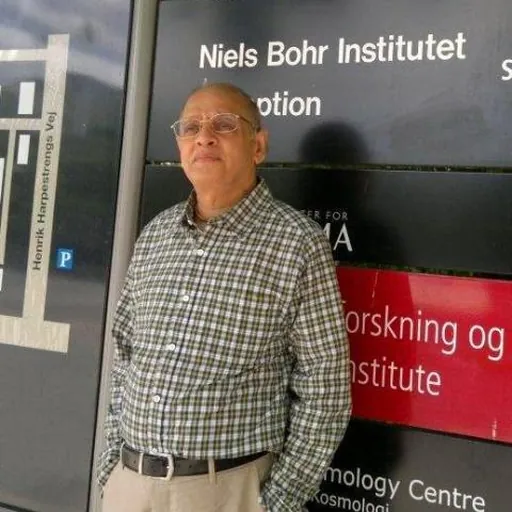
About Ravi Gomatam
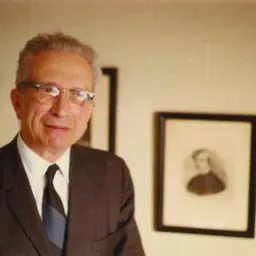
Born 1950. Ravi Gomatam is a theoretical physicist.
Ravi Veeraraghavan Gomatam (born in Chennai, India) is the director of Bhaktivedanta Institute (Berkeley and Mumbai) and the newly formed Institute of Semantic Information Sciences and Technology, Mumbai. He teaches graduate-level courses at these institutes. He was an adjunct professor at Birla Institute of Technology & Science (BITS), Pilani, Rajasthan, India (1993–2015).
He has been made a visiting professor for the year 2016–2017 at the Indian Council of Philosophical Research (ICPR), a Government of India body, under the Ministry of Human Resource Development.
In January 1990, he organized a conference titled First International Conference on the Study of Consciousness within Science in San Francisco. Subsequently, in 1997 Gomatam conceived and launched the world's first M.S./Ph.D. programs in "consciousness studies", in collaboration with the Birla Institute of Technology & Science (BITS), Pilani (one of India's foremost technological universities). "Consciousness Studies" is a developing, inter-disciplinary scientific field, which Gomatam has particularly re-conceived as a new way of studying matter.
In 2015, the Institute of Semantic Information Sciences and Technology started offering M.A. (by research) and Ph.D. programs in collaboration with the Mumbai University, India.
Gomatam's own field of research is foundations of quantum mechanics, wherein he is introducing a few new ideas, including those of "Objective, Semantic Information" and a notion of "Relational Properties" that is different from that of Rovelli and others. His new ideas have received notice for their potential. He has related research interests in semantic computation, systems sciences, artificial intelligence, philosophy of science and philosophy of language.
Education B.E. Electrical and Electronics Engineering, Annamalai University, India M.E. Electronics Engineering, Birla Institute of Technology & Science, Pilani, India Ph.D. Foundations of Quantum Mechanics, Mumbai University, India. Dissertation Title: Toward a realist interpretation of quantum theory – Integrating Bohr and Einstein.
Early work in the industry Gomatam worked as a freelance consultant for a number of Fortune-500 companies including General Motors, Ford, Chrysler, Burroughs and IBM in the areas of operating system design, data communications and very-large database design. and ‘macroscopic quantum coherence’, developed in the early 80s by Anthony James Leggett. In general, Leggett's attempt is to create an experimental situation using a SQUID, wherein a coherent superposition at the microscopic level can also be scaled up to the macroscopic level, because of involving a large number of microscopic objects (that is, electrons, of the order of 10^15 to 10^20) in coherent superposition. In this regard, he is also developing two further new ideas within physics: the ontology of "Objective, Semantic Information" (OSI) and corresponding "Relational Properties" (RPs).
As part of developing his version of MQM, Gomatam has related interests in exotic manifolds, semantic information processing, quantum computation, and philosophy of ordinary language. Here Gomatam contrasts Bohr's Interpretation with Copenhagen Interpretation (where Bohr is a co-author). This paper was a required reading in a course in Quantum Mechanics at Brown University. Quantum Theory and the Observation Problem. Michael Turvey credits Gomatam for labeling a key problem in quantum mechanics as "observation problem" which he says were only "implicit in deliberations of Bohr, Einstein, Bell and others: to identify a quantum-compatible nonclassical conception of everyday objects, one consonant with the principle of superposition." Wolfgang Prinz, M.W. Stuckey and Panos Pardalos cite this paper for its key contribution in the field of macroscopic quantum mechanics. How Do Classical and Quantum Probabilities Differ? Macroscopic Quantum Mechanics and System of Systems Design Approach. Quantum Theory, the Chinese Room Argument and the Symbol Grounding Problem. Quantum Realism and Haecceity. Popper's Propensity Interpretation and Heisenberg's Potentia Interpretation — A comparative assessment. Do Hodgson's Propositions Uniquely Characterize Free Will? Invited commentary on a target paper, "A Plain Person's View of Free Will" by David Hodgson. Physics and Common Sense: Relearning the Connections in the Light of Quantum Theory.
Activities and societies Member of American Association for Artificial Intelligence Member of American Philosophical Society
Don’t just read it —
keep it.
Full-length biographies made to live with: read them, listen on the way to work, watch them tonight.
- E-book
- Audio
- Video
Instant download · yours to keep · every purchase keeps this site free
Important facts
People in Ravi Gomatam's life
Named in this biography and alive at the same time





Related people
Same field, nearest in time




Contemporaries
People whose lives overlapped Ravi Gomatam's



Frequently asked questions
Who is Ravi Gomatam?
Indian academic
When was Ravi Gomatam born?
Ravi Gomatam was born in 1950.
What is Ravi Gomatam's occupation?
Ravi Gomatam is a theoretical physicist.
Sources & further reading
Cite this page
APA: Biography.guide. (2026). Ravi Gomatam. https://biography.guide/ravi-gomatam/
MLA: "Ravi Gomatam." Biography.guide, https://biography.guide/ravi-gomatam/.
Chicago: "Ravi Gomatam." Biography.guide. https://biography.guide/ravi-gomatam/.
Data last updated: 2026-09-20 · Spot an error? Report a correction.
Portrait: Wikimedia Commons · author & licence
Page generated 2026-09-27 04:57 UTC