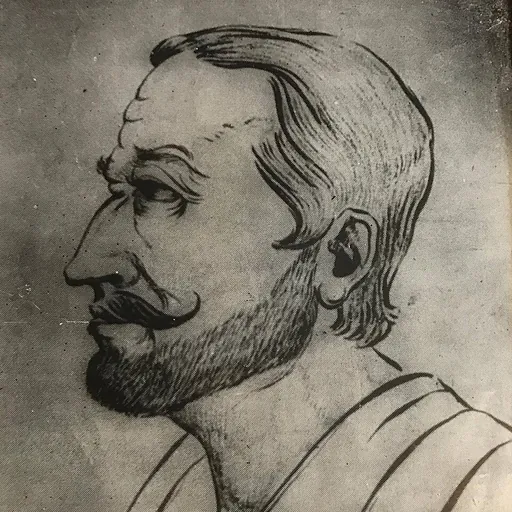
About Rasul Mir
Rasul Mir was a writer, poet and muqaddam.
As Lawrence suggests, the Sikh rule, though mild in degree, was no better than the Afghan rule. The first ruler of the Sikh empire, Ranjit Singh, had banned Azaan (the Islamic call for prayer) and the gathering of Muslims in Jama Masjid, Srinagar for 21 years. The Sikhs enacted a number of anti-Muslim laws, which included handing out death sentences for cow slaughter too. The Sikhs ruled for twenty-seven years- the years of Rasul Mir's youth and manhood.
The above reference from this poem could be felt as an expression of departing away from the Beloved (or the Shahid, pious self).
While some are of opinion he was referring to the famous Kashmiri poet Habba Khatoon, "whose name was Zun, the Kashmiri word for the moon. She was born in Chandrahar village" says K. N Dhar while quoting Mahjoor.
It was also during the Sikh rule in 1831 that Kashmir experienced another great famine. Godfrey Vigne, who visited the valley in 1835 after the great famine, writes:
The Sikh rule ended in 1846 when, under the Treaty of Amritsar, Kashmir was handed over by the British to the Dogra ruler, Gulab Singh, in return of seventy-five lakh (7.5 million) Nanakshahee rupees and some political concessions. With the accession of Dogras to the throne of Kashmir there was, however, a change for the better. Though, the fourth-time, valley had to approach another Great famine in 1877, wiping or migrating out 30–40% of the population.
It was in a milieu like this that Rasul Mir spent his life. He must have seen the worst prevailing tyranny and exploitation as he belonged to the countryside, where the rule of law seldom prevailed. Mir was himself a muqdam (village chieftain), he must have sometimes acted as a convenient instrument of all-pervasive tyranny and exploitation but, what is surprising, his poetry shows little or no trace of the surroundings in which he lived. Though, Rasul Mir was fond of wandering around and visiting different places. Almost every year, he would take a trip to Pogul Paristan, Ramban and return after long intervals to live at the place to which he returns again and again with tenderness and affection is his native area- Dooru, Shahabad. The geographical features of the valley, such as the springs of Verinag and local gardens, heavily influenced the imagery in Rasul Mir's poetry. The famous stone carrying its name was also quarried there. The Persian translator of Rajatarangini, Mulla Muhammad, who had translated Rajatarangini in Persian, entitled Behr-ul-Asmar, (or the sea of tales), at the behest of Sultan Zain-ul-Abidin (1421–1472) A.D of Kashmir, was from Dooru, Shahabad. The colonial Indian-Pakistani writer Saadat Hasan Manto's family had also originated from Dooru, Shahabad.
Poetic tradition The tradition to which Rasul Mir belongs is quite a complex one. Essentially rooted in folklore and folk sensibility, the tradition has been widened and enriched by influences from diverse sources; particularly Persian poetry. From this point of view the most remarkable Persian poets are Sadi, Hafez, Nizami, Rumi, Attar, Firdausi, Bedil and Ghani Kashmiri. Sadi's works - Gulistan, Bostaan and Pandnamah (popularly known as Karima)- constituted the first formal syllabus of conventional education in Kashmir, besides the religious texts. This was the education that Rasul Mir had in his childhood and boyhood. Another form of communal singing prevalent in Kashmir was nende baeth (songs sung while de-weeding paddy fields). Such communal singing was a common feature of 19th century Kashmir. Every village had one or more such singing companies. The aesthetic underlying this kind of poetry suited the feudal ethos. The singing companies would usually sing during the night in large gatherings. The social value of these musical concerts was to wash away care and anxiety from laden hearts through nights of singing and revelry. Rasul Mir is always alive to the musical possibilities of language and exploits them to the maximum. Most of his songs were composed for occasions of singing and would surely have been different if written with some different purpose. His poems, "Dil hai nyunam tsuri lo lo", "Chaw mai jami jamai", "Kout goum" and "Rind posh maal" are metrically what they are because they were written for certain occasion of singing. These insights are supported by the internal evidence supplied by his poetry where he is morbidity pre-occupied with the contours of a female body and, almost in every poem, refers to the sensitive parts of a woman's body so vividly that the effect is often aphrodisiac. Somewhere these heady portraits of the lover and beloved mingle into one whole. 'The Kashmiri Gazal', says Abdul Ahad Azad, is a female seeking the lover, who is male. In Persian, from where 'Kashmiri gazal' derives its inspiration, the object of love is a male sought by a male singer. In Rasul Mir's persuasion, the singer changes from woman to man, the poems, and the elements of female beauty get mixed with distinctly male attributes producing a bivalent image. Azad calls it a 'defect of conception'. This defected concept, runs in the Kashmiri gazals from Mahmood Gami to Mahjoor. It certainly mars a distinctive characteristic of Kashmiri gazals, that set it apart from Persian and its offspring Urdu gazal. This trait has been preserved in female poets alone, like Habba Khatoon and Arnimaal where there could be no confusion. Rasul also gets into the gazal a boldness that is characteristically masculine. A male poet, to be successful in this form, would always have to maintain such a pose may be easier in a dramatic work but is essentially difficult in lyrical form, like the vatsun, which, in essence, is the expression of the author's personality. Rasul Mir was aware of the artistic implications of this problem and tried to effect a bold and revolutionary change by altering the sex of the speaking voice from female to male in most of his lyrics. This lent a note of realism and authenticity to his poetry and made it appear more natural as the speaking voice was freed from the fetters of an artificial pose. That is Rasul Mir – bold, beautiful poet of exquisite love, singer of fervent lyrics. The breath of vibrant air, that sent its freshness over cobwebs of cloistered verses. Almost single-handedly, he turned Kashmiri poetry into a bubbling love, gushing forth helplessly, sincerely, fervently, as it should in a vale of beauty.
Notable works Mir emphasised romance in his poems, and delved less on Tasavvuf (mysticism). He had turned his back on mysticism as he was not a mystic but whatever he wrote was something pure and straight from his heart. His language does not give the impression of flaunting a foreign medium, which was in his time considered the language of culture. His genius lay in acclimatising Persian words and phrases so that the reader does not get an impression that he is being served a foreign fare. He confined himself to the theme of human love- not on the exalted platonic plane but on the human level. He was sensuous, uninhabited and lavish. His expression is passionate and spontaneous, with the added asset of melody and rhyme.
The Kalaam (poetic works) of Rasul Mir is limited to seventy-nine poems There is mention too, of native myths, like Kashmir's famed fable, Himal and Nagrai, in his poems, including the legend of Yusuf and Zulaikha. Even though, with some limited works, he has already been embodied in the integral Kashmiri oral tradition. His notable works include Rind poshmal, Bal maraeyo, Gaste wesiye, Baeliye ruthai mea yaar, Lo lati lo, and Ashkh Tsuro.
Literary controversy There are a lot of speculations regarding Rasul Mir writing a Mathnavi based on the love story of Zeba and Nigar, which is exclusively credited to Miskin. Prof. G.R Malik in his monograph on Rasul Mir, contests the authenticity of Zeba and Nigar being written by Rasul Mir.
Death He wrote:
Rasul Mir's later life, however, seems to have been quite sober and serene. He became a disciple of a murshid (spiritual guide), Sheikh Ahmad Tarabali char=|sign=|title=|source= Prominent Kashmiri artists - Shameema Dev Azad, Abdul Rashid Hafiz, Gulzar Ahmad Mir, Yawar Abdal, Tanveer Ali, Abhay Sopori, Funkaar Noor Mohammad, and many others have composed songs rendering poetry of Rasul Mir. thumb Yawar Abdal performing 'Bal Maraeyo' live at Jamia Millia Islamia, DelhiLegendary Indian singer Asha Bhosle recorded a song by Rasul Mir for Radio Kashmir, Srinagar in the summer of 1966.
Amongst others- Academian, Poet, Director Radio Kashmir, Srinagar and DD Srinagar; Ashraf Sahil was also profoundly influenced by Rasul Mir.
In remembrance of the late poet, Verinag Development Authority and Cultural Academy would observe Rasul Mir's Day in the month of July, but as of 2015 the event has seen to be losing attention from any former authority.
A park near the khanqah has also been named after the poet by the Verinag Development Authority.
Don’t just read it —
keep it.
Full-length biographies made to live with: read them, listen on the way to work, watch them tonight.
- E-book
- Audio
- Video
Instant download · yours to keep · every purchase keeps this site free
Important facts
Related people
Same field, nearest in time




Frequently asked questions
Who was Rasul Mir?
Kashmiri poet
When was Rasul Mir born?
Rasul Mir was born in Doru Shahabad.
When did Rasul Mir die?
Rasul Mir died in 1870.
What was Rasul Mir's occupation?
Rasul Mir was a writer, poet and muqaddam.
Sources & further reading
Cite this page
APA: Biography.guide. (2026). Rasul Mir. https://biography.guide/rasul-mir/
MLA: "Rasul Mir." Biography.guide, https://biography.guide/rasul-mir/.
Chicago: "Rasul Mir." Biography.guide. https://biography.guide/rasul-mir/.
Data last updated: 2026-09-23 · Spot an error? Report a correction.
Portrait: Wikimedia Commons · author & licence
Page generated 2026-09-27 05:07 UTC