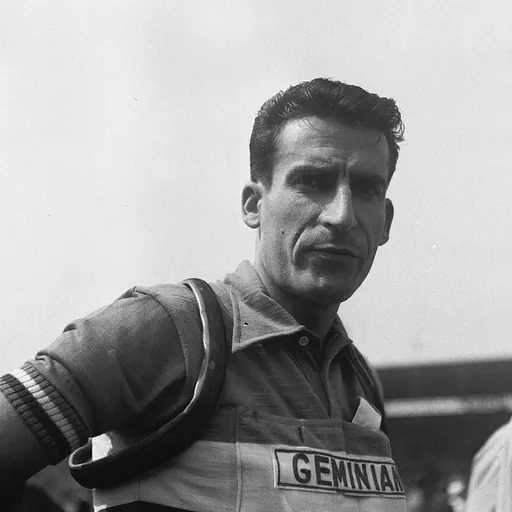
About Raphaël Géminiani
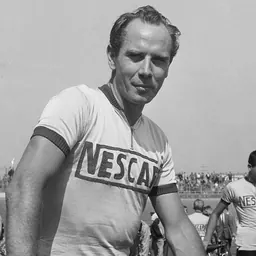
Lived 1925 – 2024 (aged 99). Raphaël Géminiani was a French sport cyclist and sporting director.
Raphaël Géminiani (12 June 1925 – 5 July 2024) was a French road bicycle racer. He had three podium finishes in the Grand Tours. He was one of four children of Italian immigrants who moved to Clermont-Ferrand fleeing from fascist violence. He worked in a cycle shop and started racing as a boy. He became a professional and then a directeur sportif, notably of Jacques Anquetil and the St-Raphaël team.
His professional career ran from 1946 to 1960. He won the mountains competition in the Tour de France in 1951. His best overall place was second in 1951 behind Hugo Koblet. He won seven stages of the Tour between 1949 and 1955 and wore the yellow jersey as leader of the general classification for four days. He won the national championship in 1953, the mountain competition of the Giro d'Italia in 1951, and third place in the Vuelta a España 1955. In 1955, Géminiani finished in the top 10 of the three big tours (Tour de France, Giro d'Italia and Vuelta a España), equalled only by Gastone Nencini in 1957. It has not been equalled since.
In 1977 he called doping checks the "cancer of cycling". He recognised that he had used drugs during his career. His strong personality earned him the nickname of Le Grand Fusil, which translates roughly as "Top Gun".
Géminiani died in Pérignat-sur-Allier on 5 July 2024, at the age of 99.
Background Géminiani's father, Giovanni, brought his family to France in 1920, being prosecuted in Italy by the rising fascist movement. He had run a bicycle factory in Lugo. It burned down. He established a bike shop in Clermont-Ferrand and worked in the shop,
Géminiani started racing in mixed amateur-professional races after the war, first locally and then nationally. He received a professional contract in 1946 for the Métropole team from its manager, Romain Bellenger, and in 1947 rode his first Tour de France.
First Tours de France Géminiani's first Tour de France, in 1947 was unsuccessful. The first stage was from Paris to Lille in one of the hottest summers for decades. The roads were still in poor shape from the war and those that were surfaced were often cobbled. Géminiani finished 20 minutes behind the leaders. Next day the race went to Brussels. Géminiani and eight others stayed away for 100 km but by the Belgian capital he was 30 minutes behind. The first riders had dropped out because of the heat. Things got worse. The stage from Brussels to Luxembourg was advertised as 365 km but was more than 400. Riders plundered wayside cafés for drink. Others fought each other to get to drinking fountains. Firemen sprayed water over the competitors as they approached Luxembourg.
Géminiani finished 50 minutes down and he and his room-mate, Jo Néri, were too exhausted to eat dinner. On the stage to Strasbourg Géminiani's face was so bloated and blistered that he could no longer see clearly. Next morning he was feverish and close to blind and left the race for hospital. It took two days to reach Clermont-Ferrand and another six to recover.
The episode brought criticism when Géminiani was chosen for the Southwest-Centre team. It was strongest in his own area, the Auvergne, where rumours had spread that Géminiani had ridden the 1947 race only because his father had bribed the selectors. There was astonishment when he was picked for the national team in the 1948 Tour de France. He was insulted when he beat a local favourite, Jean Blanc, in a race near Clermont-Ferrand three days before the start.
Géminiani said: "The night before that race, my first selection for the national team, I slept in all my race clothes." That denial led to a row over dinner in the French team's hotel. Géminiani became so annoyed at Bobet's accusations that legend says he emptied his plate on Bobet's head. Bobet, as emotional as Géminiani was quick-tempered, is said to have burst into tears and left the table.
That quick temper was behind an episode in the Tour of 1952, after a stage to Namur, in Belgium. Robic held an impromptu press conference in his bath. Géminiani heard him tell reporters "I was the crafty one today. I played dead so that I didn't have to do any of the work. And now I've got plenty of chances whereas Gem ought to be in mourning for his Tour." Géminiani pushed his way through the journalists and held Robic under the water three times.
The 'Judas' Tour Differences between Géminiani and Bobet surfaced again in the 1958 Tour de France. Géminiani was leading the race when Charly Gaul of Luxembourg, the most talented climber of his generation, attacked in a rainstorm on the 21st stage. He crossed three cols alone in the Chartreuse and moved up from being 15 minutes behind Géminiani to displacing him when the race finished in Aix-les-Bains. Géminiani rounded on the national French team generally and on Bobet in particular in accusing them of being "Judas", a Biblical reference to being betrayed. Bobet in particular had been unable to support him. The row took on extra edge because Bobet and Géminiani were in different teams. Bobet was riding for the French national team and Géminiani for Centre-Midi. They were rivals but Géminiani insisted that one Frenchman should help another rather than see a foreigner win. And Bobet had said that he would, telling journalists that he would be happy to help a man he called his "friend" win the Tour.
Géminiani was additionally bitter at being excluded from Bobet's team, a consequence of selection politics. He said: At the start of the race, a fan in Brussels gave him a donkey to keep as a pet. Géminiani told reporters he would call it Marcel, after the French selector Marcel Bidot who had kept him out of the team.
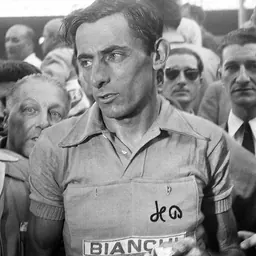
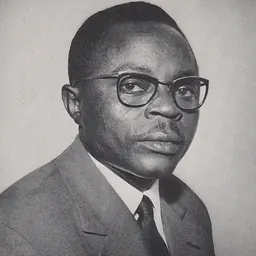
Fausto Coppi In December 1959, Burkina Faso was celebrating its first year of independence. Until then it had been the French colony of Haute Volta. The president, Maurice Yaméogo invited Fausto Coppi, Géminiani, Anquetil, Bobet, Roger Hassenforder and Henry Anglade to ride against local riders and then go hunting. Géminiani remembered:
Both caught malaria and fell ill when they got home. Géminiani said: "My temperature got to 41.6... I was delirious and I couldn't stop talking. I imagined or maybe saw people all round but I didn't recognise anyone. The doctor treated me for hepatitis, then for yellow fever, finally for typhoid."
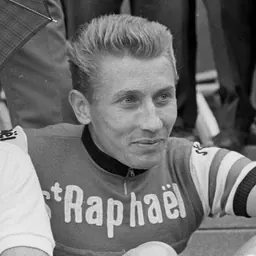
Jacques Anquetil Géminiani's management career reached its height in the St-Raphaël and Ford-France teams with Jacques Anquetil. As a partnership they won four Tours de France, two Giro d'Italia, the Dauphiné-Libéré and then next day, Bordeaux–Paris.
Today, everybody pays him homage. I nearly blow my top. I can still hear the way he was whistled when he rode. I think of the organisers of the Tour, who shortened the time trial to make him lose. His home town of Rouen organises commemorations but, me, I haven't forgotten that it was in Antwerp that he made his farewell appearance. More than once, I saw him crying in his hotel room after suffering the spitting and insults of spectators. People said he was cold, a calculator, a dilettante. The truth is that Jacques was a monster of courage. In the mountains, he suffered as though he was damned. He wasn't a climber. But with bluffing, with guts, he tore them to shreds (il les a tous couillonnés).
There are rumours that the jet laid on to get Anquetil to Bordeaux was provided through state funds on the orders of President Charles de Gaulle. Géminiani mentions the belief in his biography, without denying it, saying the truth will come out when French state records are opened to scrutiny. The team ended after seven years but Bic continued to sponsor an amateur team in the Val d'Oise.
In 1985, Géminiani became directeur sportif of the La Redoute team and was behind Stephen Roche's third place in the 1985 Tour de France. He told Roche to attack on the 18th stage when he first saw the route of that year's Tour. At the end of that year the La Redoute retired from the sport. Roche took Géminiani to his new team . In 1986 Géminiani was manager of Café de Colombia.
R. Géminiani bicycles Géminiani followed other prominent riders in licensing his name for a range of bicycles. He made himself a sponsor of his teams. There is uncertainty whether the frames were made by Mercier or another company in Saint-Étienne, Cizeron. It is possible that both made them.
Sheldon Brown said of them: "A major bike of the French glory years. Many were rather unexciting, but be on the lookout for high-end examples from the early 60s with French component exotica. In prime (less than 57) sizes in nice condition top-end models with the right stuff could be worth $1,500 or more. The pedestrian models perhaps a few hundred at best. French bikes from the 50s and 60s are tricky stuff to understand and price.
Views on the modern Tour He believed the Tour should return to national teams.
Doping Géminiani was outspoken about doping in cycling. He said in 1962:
After the death of Tom Simpson during the Tour de France of 1967, when drugs were found in his body and the pockets of his race jersey, he criticised the doctor:
Career achievements
1943
1946 1st Ambert 1949 1st Circuit des villes d'eaux d'Auvergne 1st Tour de Corrèze 1st Stage 19 Tour de France 1950 1st GP de Marmignolles 1st Polymultipliée 4th Overall Tour de France 1st Stages 17 & 19 1951 1st Overall Grand Prix du Midi Libre 1st Polymultipliée 2nd Overall Tour de France
1st Stage 9 1952 Tour de France 1st Stages 8 & 17 9th Overall Giro d'Italia
1953
9th Overall Tour de France: 1955 3rd Overall Vuelta a España 4th Overall Giro d'Italia 6th Overall Tour de France 1st Stage 9 1956 1st Abidjan 1st Bol d'Or des Monédières Chaumeil 1957 1st Bol d'Or des Monédières Chaumeil 1st Quilan 1st Tulle 5th Overall Giro d'Italia
5th Overall Vuelta a España 1958 1st Bol d'Or des Monédières Chaumeil 1st Thiviers 1st Tulle 3rd Overall Tour de France 8th Overall Giro d'Italia 1959 1st GP d'Alger Vuelta a España 1st Stages 1a (TTT) & 13 (TTT)
Don’t just read it —
keep it.
Full-length biographies made to live with: read them, listen on the way to work, watch them tonight.
- E-book
- Audio
- Video
Instant download · yours to keep · every purchase keeps this site free
Important facts
People in Raphaël Géminiani's life
Named in this biography and alive at the same time



Related people
Same field, nearest in time



Contemporaries
People whose lives overlapped Raphaël Géminiani's



Frequently asked questions
Who was Raphaël Géminiani?
French racing cyclist (1925–2024)
When was Raphaël Géminiani born?
Raphaël Géminiani was born on 12 June 1925 in Clermont-Ferrand.
When did Raphaël Géminiani die?
Raphaël Géminiani died on 5 July 2024 in Pérignat-sur-Allier, Pont-du-Château.
What was Raphaël Géminiani's occupation?
Raphaël Géminiani was a sport cyclist and sporting director.
What nationality was Raphaël Géminiani?
Raphaël Géminiani was French.
Sources & further reading
· Wikipedia: Raphaël Géminiani
Cite this page
APA: Biography.guide. (2026). Raphaël Géminiani. https://biography.guide/raphael-geminiani/
MLA: "Raphaël Géminiani." Biography.guide, https://biography.guide/raphael-geminiani/.
Chicago: "Raphaël Géminiani." Biography.guide. https://biography.guide/raphael-geminiani/.
Data last updated: 2026-09-21 · Spot an error? Report a correction.
Portrait: Wikimedia Commons · author & licence
Page generated 2026-09-27 05:00 UTC