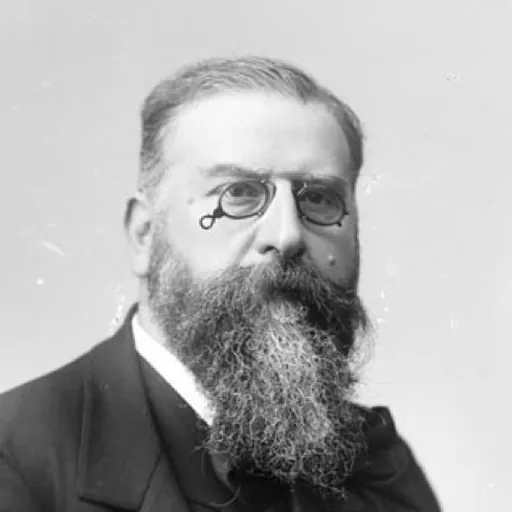
Raoul de Pugno
French composer, teacher, organist, and pianist
About Raoul de Pugno
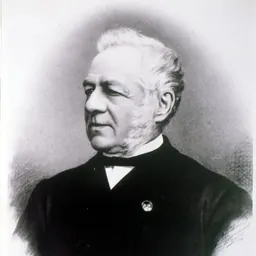
Lived 1852 – 1914 (aged 61). Raoul de Pugno was a French composer, pianist, music educator, organist, choir director and musician.
Stéphane Raoul Pugno (23 June 1852 – ) was a French composer, teacher, organist, and pianist known for his playing of Mozart's works.
Biography Raoul Pugno was born in Paris and was of Italian origin. He made his debut at the age of six, and with the help of Prince Poniatowski he was then able to study at the École Niedermeyer. He then went to the Paris Conservatoire at age 14, where he shone. He won First Prize in Piano in 1866 (his teacher being Georges Mathias, a pupil of Frédéric Chopin), First Prize in Harmony and First Medal for solfège in 1867 (his composition teacher being Ambroise Thomas), and First Prize in Organ in 1869 (his teacher was François Benoist). He was appointed Director of Music at the Opéra by the Paris Commune of March–May 1871. At the grand re-opening of the Opéra, two of his works were performed.
He was organist at the Church of Saint-Eugène, 1872–92, chorus master at the Théâtre Ventador in 1874, and Professor of Harmony at the Conservatoire 1892–96 and Professor of Piano 1896–1901.
He remained a pedagogue until 1893, when he was over 40. One of his notable pupils was Léo-Pol Morin. He then decided to resume his career as a concert pianist, commencing with the Piano Concerto in A minor by Edvard Grieg. At a small-scale performance of Richard Wagner's Das Rheingold in 1893, Pugno and Claude Debussy provided an accompaniment on two pianos. He had a brilliant career, travelling throughout Europe and to the United States, where American composer Marion Bauer acted as guide and translator for Pugno and his family.
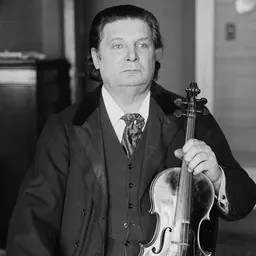
His specialty was the solo piano works and piano concertos of Wolfgang Amadeus Mozart. Pugno was also a fine interpreter of the piano works of Chopin and César Franck. He was also renowned for his appearances with the violinist Eugène Ysaÿe, with whom he worked from 1896, giving performances of works by Gabriel Fauré, Camille Saint-Saëns, and Ernest Chausson. The duo also gave the premiere performances of violin sonatas by Albéric Magnard and Louis Vierne. He also appeared with the violinist Leopold Auer.
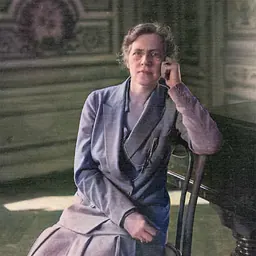
He spent his summers at his home in Gargenville where he taught and entertained, often playing concertos and works for two pianos with Saint-Saëns and the young Nadia Boulanger. He died in 1914 in Moscow, while on a concert tour of Russia. His compositions are no longer in the repertoire, but his legacy lives on through his students.
Selected works
Poster for the operetta , by Louis-Maurice Boutet de Monvel, from series, printed by Eugene Marx, Paris, c. 1891
La Resurrection de Lazare, oratorio (1879) La Fée Cocotte, féerie Les Papillons, ballet (London, 1881) Ninetta, opéra-comique (1882) Le Sosie, opéra-bouffe (1887) Le Valet de coeur, opéra-comique (1888) Le Retour d'Ulysse, opera (1889) La Vocation de Marius, opera (1890) La Petite Poucette, opera (1891) Melusine, opera La Danseuse de corde, pantomime (1892) Pour le drapeau, mimodrame (1895) Le Chevalier aux fleurs, Ballet (1897, with André Messager) La ville morte (Gabriele d'Annunzio), opera, with Nadia Boulanger songs piano pieces
Recordings Pugno was the first internationally renowned pianist to make recordings. In 1903 he recorded pieces by George Frideric Handel, Domenico Scarlatti and Chopin and one of his own compositions, an Impromptu Valse. In a Chopin waltz, Pugno displays his famous jeu de perle technique. His other Chopin recordings include the Impromptu in A flat, Op. 29, Berceuse, Op. 57, Waltz in A flat, Op. 34 No. 1, and the Marche funèbre from the Sonata in B flat minor. Pugno's most important recording however, is that of Chopin's Nocturne in F sharp, Op. 15, No. 2, in which he plays the piece noticeably slower than the norm, a practice bequeathed to him by his teacher Georges Mathias, himself a student of Chopin. His most extended recording is that of Franz Liszt's Hungarian Rhapsody No. 11. It is impetuous and exciting, and has Pugno pushing himself to the extremes of his abilities without any loss of control.
Legendary Piano Recordings: The Complete Grieg, Saint-Saëns, Pugno, and Diémer (Marston Records) (the sound is distorted because the record was cut on a defective turntable with fluctuating speed).
Don’t just read it —
keep it.
Full-length biographies made to live with: read them, listen on the way to work, watch them tonight.
- E-book
- Audio
- Video
Instant download · yours to keep · every purchase keeps this site free
Important facts
People in Raoul de Pugno's life
Named in this biography and alive at the same time

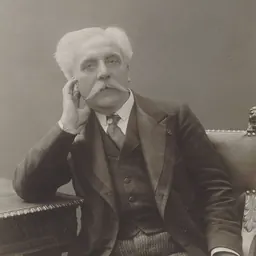

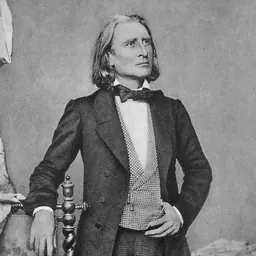

Related people
Same field, nearest in time

Contemporaries
People whose lives overlapped Raoul de Pugno's

Frequently asked questions
Who was Raoul de Pugno?
French composer, teacher, organist, and pianist (1852-1914)
When was Raoul de Pugno born?
Raoul de Pugno was born on 23 June 1852 in Montrouge, Paris.
When did Raoul de Pugno die?
Raoul de Pugno died on 3 January 1914 in Moscow.
What was Raoul de Pugno's occupation?
Raoul de Pugno was a composer, pianist, music educator, organist, choir director and musician.
What nationality was Raoul de Pugno?
Raoul de Pugno was French.
Sources & further reading
Cite this page
APA: Biography.guide. (2026). Raoul de Pugno. https://biography.guide/raoul-de-pugno/
MLA: "Raoul de Pugno." Biography.guide, https://biography.guide/raoul-de-pugno/.
Chicago: "Raoul de Pugno." Biography.guide. https://biography.guide/raoul-de-pugno/.
Data last updated: 2026-09-21 · Spot an error? Report a correction.
Portrait: Wikimedia Commons · author & licence
Page generated 2026-09-27 04:59 UTC