
About Randy Linden
Born 1970. Randy Linden is a Canadian programmer.
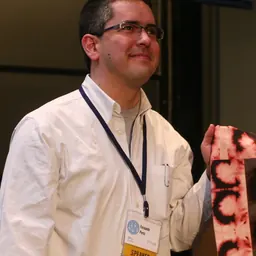
Randal N. Linden (born January 6, 1970) is a Canadian computer programmer known for his intricate work in re-implementing video game titles, as well as for creating emulators. His works include several notable video game re-implementations, approaches to emulation, code recompilation and optimization techniques, and programming practices.
Embarking on programming as a hobby in the early eighties, Linden soon moved into professional development. His early work included developing commercial video game titles and application software for the Commodore 64, Commodore 128, and Amiga. In 1989, six years into his programming activities, he created a version of Dragon's Lair for the Amiga. This was notable for being the first video game to feature full-screen animation and audio streaming from floppy disks on a home computer. offering students the opportunity to schedule time with the machine for the purpose of programming education. It was during that time that he wrote his first 6502 assembly program. The same year marked Linden's entry into game development, when he created a video game called Barriers for the Commodore PET, Given this context, the development of the Amiga version of Dragon's Lair necessitated that Linden capture and digitize all of the animation sequences found in the LaserDisc media of the arcade version. To that end, he employed a digitizer from SunRize Industries. After contacting them to discuss his project, SunRize Industries supplied Linden with a prototype
WCS memory reuse technique Dragon's Lair for Amiga also introduced a novel technique published by Bethesda Softworks in 1990. This game featured levels not found in Dragon's Lair, along with new content. It featured the capability to pair with the original Dragon's Lair for Amiga video game, enabling the transfer of the game to a hard disk drive for quicker loading times and eliminating the need for floppy disk swapping.
During his tenure at Bethesda Softworks, Linden also worked on porting the PC game Wayne Gretzky Hockey to the NES. all of which were essential for programming on the Super FX chip. This allowed Sculptured Software to move forward with the development of Dirt Trax FX.
Doom for the Super NES Linden's inspiration to bring the technically demanding PC game Doom to the Super NES came following his experience at the previously mentioned Nintendo developer conference. This experience solidified his belief in the practicality of using the Super FX chip to develop a Super NES version of the game. a specialized game engine developed ad-hoc by Linden in 65816 and Super FX assembly.
"DOOM-FX," as it came to be known, is often referred to as an "impossible port" (although, for the reason mentioned above, Doom for the Super NES does not constitute a port in its technical sense, over time, the everyday use of this term has become broader); the Super NES, even with the enhancement provided by the second-generation Super FX co-processor – a 21.4 MHz RISC chip – still fell significantly short of the PC version's recommended requirements, which were a 80486 processor, 4MB of RAM, and a VGA graphics card.
In North America, the Super NES version of Doom was released on September 1, 1995, published by Williams Entertainment. Ocean Software published the game in Europe, where it was released on October 26, 1995. In Japan, the game was brought to market by Imagineer and released on March 1, 1996.
More than twenty years later, Linden expressed in an interview his enthusiasm for undertaking projects such as the version of Doom for the Super NES, a reflection of his career-long trend. While he did not mention the title specifically, he emphasized his fondness for engaging in technical projects widely regarded as insurmountable, stating that he "[likes] technical projects and programming challenges that people think are impossible to accomplish."
Source code publication In 2020, Linden made public the source code for the original Super NES version of Doom, together with related development tools in binary form.
Enhanced version On August 8, 2024, Limited Run Games announced a new and enhanced version of Doom for the Super NES, set to be released in physical form. Nearly 30 years after the original Super NES version was released, Linden, now employed at Limited Run Games, returned to develop this upgraded edition. The enhanced version featured all four episodes of Doom, including "Thy Flesh Consumed," which was originally introduced in 1995 as part of the updated PC release "The Ultimate Doom," as well as the levels that were absent from the original Super NES release, which had only 22 levels, compared to 27 in the PC version. The enhanced Super NES version, now utilizing an improved, custom Super FX-compatible chip, introduced support for circle-strafe, performance improvements, monster respawning on "Nightmare" difficulty level, translucent rendering of the "Spectre" demon, level codes, a game music player accessible through the menu, and rumble support via a specialized, new game controller. The updated Super NES version of Doom was scheduled for release in 2025.
bleem! and bleemcast!
bleem! In 1998, motivated by the vast array of quality titles available for the PlayStation and the ability to browse the contents of PlayStation game discs on a PC unhindered, Linden set his sights on creating a PlayStation emulator for Microsoft Windows. After acquiring a reference manual for the MIPS architecture, which the PlayStation utilized, at a bookstore, he embarked on studying the system. The emulator, titled "bleem!," was developed over the course of about a year,
Linden began developing bleem! by studying and implementing emulation for the MIPS processor instructions one at a time, focusing on those essential to each specific PlayStation title he was testing. He implemented support for opcodes – such as addition, comparison, and subtraction – in the order they appeared, eventually covering most of the processor's instruction set. With support for most of the CPU instructions completed, he turned his attention to studying the way in which PlayStation titles handled graphics. He designed the emulator to intercept memory writes tied to graphics rendering and transform them into polygons for subsequent display on a PC. This approach essentially leveraged the enhanced graphics capabilities of PCs to produce higher-resolution output, while remaining transparent to the video games in question, during their playback on bleem!. these specifications were subsequently revised slightly upward. In a 1999 interview with IGN, David Herpolsheimer, Linden's partner on bleem!, mentioned that Linden programmed bleem! on a system powered by a 200 MHz Intel Pentium MMX processor, aiming to push the compatibility of the emulator to the lowest possible hardware specifications through first-hand experience. followed by "bleemcast! for Metal Gear Solid", and "bleemcast! for Tekken 3" on October 30 and 31, 2001, respectively.
Prototype of Quake for the Game Boy Advance In 2002, Linden began creating a prototype of a version of the video game Quake for the Game Boy Advance. Similar to his approach with the Super NES version of Doom, he created this prototype as a technical demonstration aimed at attracting video game publishers. The demonstration featured the game's first level, known as "E1M1," and consisted of approximately 200,000 lines of ARM7 assembly code. Unable to secure a publisher, Linden shifted focus to improving the demo's underlying engine technology. Designed once again to attract video game publishers, the upgraded version of the engine featured enhanced animations, point lighting effects, advancements in camera usage and improvements to underwater segment management.
Some twenty years later, in 2022, Linden stumbled upon his work on a Quake prototype for Game Boy Advance on a flash drive, leading to its subsequent coverage in video game media.
Employment at Microsoft In 2007, Linden was approached by two distinct groups at Microsoft, and chose to join the Developer Tools group as team lead. While at Microsoft, he took part in the engineering efforts behind several products, including the Xbox 360, Kinect, and Microsoft Band.
R&R Digital
Cyboid Employing an enhanced version of the engine initially created for the Quake for the Game Boy Advance prototype, Linden released a Symbian version of Cyboid, a first-person shooter inspired by Quake II, in 2006.
Subsequently, upon the discontinuation of Microsoft Band in 2016, Linden, who had spent nearly a decade working at Microsoft, left the company. He then established R&R Digital, which released Cyboid for Amazon Fire on October 25, 2016, followed by an Android release on March 25, 2017.
Present day Presently, Linden is employed at Limited Run Games, focusing on the Carbon Engine. Often serving as the technical backbone for Limited Run Games titles, the Carbon Engine encompasses a range of video game console emulators, frequently integrated with enhanced iterations of original video games, aimed at enriching the original gameplay experience.
Personal life In the nineties, Linden served as a volunteer firefighter, initially in Gaithersburg, Maryland, and then in San Diego, California. After a period of volunteering, he was hired as a professional firefighter at the Crest/East County Fire Protection District in San Diego, California.
A native of Toronto, Ontario, Canada, Linden is presently based in Seattle, Washington.
Don’t just read it —
keep it.
Full-length biographies made to live with: read them, listen on the way to work, watch them tonight.
- E-book
- Audio
- Video
Instant download · yours to keep · every purchase keeps this site free
Important facts
People in Randy Linden's life
Named in this biography and alive at the same time


Related people
Same field, nearest in time




Contemporaries
People whose lives overlapped Randy Linden's






Frequently asked questions
Who is Randy Linden?
Canadian software developer (born 1970)
When was Randy Linden born?
Randy Linden was born on 6 January 1970 in Toronto.
What is Randy Linden's occupation?
Randy Linden is a programmer.
What nationality is Randy Linden?
Randy Linden is Canadian.
Sources & further reading
Cite this page
APA: Biography.guide. (2026). Randy Linden. https://biography.guide/randy-linden/
MLA: "Randy Linden." Biography.guide, https://biography.guide/randy-linden/.
Chicago: "Randy Linden." Biography.guide. https://biography.guide/randy-linden/.
Data last updated: 2026-09-20 · Spot an error? Report a correction.
Page generated 2026-09-27 05:02 UTC