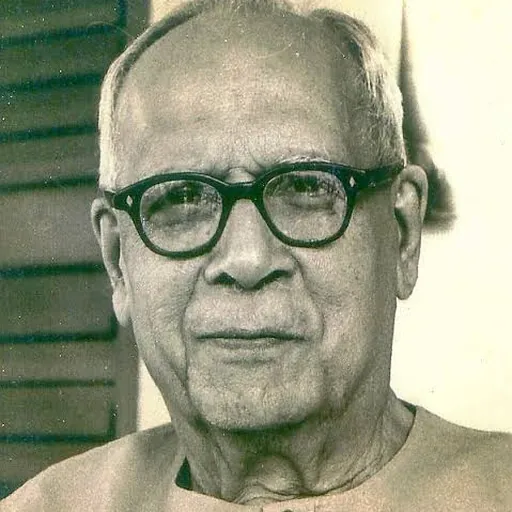
Ramesh Chandra Majumdar
Indian historian and academic
About Ramesh Chandra Majumdar
Lived 1888 – 1980 (aged 91). Ramesh Chandra Majumdar was an Indian historian, university teacher and writer.
Ramesh Chandra Majumdar (known as R. C. Majumdar; 4 December 1888 – 11 February 1980) was an Indian historian and professor, who principally studied the history of India. He is regarded as belonging to the nationalist school of Indian historiography. In 1921, he became a professor of history at the newly established University of Dacca. He also served, until he became its vice chancellor, as the head of the Department of History and the Dean of the Faculty of Arts. Between 1924 and 1936, he was Provost of Jagannath Hall. Then he became the vice chancellor of the university for five years, from 1937 to 1942.
From 1950, he was Principal of the College of Indology, Benares Hindu University. In 1955, Majumdar established the College of Indology of Nagpur University and joined as Principal. In 1958–59, he taught Indian history at the University of Chicago and the University of Pennsylvania. He was also the president of the Asiatic Society (1966–68) and the Bangiya Sahitya Parishad (1968–69), and also the Sheriff of Calcutta (1967–68).
Majumdar was elected the General President of the Indian History Congress and also became the vice president of the 'International Commission for a History of the Scientific and Cultural Development of Mankind' (1950–1969) set up by the UNESCO for the history of mankind.
Contributions Majumdar started his research on ancient India. After extensive travels to Southeast Asia and research, he wrote detailed histories of Champa (1927), Suvarnadvipa (1938) and Kambuja Desa (1944). On the initiative of Bharatiya Vidya Bhavan, he took up the mantle of editing a multi-volume tome on Indian history. Starting in 1951, he toiled for twenty-six long years to describe the history of the Indian people from the Vedic Period until the Independence of India in eleven volumes.
When the final volume of The History and Culture of the Indian People (HCIP) was published in 1977, he had turned eighty-eight. He also edited the three-volume history of Bengal published by Dacca University. His last book was "Jivaner Smritidvipe".
The proposal to write on "Freedom movement" with government sponsorship was put forth in 1948 by R. C. Majumdar. In 1952 the ministry of education appointed a Board of Editors for the compilation of the History. Majumdar was appointed by the Board as the Director and entrusted with the work of sifting and collecting materials and preparing the draft of the history. However, the Board as consisting of politicians and scholars, was least likely to function harmoniously. Perhaps this was the reason why it was dissolved at the end of 1955. The scheme remained in balance for a year until the government decided to transfer the work on to a single scholar. To the disappointment of Majumdar the choice of the ministry of education fell on one Tara Chand, a historian but also an ex-secretary of the Ministry of Education. Majumdar then decided to write independently The History of the Freedom Movement in India in three volumes.
He also wrote articles for Rashtriya Swayamsevak Sangh (RSS) publication Organiser, but refused to do so after it published pseudo-historical claims about supposed Hindu antecedents of Red Fort and Taj Mahal. Majumdar also declined to agree with K. M. Munshi's theory of an Aryan homeland in India,
Majumdar was in turn highly critical of the secularist historiography that came into prominence after Indian independence. He termed it a "conscious attempt to rewrite the whole chapter of bigotry and intolerance of the Muslim ruleres towards Hindu religion". He saw the secularist historians repudiating that Muslim rulers ever broke any Hindu temple, and claiming that they were most tolerant in matters of religion. They exonerated Mahmud of Ghazni's bigotry and fanaticism, and several of them even defended Aurangzeb against Jadunath Sarkar's charge of religious intolerance.
Works Corporate Life in Ancient India, Surendra Nath Sen, Calcutta. 1918 The Early History of Bengal, Dacca, 1924. Champa, Ancient Indian Colonies in the Far East, Vol.I, Lahore, 1927. . Outline of Ancient Indian History. 1927 Arab Invasion of India 1931. Suvarnadvipa, Ancient Indian Colonies in the Far East, Vol.II, Calcutta, 1938. The History of Bengal, 1943. . Kambuja Desa Or An Ancient Hindu Colony In Cambodia, Madras, 1944. An Advanced History of India. London, 1960. . (Part 1 Online) (Part 2) The History and Culture of the Indian People, Bombay, 1951–1977 (in eleven volumes). Ancient India, 1977. . History of the Freedom movement in India (in three volumes), Calcutta. Vakataka – Gupta Age Circa 200–550 A.D.. Main currents of Indian history. Hindu Colonies in the Far East, Calcutta, 1944. Classical Accounts of India, 1960. Ideas of History in Sanskrit Literature Oxford University Press, 1961. Nationalist Historians, Oxford University Press. 1961. Sepoy Mutiny and Revolt of 1857, 1963. Historiography in Modern India, Asia Publishing House, NY 1970. India and South-East Asia, I.S.P.Q.S. History and Archaeology Series Vol. 6, 1979. The History of Ancient Lakshadweep, Calcutta, 1979.
Don’t just read it —
keep it.
Full-length biographies made to live with: read them, listen on the way to work, watch them tonight.
- E-book
- Audio
- Video
Instant download · yours to keep · every purchase keeps this site free
Important facts
People in Ramesh Chandra Majumdar's life
Named in this biography and alive at the same time




Related people
Same field, nearest in time

Contemporaries
People whose lives overlapped Ramesh Chandra Majumdar's




Frequently asked questions
Who was Ramesh Chandra Majumdar?
Indian historian and academic (1888–1980)
When was Ramesh Chandra Majumdar born?
Ramesh Chandra Majumdar was born on 4 December 1888 in Faridpur District.
When did Ramesh Chandra Majumdar die?
Ramesh Chandra Majumdar died on 11 February 1980 in Kolkata.
What was Ramesh Chandra Majumdar's occupation?
Ramesh Chandra Majumdar was a historian, university teacher and writer.
What nationality was Ramesh Chandra Majumdar?
Ramesh Chandra Majumdar was Indian.
Sources & further reading
· Wikipedia: Ramesh Chandra Majumdar
Cite this page
APA: Biography.guide. (2026). Ramesh Chandra Majumdar. https://biography.guide/ramesh-chandra-majumdar-historian/
MLA: "Ramesh Chandra Majumdar." Biography.guide, https://biography.guide/ramesh-chandra-majumdar-historian/.
Chicago: "Ramesh Chandra Majumdar." Biography.guide. https://biography.guide/ramesh-chandra-majumdar-historian/.
Data last updated: 2026-09-21 · Spot an error? Report a correction.
Portrait: Wikimedia Commons · author & licence
Page generated 2026-09-27 05:00 UTC