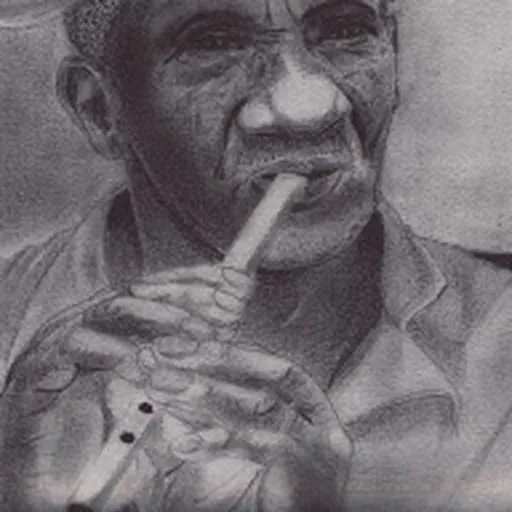
Rakoto Frah
Flautist and composer of traditional music of the central highlands of Madagascar.
About Rakoto Frah
Lived 1923 – 2001 (aged 77–78). Rakoto Frah was a composer.
Philibert Rabezoza (1923 – 29 September 2001), better known by the name Rakoto Frah, was a flautist and composer of traditional music of the central highlands of Madagascar. Born in 1923 near the capital city of Antananarivo to a poor rural family, Rakoto Frah surmounted the challenges posed by his underprivileged origins to become the most acclaimed 20th century performer of the sodina flute, one of the oldest traditional instruments on the island. Through frequent international concerts and music festival performances, he promoted the music of the highlands of Madagascar and became one of the most famous Malagasy artists, both within Madagascar and on the world music scene.
After gaining regional recognition for his sodina skills as a youth, Rakoto Frah rose to national fame in 1958 when he was selected by Malagasy President Philibert Tsiranana to perform on the sodina for the visiting French president Charles de Gaulle. This event launched his career as a professional musician. He first played at traditional ceremonies around the country, then expanded his performances from 1967 to include participation in international music competitions and festivals. His popularity declined in the 1970s but underwent a revival that began in the mid-1980s and continued until his death in 2001. During this period Rakoto Frah recorded ten albums, toured extensively in Madagascar and overseas, was featured in two French documentaries, and collaborated with a variety of international and Malagasy artists. Over the course of his career he recorded over 800 original compositions. Rakoto Frah and his sodina were depicted on the 200 ariary Malagasy banknote in honor of his key role in revitalizing and internationally popularizing the sodina. Despite the artist's worldwide acclaim, he lived simply and died having earned little from his lifetime of musicianship. His death was widely mourned and marked by a state funeral, and in 2011 a famadihana (the Malagasy highland "turning of the bones" funerary tradition) was organized to celebrate the artist's life.
Biography
Early years Philibert Rabezoza was born in 1923 His mother was born in Antananarivo Young Rakoto began playing the sodina when he was seven years old. Tsiranana had previously seen the flutist perform and invited Rakoto and his group of 18 musicians to accompany de Gaulle and perform traditional pieces during a portion of the French statesman's walking tour through the capital city of Antananarivo. Following this performance, Rakoto dedicated himself full-time to a career in music, performing regularly at traditional celebrations on the island. At these performances, he was often accompanied by supporting musicians under the group name Orchestre Nationale. The government of President Tsirananana fell into disfavor and was overturned in 1972, and Rakoto Frah's close association with the unpopular former head of state led the artist to be marginalized for the first half of the administration of his successor, Didier Ratsiraka (1975–1993). and among the most recognized Malagasy performers in the world music circuit.
Rakoto Frah released a series of albums and performed internationally throughout the 1990s. The World Out of Time compilation, recorded and produced by David Lindley and Henry Kaiser in 1991, featured him alongside a variety of other performers of the island's diverse musical genres and instruments; two further compilations with Lindley and Kaiser followed in 1993 and 1994. with 30 members of his family. There he produced instruments and provided lessons in sodina performance. and a lung infection.
Rakoto Frah performed traditional vakindrazana and vazikoava pieces for sodina, commonly heard at a variety of holidays and rites observed in the central highlands of Madagascar. The music accompanying the famadihana reburial ceremonies of the central highlands, for instance, is typically performed by an ensemble of sodina players accompanied by the amponga drum. These sodina performances, which express the joy of reuniting with the ancestors, are often competitive. More than one troupe may be present at the famadihana and will take turns showing off their musical skills, with the rapid flight of notes intended to inspire dancing over the course of the entire day or week of the celebration. The rural artistic tradition of the hira gasy is equally joyful but more elaborate, showcasing the music, dance and oratory skills of a large troupe that includes male and female vocalists, drums, sodina, and a variety of orchestral instruments such as clarinets, trumpets and violins.
Although he learned his repertoire by listening to elders perform traditional pieces, Rakoto Frah often performed personalized variations and interpreted the traditional airs in original ways.
Legacy His greatest achievement was without a doubt keeping alive the tradition of this iconic instrument of the Red Island during the colonial period and then revitalizing it after independence. His airy, elegant, spare and extremely pure phrasing made its mark on all the musical styles of the island ... — — "Rakoto Frah", Afrisson (7 May 2007) The artist was also invited by international filmmakers to feature in two French films: the Madagascar documentary L'Ile Rouge released in 1992 by French director Jean-Michel Carré, and an eponymous documentary about the artist himself, produced by director Camille Marchand in 1997. On 28 October 2011 the Ministry of Culture renamed a street in the capital city after him.
In November 2012, several of Rakoto Frah's adult children launched the École Rakoto Frah Junior ("Rakoto Frah Junior School") initiative in November 2012 to continue the artist's work as an educator of sodina performance. The informal cultural school organized lessons in sodina performance for 50 students at the community center in the artist's former neighborhood of Isotry and awarded certificates of completion to 31 graduates on 16 December with plans to continue training further cohorts of sodina players.
Discography
Don’t just read it —
keep it.
Full-length biographies made to live with: read them, listen on the way to work, watch them tonight.
- E-book
- Audio
- Video
Instant download · yours to keep · every purchase keeps this site free
Important facts
People in Rakoto Frah's life
Named in this biography and alive at the same time





Related people
Same field, nearest in time


Contemporaries
People whose lives overlapped Rakoto Frah's





Frequently asked questions
Who was Rakoto Frah?
flautist and composer of traditional music of the central highlands of Madagascar. (1923–2001)
When was Rakoto Frah born?
Rakoto Frah was born in 1923 in Madagascar.
When did Rakoto Frah die?
Rakoto Frah died on 3 October 2001 in Antananarivo.
What was Rakoto Frah's occupation?
Rakoto Frah was a composer.
What nationality was Rakoto Frah?
Rakoto Frah's recorded nationality: Madagascar.
Sources & further reading
Cite this page
APA: Biography.guide. (2026). Rakoto Frah. https://biography.guide/rakoto-frah/
MLA: "Rakoto Frah." Biography.guide, https://biography.guide/rakoto-frah/.
Chicago: "Rakoto Frah." Biography.guide. https://biography.guide/rakoto-frah/.
Data last updated: 2026-09-22 · Spot an error? Report a correction.
Portrait: Wikimedia Commons · author & licence
Page generated 2026-09-27 05:03 UTC