
About Rafael Israelyan
Lived 1908 – 1973 (aged 65). Rafael Israelyan was a Russian and Armenian architect and lecturer.
Rafayel "Rafo" Israyelian (; – 8 September 1973) was a Soviet Armenian architect.
Seen as a follower of Alexander Tamanian, Israyelian then worked at the Yerevan Polytechnic Institute first as a lab technician, then as an assistant, and after 1947, as an associate professor.
Israyelian died on September 8, 1973, aged 65, at his Yerevan home, after a long illness. In the 1960s he revived Tamanian's neo-Armenian style; Israyelian, "while employing the stylistic principles of medieval as well as vernacular Armenian architecture, was able to re-examine its aesthetic through a functional-constructivist prism." Israelyan thus emerged as a leading figure in the reemergence of a national "school" of architecture by the 1970s. As "a politically bold architect of talent", he used his projects "to reassert Armenian traditions of heavy mass, natural stone, small cleancut apertures and bas relief decoration."
He also borrowed from the architecture of Mesopotamia (Sumer, Babylon, and Assyria).
In their 1986 book on Soviet Armenian architecture, Artsvin Grigoryan and Martin Tovmasyan commended Israelyan's work, namely the Victory Monument and the Museum of Armenian Ethnography. They found the monument to be a masterful resolution of complex scaling challenges and praised the choice of black tuff. The museum, in their view, represented one of the most outstanding works of Soviet Armenian architecture, demonstrating a profound understanding of museum design through its innovative use of natural light. They saw this as a groundbreaking reinterpretation of traditional Armenian architectural elements.
Works
Memorials Israyelian created two memorials dedicated to the victims of the Armenian genocide, when its 50th anniversary was commemorated in 1965. The better known monument is located at Mother See of Holy Etchmiadzin and was inaugurated on April 24, 1965. It features several crosses inspired by traditional khachkars and a sword and shield, symbolizing Armenian self-defense efforts during the genocide. The second memorial is located Yerevan's Erebuni District. The latter was sculpted by Ara Harutyunyan.
Israyelian's best-known memorial It is dedicated to the 1918 Battle of Sardarabad, in which the Armenian forces stopped the advantage of Turkish forces towards Yerevan. He also designed memorials dedicated to self-defenses during the Armenian Genocide. The monument to 1915 Defense of Hachn, was erected in Nor Hachn in 1974 and the memorial of Musa Dagh in Musaler in 1976. The latter was sculpted by Ara Harutyunyan. The memorial of the 1918 Battle of Bash-Aparan was erected in Aparan in 1979. The Catholicos often hosted guests at the residency. The reconstruction of Saint John the Baptist church, designed by Israyelian, was completed in the 1980s. The reconstruction works were further developed by Baghdasar Arzoumanian and engineer Avetik Teknejian.
Israyelian designed and co-designed three churches in the Armenian diaspora: Holy Forty Martyrs Church in Milan, Italy (1958), St. Vartan Armenian Cathedral in New York City (1968), and Surp Nerses Shnorhali Cathedral in Montevideo, Uruguay (1968). while the church in Montevideo with Varazdat Harutyunyan. It is based on classical Armenian church architecture, namely Saint Hripsime Church in Ejmiatsin. According to some sources, it was designed by Walker O. Cain, however, the Armenian church publication indicates Israyelian as its architect. Varazdat Harutyunyan noted that Israyelian's design was only modified slightly. According to the website dedicated to Israyelian, it was designed by Israyelian, but because he could not travel to the US, its construction was supervised by Édouard Utudjian.
Monuments Israyelian designed two structures at Victory Park in Yerevan. The first is the pedestal for the statue of Stalin (removed in 1962), which has served as a museum of "Great Patriotic War" (World War II). It was completed in 1950. It is now also the pedestal of the monument Mother Armenia (erected in 1967). In the same year, on a small hill on the road to the temple of Garni, a monument known as Charents Arch was erected. It offers a panoramic view of Mount Ararat. It is often referred to as the "Arch of Ararat". Lines from a Yeghishe Charents poem glorifying the mountain are inscribed into the monument.
Other buildings Israyelian designed a number of structures and buildings for civic use. They include the Ararat Wine Factory in Yerevan (1937–1961); the building of the Union of Artists of Armenia in Yerevan (1955–56); A street in Yerevan was named after him.
In mid-2000s Israyelian's son Vahagn proposed to turn the second floor of Israyelian's house at 9 Saryan St. in Yerevan into a house-museum. The house, designed and built by himself, was demolished in October 2011 to make way for a hotel. The Municipality of Yerevan stated that Israyelian's son, Vahagn, had sold the house earlier and gave formal permission to demolish it.
As of 2025, there is no memorial honoring Israyelian, although it was discussed in 2020. His archives have been donated to the National Museum and Institute of Architecture.
Awards Israyelian was awarded: Honored worker of art of the Armenian SSR (1961) Honored Architect of Armenian SSR (1968) People's Architect of the USSR (1970) Military awards
Don’t just read it —
keep it.
Full-length biographies made to live with: read them, listen on the way to work, watch them tonight.
- E-book
- Audio
- Video
Instant download · yours to keep · every purchase keeps this site free
Important facts
People in Rafael Israelyan's life
Named in this biography and alive at the same time


Related people
Same field, nearest in time
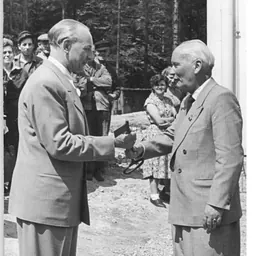
Contemporaries
People whose lives overlapped Rafael Israelyan's



Frequently asked questions
Who was Rafael Israelyan?
Armenian architect (1908–1973)
When was Rafael Israelyan born?
Rafael Israelyan was born on 4 September 1908 in Tbilisi.
When did Rafael Israelyan die?
Rafael Israelyan died on 8 September 1973 in Yerevan.
What was Rafael Israelyan's occupation?
Rafael Israelyan was an architect and lecturer.
What nationality was Rafael Israelyan?
Rafael Israelyan was Russian and Armenian.
Sources & further reading
Cite this page
APA: Biography.guide. (2026). Rafael Israelyan. https://biography.guide/rafael-israelyan/
MLA: "Rafael Israelyan." Biography.guide, https://biography.guide/rafael-israelyan/.
Chicago: "Rafael Israelyan." Biography.guide. https://biography.guide/rafael-israelyan/.
Data last updated: 2026-09-22 · Spot an error? Report a correction.
Page generated 2026-09-27 05:24 UTC