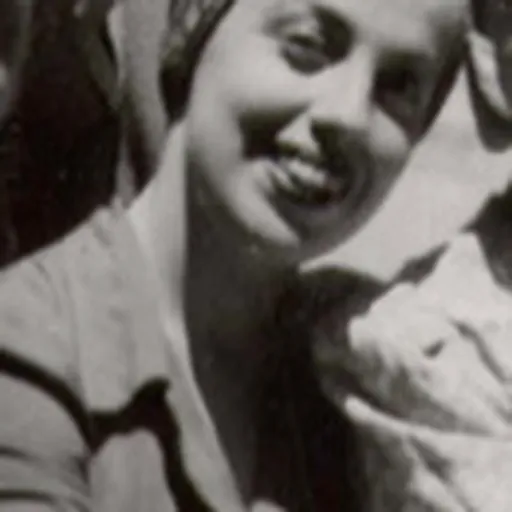
About Rachel Cameron
Lived 1924 – 2011 (aged 86). Rachel Cameron was an Australian ballet dancer and teacher.
Rachel Cameron (27 March 1924—6 March 2011) was an Australian ballet dancer and teacher. She was one of the leading dancers in early Australian ballet in the 1940s, performing with the Borovansky and Kirsova ballet companies, and was one of the first ballet dancers in Australia to reach the rank of principal. After emigrating to Great Britain she was an inspirational educator of ballet teachers at the Royal Academy of Dance in London for over forty years. In 2010, she received the Royal Academy of Dance's prestigious Queen Elizabeth II Coronation Award in recognition of her outstanding services to ballet.
Early life
Rachel Cameron was born in Brisbane, Queensland, [Australia, on 27 March 1924. She spent her very early years in the coastal city of Townsville in north-eastern Queensland. She was severely ill as a child and was bored with the enforced regimen of rest imposed on her, but her parents noticed her love of movement and sent her to eurhythmics classes. She later reported that a passerby saw her dancing among some flowers and suggested that she take dance classes. She was enthusiastic about the idea and insisted in taking part when her school offered her dance lessons.
At this time Cameron, while only just five years old, saw the Russian prima ballerina Anna Pavlova, formerly of the Imperial Russian Ballet and the Ballets Russes of Sergei Diaghilev, dance in Townsville on her final Australian tour in 1929.
Following her father's transfer to another bank branch, the family moved from Townsville to Sydney in about 1930, and it was in Sydney at the age of 10 that Cameron saw the legendary ballerina of the Paris Opera in the 1920s, Olga Spessivtseva, dance during her truncated tour of Australia with the Dandré-Levitoff Russian Ballet.
Enchanted with the world of dance, in Sydney Cameron was able to pursue further dance lessons with Muriel Sievers. This English system was the foundation of Cameron's formal ballet training. The studio filled the enormous first floor of Roma House in Elizabeth Street, above a shop selling devotional artefacts. Xenia Borovansky, a ballerina of the Moscow school, was the principal teacher. In starting their school the couple "embarked on an enterprise that permeated the subsequent history of ballet in Australia". The fees were not cheap; a single class was five shillings, though a commitment to taking more than one class in a week occasioned a reduction. In a short period of time, Borovansky's students were ready for their first joint public performance, though they were not viewed as necessarily that impressive. It has been reported that at this time Borovansky "had about a dozen girls who could dance reasonably well and about half a dozen boys, most of whom couldn't dance at all". Cameron and other senior pupils travelled to Sydney with the Borovanskys and continued with their classes while making appearances with the Russian Ballet. As well as public performances, work also began on preparing a first full-scale ballet, Autumn Leaves, and other works like Vltava, Pas Classique and L'Amour Ridicule.
Cameron, fast developing her powers, was now one of Borovansky's leading dancers and considered to be highly promising. She was "highly sensitive, lyrical and musical", though it was also said her line was "a little short for a truly classical dancer". in search of funds and without Borovansky's permission, she performed with a fellow student for a fee at the Melbourne University Bal Masque. They appeared as "Rachel Cameron and Laurie Rentoul: Danse Espagnol".
Cameron attended her "technically demanding" classes which had a great emphasis on turns, beats and jumps and on "speed, footwork and brain" The classes were mentally and physically demanding. Kirsova soon discovered that in Cameron she had a supreme technician whose lyrical talent she was able to extend. She also recognised that her new protégée had teaching skills and quickly encouraged her to develop them at the school. But, outstandingly, Kirsova's leading Australian dancer at the beginnings of the company and remaining with utmost loyalty to its end, was Rachel Cameron.
The Kirsova Ballet began, as had Borovansky's, with a series of performances in aid of charity, but in November 1941 Kirsova was able to present her first major season of six weeks at the Minerva Theatre in Kings Cross, Sydney. The dancers, including Cameron, were paid trade union rates for the first time and Kirsova paid their dues to Actors Equity of Australia, which registered them as professional performers. partnered by Henry Legerton, in Les Sylphides. Les Sylphides and Faust, with Cameron featured again, appeared once more when the Kirsova Ballet moved to Melbourne for a season at His Majesty's Theatre on 31 January 1942. Cameron's "sensitivity and musicality" in Faust "staggered critics and proved false immediately the popular theory that the Australian temperament is not capable of dramatic depths".
Rachel Cameron and Henry Legerton in the Kirsova Ballet Les Sylphides, Max Dupain Studio, Sydney, between 1941 and 1944. Photographer Max Dupain
Cameron was now one of Kirsova's leading dancers, and she was to stay with the company until October 1945, performing seasons in Sydney and tours to Melbourne, Adelaide and Brisbane. The company's ever–widening repertoire over the years included several original Kirsova works, such as Revolution of the Umbrellas, Harlequin, and Jeunesse together with a choice of the classics, like Swan Lake, Les Sylphides and Aurora's Wedding. In all, there were 14 ballets in the Kirsova Ballet repertoire. Another Kirsova creation, Harlequin, based on Maurice Ravel's Rapsodie espagnole, showed Cameron as "a dancer possessing intense musicality and poetic understanding - an artist as well as a dancer", Kirsova was so pleased with all of her enthusiastic performers that she would have taken the company overseas if there had been no wartime restrictions. She remarked to Cameron that "if she could take us to Europe we would cause a sensation".
Australian dance writer and archivist, Michelle Potter, has written that Cameron's "happiest days as a dancer were with Kirsova". She reports that Cameron recalled of Kirsova: "She was a woman who tried to mould her company in the Diaghilev tradition where music, the scenery, the dancers became part of one whole, and there it was I think that the true beginnings of Australian ballet lie." In 1946 the Society formed its first company. The producer was Philippe Perrottet, a close friend of Cameron who had been a student with her at the Borovansky studio but had been fired in a typical Borovansky rage shortly before Cameron's ejection, Cameron joined him as assistant producer and she and Perrottet and four other dancers were the sole performers of the pocket–sized company. They had a permanent coach in Kira Abricossova. "She gave good classes, but difficult ones," said Cameron. "Discipline with her — as with Kirsova and with Borovansky, who was known as a tyrant — was very severe." A tour of the state of Victoria in August 1946 was followed by visits to Sydney and Melbourne in September, November and December that year. Financial difficulties then overtook the troupe and it was forced to disband at the beginning of 1947.
National Theatre Movement In September 1947, in a short season in Melbourne, Cameron appeared as a guest solo artist with the National Theatre Movement ballet group in a new Australian ballet Euroka, based on aboriginal mythology, and in a number of other popular ballets. "Rachel Cameron," enthused the dance critic of The Age, "displayed thrilling technique in Perpetuum … and set a welcome standard in the divertissements, which included the charming Gigue."
Ballet Rambert Also in September 1947, Cameron was among a number of leading Australian dancers invited to supplement the British dance company Ballet Rambert on their Australasian tour from 1947 to 1949. Led by its founder and director, the Polish-born Marie Rambert, the extensive tour included a great variety of work, both classical and modern.
The impact of the tour on the Australian public, used to the large–scale Russian style but now presented with smaller works — art rather than spectacle — was immediate: the company was received with "feverish acclaim" and the public were delighted to recognise some of their home–grown ballet stars, like Cameron, amongst the visiting company. An initial six–month tour was extended to 15 months and Rambert sent home twice for more ballets to cope with the enthusiastic demand.
From October 1947 to May 1948, the company visited the Princess Theatre in Melbourne, the Crystal Theatre in Broken Hill in New South Wales (for a brief 3–day season) and the New Tivoli Theatre in Sydney, and then from May to July 1948 in New Zealand where they performed at St. James Theatre in Auckland, St. James Theatre in Wellington and then His Majesty's Theatre in Dunedin.
Throughout the Australian and New Zealand legs of the tour Cameron danced in the popular classics, Giselle and Les Sylphides, with choreography by Michel Fokine, and in Gustav Holst's The Planets, with contemporary choreography by Antony Tudor. All three premiered in Melbourne in October and November 1947.
London remained Cameron's home for the rest of her life. In 1948, however, Cameron, in common with the many Australian dancers who emigrated to Britain in the years after the Second World War, found a grim postwar environment and limited opportunities to perform. She also came to see that she should have left Australia earlier. "English ballet had developed rapidly after the war, but I realised that I was too late," she recalled. "Although I received the highest compliments, from Ninette de Valois among others, no-one wanted to take me. I was an Australian, and the English companies wanted English dancers." The show featured a fifteen–minute ballet at the close, choreographed by Robert Helpmann and performed in the London West End theatre version by the Ballets Russes de Monte Carlo. A theatre critic in Manchester described the ballet as "mediocre", though in Birmingham it was considered "an exquisite spectacle".
Studying in Paris, France After leaving Song of Norway, although she had severely limited funds, Cameron travelled to Paris to study for a time with the former Ballets Russes ballerina Lyubov Yegorova and with Olga Preobrajenska, formerly of the Russian Imperial Ballet, and one of the most prominent ballet teachers in Paris. Preobrajenska, seeing how poor Cameron was, offered to give her every second class free. "She taught me so much, paying especial attention to style," remembered Cameron. one of several small touring ballet companies "all vying for a living and living a hand–to–mouth existence". The Continental Ballet had been founded in 1945 (as the Empire Ballet) by Molly Lake, a British ballerina and pupil of Serafina Astafieva and Enrico Cecchetti, and who had danced in the companies of Pavlova and Markova–Dolin. Her ballet group toured around many of the smaller theatres in Britain with herself as choreographer and her husband Travis Kemp being the main leads, and a group of about nine other leading dancers and a corps de ballet. In the early 1950s Cameron became one of the leading dancers in the company and toured regularly with them for two years or so, being particularly noticed as one of the Ugly Sisters in a full–length production of Cinderella.
Ballet demonstrator Cameron stated that one of the most exciting periods of her life came when she was asked to demonstrate for two great teachers and former ballerinas, Lydia Sokolova and Tamara Karsavina. Sokolova was looking for a dancer to demonstrate the steps she would be describing in a forthcoming lecture for the British Society of Ballet Teachers. She invited Cameron to take on the task. "She was wonderful to work for," Cameron told an interviewer in 2005, Around the time Cameron joined him he was principal dancer and choreographer at London's Windmill Theatre, staging over 150 shows, and creating the revue theatre's famous fan dances, but he was simultaneously developing a strong teaching career at the Royal Ballet School and at the Royal Academy of Dance (the RAD), where he eventually became Director of its Teacher Training Course.
Cameron, benefitting from her professional alliances with both Lester and Karsavina, became increasingly involved in teaching at the RAD, particularly through the development and perpetuation of the Karsavina Syllabus. Karsavina had been influential in the formation of The Association of Operatic Dancing (the predecessor to the RAD) in 1920 and had become the RAD's first Vice President in 1949. Drawing on her own training in pre-revolutionary Russia, she created and established the Karsavina Syllabus for the Teacher Training Course at the academy and it was formally launched in 1954. The Syllabus is not an examination syllabus; it is specifically designed to enhance and supplement practical study. It concentrates on technique, musicality and the quality of movement and the different styles of ballet. While somewhat revised since Karsavina created it, not least by Cameron, it is still a crucial part of RAD teacher training and education.
Cameron was instrumental in helping Karsavina in her development of the Syllabus and in its instruction, demonstrating technical points as Karsavina was no longer able to dance. "Karsavina's teaching was pretty hot stuff," Cameron recalled. "She was beautiful. It sounds ridiculous, but you only had to see her slide her feet into fifth and you just melted." She continued training ballet teachers in the second and third years of their studies, As a teacher, she was exacting, demanding full attention. If students were a minute late, they were late, and they would have to catch up in their own way.
While working at the RAD, her reputation as a ballet teacher at its peak, Cameron was also for many years in great demand as a guest teacher for companies, theatres and ballet schools around the world, including the Royal Ballet School, The Australian Ballet, Scottish Ballet and Israel's Bat-Dor Dance Company, "aspiring to achieve the purity of form that my Russian teachers had taught me".
Montessorri schooling
Cameron and her husband, Keith Parker, were strong believers in the child–centred Montessori method of education. Together they took over the Carroll Primary School in Gunterstone Road in West London in 1957 which they ran on Montessorri lines. and was also involved in the training of Montessori teachers nationally and internationally. Cameron, as well as leading classes at the RAD, taught the youngest children at the school, enjoying their ability to absorb her teaching. "Like blotting paper," she said.
Personal life On 10 December 1946 in Melbourne, Cameron married Keith Frederick Parker, a recently discharged Royal Australian Air Force warrant officer. During the Second World War Parker had piloted aircraft in England. They had met when they were teenagers. As a 17–year–old, working as a clerk for The Australian Women's Weekly in Melbourne, They had no children.
Once in London, Cameron and Parker at first lived in Ledbury Road in Notting Hill, but then rented part of a large house in Tanza Road in Hampstead, backing onto Parliament Hill Fields. They were able to buy the house in the 1960s. In 1975 they also bought a property in the village of Cormot-le-Grand in the Côte-d'Or department in eastern France.
Legacy and influence Cameron left all her balletic effects, "including paintings, lithographs, memorabilia, books and all written work", to performance archives. The Rachel Cameron collection was split between the Royal Academy of Dance, who received papers relating to her work there,
In Cameron's memory, in 2018 the Royal Academy of Dance established the Rachel Cameron Prize. This is awarded annually to a Faculty of Education student studying at level 5 or 6 who has demonstrated exemplary attendance, the most progress in understanding the qualities, style, musicality and historical aspects of the Karsavina Syllabus, and displayed a positive attitude and consistent interest.
Cameron's successor, Joahne O'Hara, declared: "I think she would have been most proud of the fact that she taught the beautiful Karsavina Syllabus for so many years to students who were going to be teachers and who loved it and loved her and went out understanding so much more than just mere technique."
One obituarist described her as "the keeper of the flame … that very small body was a repository of the history of ballet."
Cameron was, through Tamara Karsavina, a direct link to Sergei Diaghilev for a multitude of ballet teachers, and through them for the ballet dancers of today.
Don’t just read it —
keep it.
Full-length biographies made to live with: read them, listen on the way to work, watch them tonight.
- E-book
- Audio
- Video
Instant download · yours to keep · every purchase keeps this site free
Important facts
People in Rachel Cameron's life
Named in this biography and alive at the same time





Related people
Same field, nearest in time


Contemporaries
People whose lives overlapped Rachel Cameron's


Frequently asked questions
Who was Rachel Cameron?
Australian ballet dancer and teacher
When was Rachel Cameron born?
Rachel Cameron was born on 27 March 1924.
When did Rachel Cameron die?
Rachel Cameron died on 6 March 2011.
What was Rachel Cameron's occupation?
Rachel Cameron was a ballet dancer and teacher.
What nationality was Rachel Cameron?
Rachel Cameron was Australian.
Sources & further reading
Cite this page
APA: Biography.guide. (2026). Rachel Cameron. https://biography.guide/rachel-cameron/
MLA: "Rachel Cameron." Biography.guide, https://biography.guide/rachel-cameron/.
Chicago: "Rachel Cameron." Biography.guide. https://biography.guide/rachel-cameron/.
Data last updated: 2026-09-22 · Spot an error? Report a correction.
Portrait: Wikimedia Commons · author & licence
Page generated 2026-09-27 05:03 UTC