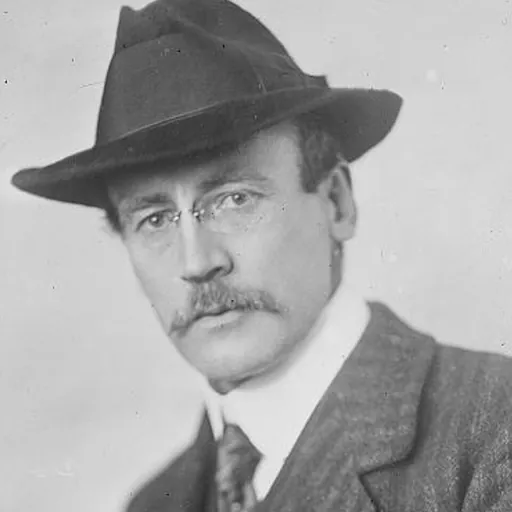
About R. Tait McKenzie
Lived 1867 – 1938 (aged 70). R. Tait McKenzie was a Canadian military physician, teacher, sculptor and athlete.
Robert Tait McKenzie ( MacKenzie) (May 26, 1867 – April 28, 1938) was a Canadian physician, educator, sculptor, athlete, soldier and Scouter. Born in Ramsay Township, Lanark County, Ontario, Canada, he attended McGill University in Montreal as an undergraduate and medical student, and was an instructor in its medical school beginning in 1894. In 1904, he moved to the United States to teach at the University of Pennsylvania in Philadelphia, Pennsylvania. In the 1930s, he returned to the county of his birth, retiring to the Mill of Kintail in Almonte.
He pioneered physical fitness programs in Canada. During World War I, his methods and inventions for restoring and rehabilitating wounded soldiers laid a foundation for modern physiotherapy practices.
In preparation for McGill he attended Ottawa Collegiate Institute (currently known as Lisgar Collegiate Institute) in 1883 at nearby Ottawa, Ontario.
McGill University This attitude changed after he enrolled at McGill University in 1885. A pre-med major, he developed a great appreciation for and attraction to athletics and physical training. In 1889, he won the Wickstead gold medal, which made him an acknowledged gymnastic champion. McKenzie found his athletic abilities focused on sports that did not solely require strength or stamina, but rather skill, coordination, and practice. During his senior year at McGill, McKenzie was an intern at the University Hospital. He graduated from McGill University in 1892 Medicinæ Doctorem et Chirurgiæ Magistrum, and then got an internship at Montreal General Hospital.
After graduating, McKenzie gained experience as a physician and surgeon, developed his own medical practice and became an anatomy instructor at McGill. He became convinced of the need for preventive medicine. Training and conditioning of the body, he believed, would prevent disease, physical breakdown and accidents, so he developed a program of physical exercise. He spent 15 months in the Governor General's household, where he mingled with various political figures.
During the 1890s, McKenzie asked McGill to develop a department and school of physical education, but the university declined, citing lack of money. As a compromise, in 1898, McGill appointed him as Medical Director of Physical Training, the first such appointee at a Canadian university. and the school allowed him to start physical examinations for incoming students. His interest in sculpting was a result of his extensive knowledge of human anatomy, his desire to portraying athletics artistically, and the limitations of portraying musculature in two-dimensional art forms.
McKenzie's first untrained sculptural effort was a series of masks known as Violent Effort, Breathlessness, Fatigue and Exhaustion. His research led to an article, "The Facial Expression of Violent Effort, Breathlessness and Fatigue," published around 1900 in the Journal of Anatomy and Physiology in London.
University of Pennsylvania In 1904, McKenzie took a position at the University of Pennsylvania in Philadelphia,
Relief bust of J. William White (1919), Rittenhouse Square, Philadelphia, Pennsylvania While in Philadelphia, he also worked closely with Lord Robert Baden-Powell, founder of Scouting.
As a longtime supporter and spectator at the Olympic Games, McKenzie often exhibited works at the competition of fine arts. To commemorate the Olympic Games scheduled for 1912 Stockholm in, the American Olympic Committee commissioned him to create a sports medallion. The result was one of his most famous works, the Joy of Effort medallion. Within years, the YMCA started to use the motif in Asia. Later, at the 1932 Summer Olympics, McKenzie would win a medal for a sculpture.
In 1915, with the outbreak of the First World War, McKenzie made his way to England to enlist with the Canadian Forces. Eager to volunteer his services as a physician and surgeon, McKenzie chose instead to enlist with the Royal Army Medical Corps after encountering some red tape and delays in his paperwork. Given the commission of Lieutenant (and later becoming Major), they quickly assigned him to the physical training program for new soldiers. He also spent a large portion of his time helping plastic surgeon Dr. William L. Clark rehabilitate those whose faces had been disfigured by war.
Almonte In McKenzie's final years, he was an internationally recognized figure and comparatively well off, so that he had the ability to retire anywhere. In 1931, he received an invitation from the Mayor of Almonte to return to his hometown to participate in the celebration of Almonte's 50th Anniversary of Incorporation. During the celebrations, the mayor offered McKenzie "The Freedom of Almonte" - a local award of recognition. After Ethel O'Neil McKenzie's death in 1954, the Mill of Kintail, as McKenzie and his wife Ethel renamed the property, passed eventually into management by the local natural resource management office, the Mississippi Valley Conservation Authority, who open the museum to the public from May to October. During his retirement, McKenzie took advantage of the peaceful surroundings of Almonte. Being a man who could never sit still for very long, a typical summer's day would find him working in his studio, walking in the woods, swimming, canoeing, going into town or giving presentations to local groups. His spirit refused to allow him to slow down, despite warnings from his physician about his deteriorating heart, and consequently, McKenzie collapsed suddenly and died on April 28, 1938.
Legacy
R. Tait McKenzie's influence was so strong in the fields of physical education, medicine, the arts, and the military that hundreds of people expressed sadness and felt personal loss in his passing, many sending condolences to his widow, Ethel.
His more than 200 works of art are seen around the world. A collection of his work can be seen at his former residence, the Mill of Kintail, also known as the R. Tait McKenzie Memorial Museum at the Mill of Kintail Conservation Area in Almonte. The Joseph B. Wolffe Collection of R. Tait McKenzie Sculpture of Athletes is housed on the campus of the University of Tennessee. Numerous sculptures can be seen in the public areas of the Inn at Penn in Philadelphia.
Near the end of his life, McKenzie said he wanted his heart to be buried in front of the Scottish-American War Memorial that he had created in Edinburgh, Scotland. When he died in Philadelphia, this request was denied by the "corporation of that city", but the organ was subsequently buried at the nearby St. Cuthbert churchyard.
An elementary school in Almonte was named after him in 1998.
Tait McKenzie Centre is a sports facility named after him at York University in Toronto, Canada.
Honors and awards Fellow #2 in the National Academy of Kinesiology
Selected works
Benjamin Franklin in 1723 (1910–1914), University of Pennsylvania, Philadelphia, Pennsylvania. Duplicates are at the University of North Carolina, Chapel Hill; Philadelphia Free Library, Philadelphia, Pennsylvania; and Brookgreen Gardens, South Carolina. J. William White Memorial Drinking Fountain (1919–1921), Rittenhouse Square, Philadelphia, Pennsylvania. The Reverend George Whitefield (1914–1919), University of Pennsylvania, Philadelphia, Pennsylvania. The Homecoming (1922), Cambridge War Memorial, Hills Road, Cambridge, England. The Victor (1925), War Memorial, Woodbury, New Jersey. Edgar Fahs Smith (1925–26), University of Pennsylvania, Philadelphia. Scots American War Memorial (1927), Princes Street Gardens, Edinburgh, Scotland. General James Wolfe (1927), Greenwich Park, London, England. Bust of General John Grubb Parke (1930), Vicksburg National Military Park, Vicksburg, Mississippi. Bust of Governor Andrew G. Curtin (1930), Vicksburg National Military Park, Vicksburg, Mississippi. World Wars Monument (1932), Girard College, Philadelphia, Pennsylvania. Monument to Jane A. Delano and the Nurses Who Died in Service in World War I (1933), Red Cross Headquarters, Washington D.C. The Fields Medal (1933), awarded at the International Congress of Mathematicians. Three bronzes at Mercersburg Academy (1935), depicting the school's first headmaster William Mann Irvine, Rhodes scholar Robert Michelet, and Olympian Bill Carr. Rejoice Young Man in Thy Youth (1936), 13th issue of the Society of Medalists. Highlander Monument (1936), Darien, Georgia. The Ideal Scout (1937) also known as The Boy Scout.
Other Sculptures
Don’t just read it —
keep it.
Full-length biographies made to live with: read them, listen on the way to work, watch them tonight.
- E-book
- Audio
- Video
Instant download · yours to keep · every purchase keeps this site free
Important facts
People in R. Tait McKenzie's life
Named in this biography and alive at the same time




Related people
Same field, nearest in time

Contemporaries
People whose lives overlapped R. Tait McKenzie's




Frequently asked questions
Who was R. Tait McKenzie?
Canadian artist (1867–1938)
When was R. Tait McKenzie born?
R. Tait McKenzie was born on 26 May 1867 in Mississippi Mills.
When did R. Tait McKenzie die?
R. Tait McKenzie died on 28 April 1938 in Philadelphia.
What was R. Tait McKenzie's occupation?
R. Tait McKenzie was a military physician, teacher, sculptor and athlete.
What nationality was R. Tait McKenzie?
R. Tait McKenzie was Canadian.
Sources & further reading
Cite this page
APA: Biography.guide. (2026). R. Tait McKenzie. https://biography.guide/r-tait-mckenzie/
MLA: "R. Tait McKenzie." Biography.guide, https://biography.guide/r-tait-mckenzie/.
Chicago: "R. Tait McKenzie." Biography.guide. https://biography.guide/r-tait-mckenzie/.
Data last updated: 2026-09-24 · Spot an error? Report a correction.
Portrait: Wikimedia Commons · author & licence
Page generated 2026-09-27 05:08 UTC