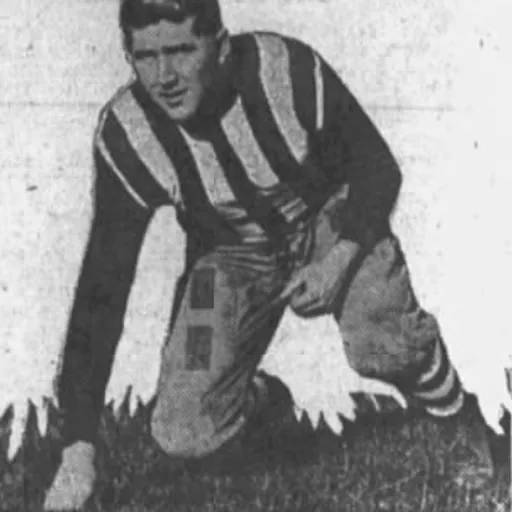
About Quentin Reynolds
Lived 1902 – 1965 (aged 62). Quentin Reynolds was an American journalist, actor, screenwriter, writer and opinion journalist.
Quentin James Reynolds (April 11, 1902 – March 17, 1965) was an American journalist and World War II war correspondent. He also played American football for one season in the National Football League (NFL) with the Brooklyn Lions.
Early life and education Reynolds was born on April 11, 1902, in The Bronx. He attended Manual Training High School in Brooklyn and Brown University. At Brown, he played college football as a tackle and starred as a breaststroker on the swimming team.
Career As an associate editor at Collier's Weekly from 1933 to 1945, Reynolds averaged 20 articles a year. He also published 25 books, including The Wounded Don't Cry, London Diary, Dress Rehearsal, and Courtroom, a biography of lawyer Samuel Leibowitz. His autobiography was titled By Quentin Reynolds.
During World War II, Reynolds was one of many Western correspondents noted for taking a pro-Soviet line. After visiting the USSR in the autumn of 1941, he argued that the victims of Stalin's purges in the 1930s had been guilty of treason to the Soviet Union, and attributed the country's survival in the face of Operation Barbarossa to the fact that before the war it had "eliminated Russia's Fifth Column." Reynolds was also misled by Soviet propaganda lauding Stalin as a battlefield commander, writing in 1942 that "there is no doubt that there is only one military genius in Russia -- Joseph Stalin."
After World War II, Reynolds was best known for his 1954 libel suit against right-wing Hearst columnist Westbrook Pegler, who in 1949 had accused him of habitually appearing naked in public, and called him "yellow" and an "absentee war correspondent". Reynolds, represented by noted attorney Louis Nizer, won $175,001 (approximately $1.9 million in 2022 dollars), at the time the largest libel judgment ever. The trial was later made into a Broadway play, A Case of Libel, which was twice adapted as TV movies.
In 1953, Reynolds was the victim of a major literary hoax when he published The Man Who Wouldn't Talk, the supposedly true story of a Canadian war hero, George Dupre, who claimed to have been captured and tortured by German soldiers. When the hoax was exposed, Bennett Cerf, of Random House, Reynolds's publisher, reclassified the book as fiction.
On December 8, 1950, Reynolds debuted as a television actor in "The Ponzi Story", an episode of Pulitzer Prize Playhouse. Reynolds was a personal friend of British media mogul Sidney Bernstein. In 1956, Reynolds paid a visit to England to co-host Meet the People, the launch night program for Manchester-based Granada Television (now ITV Granada) which Bernstein founded.
Reynolds was a member of Delta Tau Delta International Fraternity.
Death Reynolds died of cancer, on March 17, 1965, at Travis Air Force Base Hospital in Fairfield, California.
Books
Parlor, Bedlam and Bath (with S. J. Perelman), Liveright, 1930 The Wounded Don't Cry, E P Dutton, 1941 A London Diary, Angus & Robertson, 1941 Convoy, Random House, 1942 Only the Stars are Neutral, Random House, 1942; Blue Ribbon Books, 1943alt="Only the Stars are Neutral–Union Pacific–Keep 'Em Rolling–The railroads are the backbone of offense" World War II propaganda poster showing off the contributions of the Union Pacific Railroad, bearing the title of Reynolds 1942 book Only the Stars are Neutral. In small letters it notes "By special permission of Quentin Reynolds". Dress Rehearsal: The Story of Dieppe, Random House, 1943 The Curtain Rises, Random House, 1944 Officially Dead: The Story of Commander C D Smith, USN; The Prisoner the Japs Couldn’t Hold No. 511 Random House, 1945 (Published by Pyramid Books under the title He Came Back in multiple printings in the 1960s and early 1970s.) 70,000 to 1 (Seventy Thousand to One); True War Adventure, 1946 Leave It to the People, Random House, 1948,1949 The Wright Brothers, Pioneers of American Aviation, Random House Landmark Books, 1950 Courtroom; The Story of Samuel S Leibowitz, Farrar, Straus and Co, 1950 Custer's Last Stand, Random House, 1951 The Battle of Britain, Random House, 1953 The Amazing Mr Doolittle; A Biography of Lieutenant General James H Doolittle, Appleton-Century-Crofts, 1953 The Man Who Wouldn't Talk, 1953 I, Willie Sutton, Farrar, Straus and Young, 1953 The FBI, Random House Landmark Books, 1954 Headquarters, Harper & Brothers, 1955 The Fiction Factory; or, From Pulp Row to Quality Street; The Story of 100 years of Publishing at Street & Smith, Random House 1955 They Fought for the Sky; The Dramatic Story of the First War in the Air, Rinehart & Company, 1957 Minister of Death: The Adolf Eichmann Story (by Zwy Aldouby and Quentin James Reynolds), Viking 1960 Known But to God; The Story of the “Unknowns” of America’s War Memorials, John Day 1960 Winston Churchill, Random House 1963 By Quentin Reynolds, McGraw Hill, 1963 Britain Can Take It! (based on the film) Don't Think It Hasn't Been Fun The Life of Saint Patrick Macapagal, the Incorruptible A Secret for Two With Fire and Sword; Great War Adventures
Screenplays Call Northside 777 (1948) The Miracle of the Bells (1948)
Don’t just read it —
keep it.
Full-length biographies made to live with: read them, listen on the way to work, watch them tonight.
- E-book
- Audio
- Video
Instant download · yours to keep · every purchase keeps this site free
Important facts
People in Quentin Reynolds's life
Named in this biography and alive at the same time




Related people
Same field, nearest in time


Contemporaries
People whose lives overlapped Quentin Reynolds's



Frequently asked questions
Who was Quentin Reynolds?
American journalist and war correspondent (1902-1965)
When was Quentin Reynolds born?
Quentin Reynolds was born on 11 April 1902 in New York City.
When did Quentin Reynolds die?
Quentin Reynolds died on 17 March 1965 in San Francisco.
What was Quentin Reynolds's occupation?
Quentin Reynolds was a journalist, actor, screenwriter, writer and opinion journalist.
What nationality was Quentin Reynolds?
Quentin Reynolds was American.
Sources & further reading
Cite this page
APA: Biography.guide. (2026). Quentin Reynolds. https://biography.guide/quentin-reynolds/
MLA: "Quentin Reynolds." Biography.guide, https://biography.guide/quentin-reynolds/.
Chicago: "Quentin Reynolds." Biography.guide. https://biography.guide/quentin-reynolds/.
Data last updated: 2026-09-22 · Spot an error? Report a correction.
Page generated 2026-09-27 05:10 UTC