
Pyrrho
Greek philosopher and founder of Pyrrhonism (c.360-c.270 BC)
About Pyrrho
Lived 360 BC – 270 BC (aged 89–90). Pyrrho was a philosopher, painter and writer.
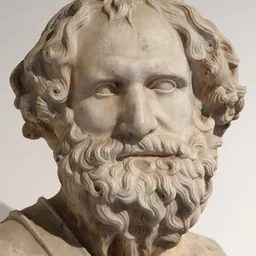
Pyrrho of Elis (; ; ) was a Greek philosopher of Classical antiquity, credited as being the first Greek skeptic philosopher and founder of Pyrrhonism.
Life
Pyrrho of Elis is estimated to have lived from around 365/360 until 275/270 BCE. a clan of seers in Elis who interpreted the oracles of the Temple of Zeus at Olympia where Pyrrho served as a high priest. The Klytidiai were descendants of Klytios, who was the son of Alcmaeon and the grandson of Amphiaraus. In the Python, Pyrrho's student Timon of Phlius describes first meeting Pyrrho on the grounds of an Amphiareion, i.e., a temple of Amphiaraus, while they were both on a pilgrimage to Delphi.
Most biographical information on Pyrrho, as well as some information concerning his demeanor and behavior, come from Diogenes Laertius; his work on Pyrrho's life drew primarily from the works of mid-third century BC biographer Antigonus of Carystus.
Pyrrho, along with Anaxarchus, travelled with Alexander the Great on his Indian campaign, "so that he even went as far as the Gymnosophists in India and the Magi" in Persia.
Imaginary engraving of Pyrrho of Elis by Girolamo Olgiati from Illustrium philosophorum et sapientum effigies ab eorum numismatibus extractae. Courtesy of Wikimedia Commons.
Philosophy
Pyrrho did not produce any written work.
A summary of Pyrrho's philosophy was preserved by Eusebius, quoting Aristocles, quoting Timon, in what is known as the "Aristocles passage."
It is uncertain whether Pyrrhonism was a small but continuous movement in antiquity or whether it died out and was revived. Regardless, several centuries after Pyrrho lived, Aenesidemus led a revival of the philosophy. Pyrrhonism was one of the two major schools of philosophical skepticism that emerged during the Hellenistic period, the other being Academic skepticism.
Pyrrhonists view their philosophy as a way of life, and view Pyrrho as a model for this way of life. Their main goal is to attain ataraxia through achieving a state of epoché (i.e., suspension of judgment) about beliefs. One method Pyrrhonists use to suspend judgment is to gather arguments on both sides of the disputed issue, continuing to gather arguments such that the arguments have the property of isostheneia (equal strength). This leads the Pyrrhonist to the conclusion that there is an unresolvable disagreement on the topic, and so the appropriate reaction is to suspend judgment. Eventually the Pyrrhonist develops epoché as a habitual response to all matters of dispute, which results in ataraxia.
Ancient Indian influences on Pyrrho Diogenes Laërtius' biography of Pyrrho reports that Pyrrho traveled with Alexander the Great's army on its conquest of India (327 to 325 BCE) and based his philosophy on what he learned there:
...he even went as far as the Gymnosophists, in India, and the Magi. Owing to which circumstance, he seems to have taken a noble line in philosophy, introducing the doctrine of incomprehensibility, and of the necessity of suspending one's judgment....
The sources and the extent of the Indian influences on Pyrrho's philosophy, however, are disputed. Philosophical skepticism was already present in Greek philosophy, particularly in the Democritean tradition in which Pyrrho had studied prior to visiting India. Richard Bett heavily discounts any substantive Indian influences on Pyrrho, arguing that based on the testimony of Onesicritus regarding how difficult it was to converse with the gymnosophists, as it required three translators, none of whom understood any philosophy, it is highly improbable that Pyrrho could have been substantively influenced by any of the Indian philosophers. According to Indologist and Buddhist scholar Johannes Bronkhorst, early Buddhism and Pyrrho's philosophy share no connection.
It has also been hypothesized that the gymnosophists were Jains, or Ajnanins, and that these are likely influences on Pyrrho. Authors see probable influence of Indian skepticism not only in Pyrrhonism, but also in Buddhism itself as a common ground.
Don’t just read it —
keep it.
Full-length biographies made to live with: read them, listen on the way to work, watch them tonight.
- E-book
- Audio
- Video
Instant download · yours to keep · every purchase keeps this site free
Important facts
People in Pyrrho's life
Named in this biography and alive at the same time


Related people
Same field, nearest in time



Contemporaries
People whose lives overlapped Pyrrho's

Frequently asked questions
Who was Pyrrho?
Greek philosopher and founder of Pyrrhonism (c.360-c.270 BC)
When was Pyrrho born?
Pyrrho was born in 360 BC in Elis.
When did Pyrrho die?
Pyrrho died in 270 BC in Elis.
What was Pyrrho's occupation?
Pyrrho was a philosopher, painter and writer.
Sources & further reading
Cite this page
APA: Biography.guide. (2026). Pyrrho. https://biography.guide/pyrrho/
MLA: "Pyrrho." Biography.guide, https://biography.guide/pyrrho/.
Chicago: "Pyrrho." Biography.guide. https://biography.guide/pyrrho/.
Data last updated: 2026-09-25 · Spot an error? Report a correction.
Page generated 2026-09-27 05:12 UTC