
Psiax
Late 6th century BC Attic vase painter during the transition between the black-figure and red-figure styles, active 525 to 505 BC
About Psiax
Lived 550 BC – 460 BC (aged 89–90). Psiax was a Greek red-figure vase painter, vase painter, attic vase-painter and black-figure vase painter.
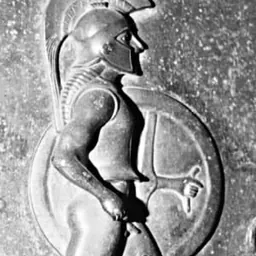
Armoured warrior on a plate acribed to Psiax, circa 510 BC, found in the sanctuary of Zeus at Olympia, Antikensammlung Berlin. Psiax was an Attic vase painter of the transitional period between the black-figure and red-figure styles. His works date to circa 525 to 505 BC and comprise about 60 surviving vases, two of which bear his signature. Initially he was allocated the name "Menon Painter" by John Beazley. Only later was it realised that the artist was identical with the painters signing as "Psiax".
Psiax collaborated with the potters Hilinos, Menon, Andokides and Nikosthenes. While he started as a painter in the black-figure technique, he played a major role in the early development of red-figure, which was invented in the workshop of Andokides. The black-figure Antimenes Painter, working for the same workshop, was stylistically close to Psiax; Beazley described the two as "brothers". Perhaps unsurprisingly, considering his chronological position, Psiax was a master of bilingual vase painting. Formerly called the Menon Painter, after the potter’s signature on a red-figure amphora (Philadelphia, U. PA, Mus., 5349), he signed two red-figure alabastra as painter, both of which bear the signature of the potter Hilinos [Karlsruhe, Bad. Landesmus., 242 (B 120) and Odessa, A. Mus.]. Psiax also knew the white ground technique, as well as coral red pottery techniques.
His signature is only known from two red-figure alabastra at Karlsruhe and Odessa, both also signed by the potter Hilinos. Three of the vases by him are signed by the potter Andokides. The fact that he painted kyathoi and used the Six's technique indicates that he also collaborated with Nikosthenes. In his early phase, Epiktetos imitated Psiax. The Pioneers Euphronios and Phintias were taught by Psiax.
Psiax mostly painted smaller vessels, appropriate to his fine painting style. Nevertheless, larger vases by him are also known, such as amphorae, hydriai and calyx kraters. On those, too, his figures are not so much powerful and lively but rather dignified and restrained. Although he experimented with the possibilities offered by the new technique (perspective), he concentrated more on the fine detail and decorative effect typical of Late Archaic art. He did not limit his activity to black-figure or red-figure but also experimented with black figures on white or coral-red ground and with the Six Technique.
His choice of subjects is conventional; arguably with a preference for scenes with horses and archers.
Works (selection) Brescia, Museo black-figure belly amphora Karlsruhe, Baden State Museum B 120 red-figure alabastron (signed; potter: Hilinos) London, British Museum 1980.10-29.1 (formerly Castle Ashby) black-figure neck amphora (potter: Andokides) Neck front: Dionysos between two satyrs, back: Warrior in chariot in frontal perspective between two youths Madrid, National Archaeological Museum of Spain 11008 (L 63) bilingual belly amphora (potter: Andokides) Front: Apollo with kithara between Artemis, Leto and Ares; back: Dionysos with kantharos between satyrs and maenads Malibu, J. Paul Getty Museum 86.AE.278 red-figure cup 90.AE.122 black-figure mastos New York City, Metropolitan Museum 63.11.6 red-figure belly amphora with black-figure lip Front: fight over the tripod, back: Dionysos with kantharos between maenad and satyr (Lip: Psiax, main images: Andokides Painter) Odessa, Archaeological Museum 266602 red-figure alabastron (signed; potter: Hilinos) Philadelphia, University Museum 5349 red-figure belly amphora (potter: Menon)
Don’t just read it —
keep it.
Full-length biographies made to live with: read them, listen on the way to work, watch them tonight.
- E-book
- Audio
- Video
Instant download · yours to keep · every purchase keeps this site free
Important facts
Related people
Same field, nearest in time



Contemporaries
People whose lives overlapped Psiax's


Frequently asked questions
Who was Psiax?
Late 6th century BC Attic vase painter during the transition between the black-figure and red-figure styles, active 525 to 505 BC
When was Psiax born?
Psiax was born in 550 BC in Attica.
When did Psiax die?
Psiax died in 460 BC.
What was Psiax's occupation?
Psiax was a red-figure vase painter, vase painter, attic vase-painter and black-figure vase painter.
What nationality was Psiax?
Psiax was Greek.
Sources & further reading
Cite this page
APA: Biography.guide. (2026). Psiax. https://biography.guide/psiax/
MLA: "Psiax." Biography.guide, https://biography.guide/psiax/.
Chicago: "Psiax." Biography.guide. https://biography.guide/psiax/.
Data last updated: 2026-09-20 · Spot an error? Report a correction.
Page generated 2026-09-27 05:20 UTC