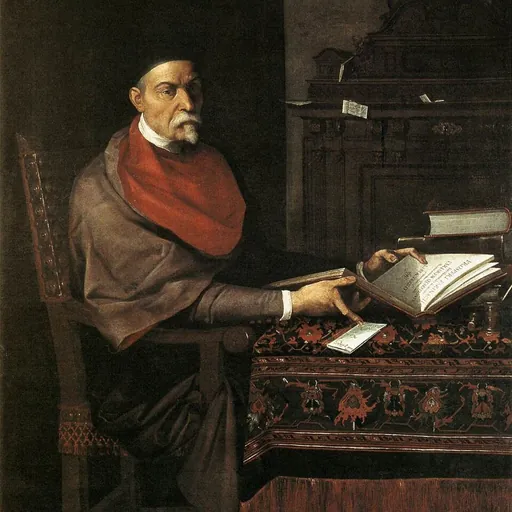
About Prospero Farinacci
Lived 1544 – 1618 (aged 74). Prospero Farinacci was an Italian jurist, lawyer, magistrate and judge.
Prospero Farinacci (1 November 1554 – 31 December 1618) was an Italian Renaissance jurist, lawyer and judge. His Praxis et Theorica Criminalis (Practice and Theory of Criminal Law) was the strongest influence on criminal law in Civil law countries until the Age of Enlightenment. Farinacci defended Beatrice Cenci who was accused of killing her father in the most famous criminal case of the time. As a judge he was known for his harsh sentencing.
Biography
The son of a Capitoline notary, Farinacci was born in Rome, in 1554. He studied law at La Sapienza in Rome, receiving his doctorate in 1567, at the early age of twenty-three. Prospero soon earned himself the reputation as an able advocate. In 1567, he became the general commissioner in the service of the Orsini family of Bracciano. He was excused of the crime by Pope Clement VIII, who famously made a pun on Farinacci's name (which alludes to "flour" in Italian) by claiming that "The flour is good, it's the bag that's bad."
Farinacci was perhaps most famous as the advocate in the scandalous trial for murder, actually patricide, of Beatrice Cenci and her relatives (1599), which ended in their gruesome public beheadings. He played a major role in the defense and although he was not able to save the girl, he did convince the pope to allow the youngest brother, Bernardo, to survive, invoking both the boy's young age and temporary mental infirmity as mitigating factors.
In 1600, Farinacci had a son with a prostitute called Cleria. Ludovico later joined the clergy and in the end, he became his father's sole heir. Prospero's portrait by Giuseppe Cesari can be found in the Museo nazionale di Castel Sant'Angelo.
Works
Prospero Farinacci was best known for his legal decisions and opinions which he published in four massive tomes and many editions. His most important works are: Praxis et theorica criminalis, 1594–1614. Farinacci's Praxis et Theorica Criminalis exerted a very considerable influence on Western legal culture and became a fundamental reference point in Civil law countries in the modern era. The Praxis was also well known in customary law countries: Sir George Mackenzie of Rosehaugh, writing in Scotland in 1678, drew extensively on Farinacci. The Praxis is most noteworthy as the definitive work on the jurisprudence of torture. Farinacci devoted considerable attention to the use of torture in criminal trials and in general placed severe restrictions on its use.
Don’t just read it —
keep it.
Full-length biographies made to live with: read them, listen on the way to work, watch them tonight.
- E-book
- Audio
- Video
Instant download · yours to keep · every purchase keeps this site free
Important facts
People in Prospero Farinacci's life
Named in this biography and alive at the same time


Related people
Same field, nearest in time



Contemporaries
People whose lives overlapped Prospero Farinacci's


Frequently asked questions
Who was Prospero Farinacci?
Italian jurist (1544-1618)
When was Prospero Farinacci born?
Prospero Farinacci was born on 1 November 1544 in Rome.
When did Prospero Farinacci die?
Prospero Farinacci died on 31 December 1618 in Rome.
What was Prospero Farinacci's occupation?
Prospero Farinacci was a jurist, lawyer, magistrate and judge.
What nationality was Prospero Farinacci?
Prospero Farinacci was Italian.
Sources & further reading
· Wikipedia: Prospero Farinacci
Cite this page
APA: Biography.guide. (2026). Prospero Farinacci. https://biography.guide/prospero-farinacci/
MLA: "Prospero Farinacci." Biography.guide, https://biography.guide/prospero-farinacci/.
Chicago: "Prospero Farinacci." Biography.guide. https://biography.guide/prospero-farinacci/.
Data last updated: 2026-09-23 · Spot an error? Report a correction.
Portrait: Wikimedia Commons · author & licence
Page generated 2026-09-27 05:06 UTC