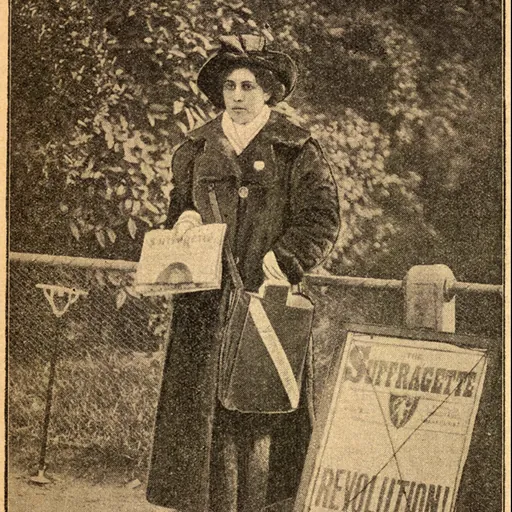
Princess Sophia Kaur of Lahore
Lahorian Royal and British Suffragist
About Princess Sophia Kaur of Lahore
Lived 1876 – 1948 (aged 72). Princess Sophia Kaur of Lahore was a British women's rights activist, suffragette and suffragist.
Princess Sophia Alexandrovna Duleep Singh ( ; 8 August 1876 – 22 August 1948) was a British suffragette. Her father was Maharaja Dalip Singh, who had lost his Sikh Empire to the Punjab Province of British India and was subsequently exiled to England. Sophia's mother was Bamba Müller, who was half German and half Ethiopian, and her godmother was Queen Victoria. She had four sisters, including two half-sisters, and three brothers. She lived in Faraday House in Hampton Court, given to her by Queen Victoria as a grace-and-favour home.
During the early twentieth century, Singh was one of several Indian women who pioneered the cause of women's rights in Britain. Although she is best remembered for her leading role in the Women's Tax Resistance League, she also participated in other women's suffrage groups, including the Women's Social and Political Union.
Early life Sophia Duleep Singh was born on 8 August 1876 in Belgravia and lived in Elveden Hall, Suffolk. She was the third daughter of Maharaja Duleep Singh (the last Maharaja of the Sikh Empire) and his first wife, Bamba Müller. The Maharaja and Bamba had ten children, of whom six survived. Singh combined Indian, European, and African ancestry with a British aristocratic upbringing, which her string of names reflected. She was named Sophia for her maternal grandmother, the formerly enslaved woman from Ethiopia; and Alexandrovna in tribute to her godmother, Queen Victoria ("Alexandrina Victoria"). Some sources also report an additional forename, Jindan, after her paternal grandmother, Maharani Jind Kaur. Because of the family's complex history, the India Office kept them under surveillance in case they became involved in any political activity around India. He was exiled from India by the East India Company at age15 and moved to England, where Queen Victoria treated him with maternal fondness. She and Prince Albert were impressed by his handsomeness and regal bearing. They formed a close bond with him over the years. The queen was godmother to several of his children, and his family's upkeep was provided for by the East India Company. Duleep Singh converted to Christianity at a young age, some time prior to his removal from India. In later life, he reconverted to Sikhism
Later life and activism
After Singh returned from India in 1909, she joined the Women's Social and Political Union (WSPU) at the behest of Una Dugdale, a friend of the Pankhurst sisters; Emmeline Pankhurst had co-founded the Women's Franchise League in 1889. She also contributed towards fundraising efforts, such as self-denial weeks, where supporters would deprive themselves of luxuries and give the money saved to their chosen organisation. She refused to pay taxes, frustrating the government. King George V asked in exasperation, "Have we no hold on her?" According to a letter from Lord Crewe, George V was within his rights to have her evicted.
Her name is also one of those listed in the 1911 Census boycotters
Singh authorised an auction of her belongings, with proceeds benefiting the Women's Tax Resistance League. She solicited subscriptions to the cause, and was photographed selling The Suffragette newspaper outside her home and from press carts. On 22May 1911 Singh was fined £3 by the Spelthorne Petty Sessions Court for illegally keeping a coach, a helper, and five dogs and for using a roll of arms. She protested that she should not have to pay the licence fees without the right to vote. On 13December 1913 she and other WTRL members appeared in court and Singh was again accused of keeping dogs without a licence. Singh tried to fall in front of Prime Minister H. H. Asquith's car while holding a poster reading, "Give women the vote!" She supported the manufacture of bombs, encouraging anarchy in Britain. She tended wounded Indian soldiers who had been evacuated from the Western Front. Sikh soldiers could hardly believe "that the granddaughter of Ranjit Singh sat by their bedsides in a nurse's uniform".
After the 1918 enactment of the Representation of the People Act, allowing women over age30 to vote, Singh joined the Suffragette Fellowship and remained a member until her death. where they were scattered in the Punjab.
Queen Victoria had given Singh an elaborately dressed doll named Little Sophie, which became her proud possession, and, near the end of her life, she gave the doll to Drovna, her housekeeper's daughter.
She was featured in the Royal Mail's commemorative stamp set "Votes for Women", issued on 15 February 2018. She appeared on the £1.57 stamp, selling The Suffragette.
Her name and picture (and those of 58 other women's suffrage supporters) are on the plinth of the statue of Millicent Fawcett in Parliament Square, London, unveiled in April 2018.
She was featured in the documentaries Sophia: Suffragette Princess (2015) and No Man Shall Protect Us: The Hidden History of the Suffragette Bodyguards (2018), portrayed in the latter production by actress Aila Peck. In 2022, Historic Royal Palaces commissioned Scary Little Girls theatre company to develop a play on Sophia Duleep Singh to tour London schools. The play, Fire: A Princess' Guide to Burning Issues, subsequently toured schools in West Yorkshire in July 2023 and Birmingham in November 2023.
In January 2023, English Heritage announced that a blue plaque would be unveiled later that year on a house in Richmond, near Hampton Court Palace which Queen Victoria granted to Singh and her sisters in 1896. The plaque was unveiled at a ceremony on 26 May 2023. In 2023 it was announced that English actress Paige Sandhu would portray Singh in a biographical film titled Lioness.
An exhibition The Last Princesses of Punjab will run at Kensington Palace from 26 March – 8 November 2026, showcasing objects illustrating Singh's life alongside her sisters, mother, grandmother and godmother.
Don’t just read it —
keep it.
Full-length biographies made to live with: read them, listen on the way to work, watch them tonight.
- E-book
- Audio
- Video
Instant download · yours to keep · every purchase keeps this site free
Important facts
Family & relationships
People in Princess Sophia Kaur of Lahore's life
Named in this biography and alive at the same time

Related people
Same field, nearest in time



Contemporaries
People whose lives overlapped Princess Sophia Kaur of Lahore's

Frequently asked questions
Who was Princess Sophia Kaur of Lahore?
Lahorian Royal and British Suffragist (1876–1948)
When was Princess Sophia Kaur of Lahore born?
Princess Sophia Kaur of Lahore was born on 8 August 1876 in Elveden Hall.
When did Princess Sophia Kaur of Lahore die?
Princess Sophia Kaur of Lahore died on 22 August 1948 in Tylers Green.
What was Princess Sophia Kaur of Lahore's occupation?
Princess Sophia Kaur of Lahore was a women's rights activist, suffragette and suffragist.
What nationality was Princess Sophia Kaur of Lahore?
Princess Sophia Kaur of Lahore was British.
Sources & further reading
· Wikipedia: Princess Sophia Kaur of Lahore
· DBpedia: Sophia Duleep Singh
Cite this page
APA: Biography.guide. (2026). Princess Sophia Kaur of Lahore. https://biography.guide/princess-sophia-kaur-of-lahore/
MLA: "Princess Sophia Kaur of Lahore." Biography.guide, https://biography.guide/princess-sophia-kaur-of-lahore/.
Chicago: "Princess Sophia Kaur of Lahore." Biography.guide. https://biography.guide/princess-sophia-kaur-of-lahore/.
Data last updated: 2026-09-21 · Spot an error? Report a correction.
Portrait: Wikimedia Commons · author & licence
Page generated 2026-09-27 04:59 UTC