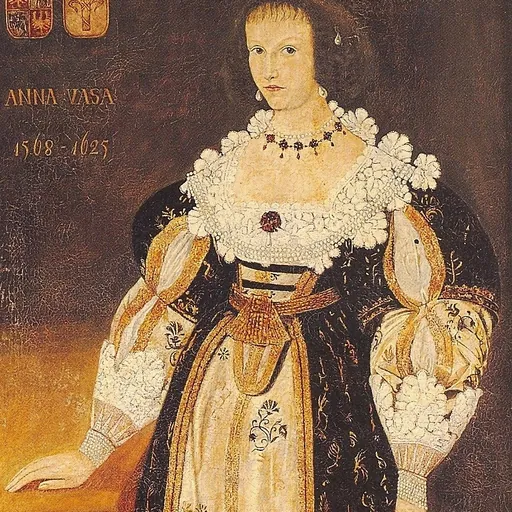
About Princess Anna of Sweden
Lived 1568 – 1625 (aged 56–57). Princess Anna of Sweden was a Swedish and Polish botanist.
Anna Vasa of Sweden (also Anne, ; 17 May 1568 – 26 February 1625) was a Swedish princess heavily involved in the politics of that country and of Poland. She was starosta of Brodnica and Golub. The youngest child of King John III of Sweden and Catherine Jagiellon, she was close to her brother Sigismund Vasa, King of Poland, Grand Duke of Lithuania (1587–1632) and King of Sweden (1592–1599). Raised a Catholic, Anna converted to Lutheranism in 1584. Though she had several suitors, she remained unmarried.
Biography
Early life
Anna was the youngest child of Duke John of Finland and Catherine Jagiellon, sister of King Sigismund III Vasa of Poland. She was born at Eskilstunahus just after her family was released from captivity at Gripsholm Castle. Her father ascended in 1569 to the throne of Sweden as John III. Like her brother Sigismund, Anna was raised a Catholic by her mother and attended Catholic mass.
Several marriages were suggested. In 1577, there had been discussions to arrange the marriage between Anna and an Austrian Archduke, either Matthias or Maximilian II, but this became impossible after her conversion a year after her mother's death. In 1587, Gustaf Brahe followed Sigismund and Anna to Poland when Sigismund was elected king there. In 1589, he formally asked Sigismund for Anna's hand, and while he was not given a clear answer, he was not refused, which made him hope that he might be accepted.
From 1592, Sigismund negotiated a marriage between Anna and Margrave John George of Brandenburg but political tensions kept delaying the agreement. In February 1598, Sigismund demanded that Charles allow Anna to return to Poland as her wedding to John George was finally set to Easter that year. Charles attempted to prevent her departure by demanding an inventory of her Swedish property and the promise that it would be confiscated by the state should she die unmarried. Anna protested, advised Charles to cooperate with Sigismund and offered herself as a mediator. At the return of Sigismund to Sweden, Anna immediately joined him in the civil war that erupted between Sigismund and Charles. She was given the task to mediate, but because of Charles' lack of confidence in her, she was not able to achieve much. After Sigismund's defeat at the Battle of Stångebro in 1598, she left Sweden to live with him in Poland.
Later life in Poland After 1598, Anna spent the rest of her life in Poland, though she always referred to herself as a Princess of Sweden. Known as Anna of Svecia (Anna of Sweden), she was a Protestant member of a Catholic royal family, and acted as a protector of the exiled Protestant Swedish loyalists of Sigismund and Polish Protestants. Princess Anna maintained a good relationship with and influence upon Sigismund, and she functioned as his political adviser on the affairs of state, something which made her a controversial figure in Poland.
During the captivity of Carl Gyllenhielm, an illegitimate son of Duke Charles, in Poland in 1610–13, she gave him much attention. She was given the task of interrogating Gyllenhielm by Sigismund, who listened hidden by a curtain. She accused Charles of conspiracy to entice conflict between Sigismund and John III, something Gyllenhielm denied.
Anna remained unmarried. In 1602, duke Charles de Gonzaga-Nevers suggested a marriage to a French prince, which was never realized. The negotiations with Johann Georg von Brandenburg were finally discontinued in 1609. The rumors that she had a love relationship with the exiled Swedish count Gustaf Brahe, a supporter of Sigismund, have never been confirmed, but it was used by Charles IX, who feared her political influence and in a letter to Sigismund from 1607 referred to her as: "Your poisonous sister, the creator of all evil and born to the destruction of all lands and the Kingdom". Charles IX once feared that she would marry Tsar Dmitrij of Russia, which was however a false rumor.
Sigismund made Anna starosta of Brodnica in 1605 and Golub in 1611. She divided her time between her fief and the court of her brother. Anna's appanage was Strasburg (now Brodnica), a Royal Prussian district in Poland near the Baltic, where she lived in Golub and Strasburg. She became very respected because of her great learning. She was interested in literature, music, gardening and medicine. She was a specialist in medicinal herbs and kept her own apothecary. With the help of an Italian assistant, she made her own experiments in herbal medicine. She financed the herbarium of Simon Syrenius.
Anna was buried at the Church of St. Mary in Toruń, Poland several years after her death, as the Pope had first forbidden the burial of a Protestant in a blessed graveyard in Catholic Poland. Her nephew, king Władysław IV Vasa, got that decree reversed. He built a beautiful black Dębnik marble tomb monument with a white alabaster figure of his beloved aunt.
Ancestry
Gallery
Don’t just read it —
keep it.
Full-length biographies made to live with: read them, listen on the way to work, watch them tonight.
- E-book
- Audio
- Video
Instant download · yours to keep · every purchase keeps this site free
Important facts
Family & relationships
People in Princess Anna of Sweden's life
Named in this biography and alive at the same time



Related people
Same field, nearest in time

Contemporaries
People whose lives overlapped Princess Anna of Sweden's




Frequently asked questions
Who was Princess Anna of Sweden?
Swedish princess (1568-1625)
When was Princess Anna of Sweden born?
Princess Anna of Sweden was born on 17 May 1568 in Eskilstuna.
When did Princess Anna of Sweden die?
Princess Anna of Sweden died in 1625 in Brodnica.
What was Princess Anna of Sweden's occupation?
Princess Anna of Sweden was a botanist.
What nationality was Princess Anna of Sweden?
Princess Anna of Sweden was Swedish and Polish.
Sources & further reading
· Wikipedia: Princess Anna of Sweden
· DBpedia: Anna Vasa of Sweden
Cite this page
APA: Biography.guide. (2026). Princess Anna of Sweden. https://biography.guide/princess-anna-of-sweden/
MLA: "Princess Anna of Sweden." Biography.guide, https://biography.guide/princess-anna-of-sweden/.
Chicago: "Princess Anna of Sweden." Biography.guide. https://biography.guide/princess-anna-of-sweden/.
Data last updated: 2026-09-20 · Spot an error? Report a correction.
Page generated 2026-09-27 05:10 UTC