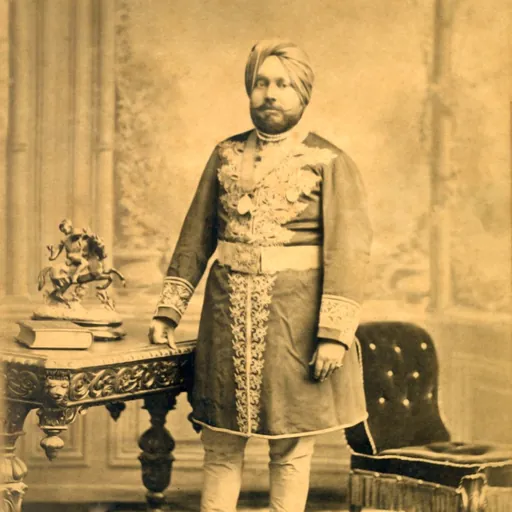
Prince Bikrama Singh of Kapurthala
Kapurthalian Royal
About Prince Bikrama Singh of Kapurthala
Lived 1835 – 1887 (aged 51–52).
Kanwar Sri Bikrama Singh Bahadur (1835–8 May 1887) was a 19th-century Sikh leader. He was born in the Kapurthala ruling family as the son of Raja Nihal Singh and was passed-over in succession of his father in-favour of his brother, Randhir Singh, due to British influence. This would lead to a long-lasting dispute within the family.
Early life and political contribution
Born in Kapurthala as the second son of Raja Nihal Singh of Kapurthala (from his second Rani, the philanthropist Mai Hiran). He was one of the main progenitors of the 19th Century Sikh Renaissance, being one of the founders of the Singh Sabha Movement aimed at a revival of the Gurudwaras as centres of worship and learning which ultimately culminated in the Gurudwara Reform movement and led to the liberation of the Gurudwaras from the clutches of the hereditary Mahants. He was married and two of his children were Pratap Singh of Kapurthala and Raja Sir Daljit Singh of Kapurthala.
Bikrama Singh had constructed, as his personal residence, the first French inspired building in Kapurthala, the Elysee Palace. (His example was later followed by the francophile Maharaja Jagatjit Singh, who constructed the famous French inspired Jagatjit Palace at Kapurthala). When he relocated to Jullunder, he built for himself another residence, Bikram Hall; it has since been demolished, though the grounds, now referred to as Bikrampura, still bear his name.
Dispute with the Raja of Kapurthala His father Raja Nihal Singh wanted him to succeed to the throne but this was opposed by the British. His father's will, which entitled him to inherit large estates, was challenged by his brother, Raja Randhir Singh. After long litigation, a settlement was arrived at by which Bikrama Singh was given a pension by the state; under the terms of this settlement, Bikrama Singh left Kapurthala to settle in Jullunder.
Settlement of estates through the Bikrama Singh Estates Act He was the joint owner of the Kapurthala Estate in Awadh, Uttar Pradesh. When he sought a partition of this Estate his brother, Raja Randhir Singh opted to keep the Estate undivided and, instead, chose to compensate Bikrama Singh. A settled amount was deposited into a Trust which was used to procure a fresh Estate for Bikrama Singh. The lands finally vested in Bikrama Singh in the districts of Sitapur and Rae Bareli in the United Provinces (present day Uttar Pradesh) were formalized by the central government through the Bikrama Singh Estates Act 1883 (an unrepealed Act of the Government of India).
He died at Jullunder on 8 May 1887.
Don’t just read it —
keep it.
Full-length biographies made to live with: read them, listen on the way to work, watch them tonight.
- E-book
- Audio
- Video
Instant download · yours to keep · every purchase keeps this site free
Important facts
People in Prince Bikrama Singh of Kapurthala's life
Named in this biography and alive at the same time

Contemporaries
People whose lives overlapped Prince Bikrama Singh of Kapurthala's
Frequently asked questions
Who was Prince Bikrama Singh of Kapurthala?
Kapurthalian Royal
When was Prince Bikrama Singh of Kapurthala born?
Prince Bikrama Singh of Kapurthala was born in 1835.
When did Prince Bikrama Singh of Kapurthala die?
Prince Bikrama Singh of Kapurthala died in 1887.
Sources & further reading
· Wikipedia: Prince Bikrama Singh of Kapurthala
Cite this page
APA: Biography.guide. (2026). Prince Bikrama Singh of Kapurthala. https://biography.guide/prince-bikrama-singh-of-kapurthala/
MLA: "Prince Bikrama Singh of Kapurthala." Biography.guide, https://biography.guide/prince-bikrama-singh-of-kapurthala/.
Chicago: "Prince Bikrama Singh of Kapurthala." Biography.guide. https://biography.guide/prince-bikrama-singh-of-kapurthala/.
Data last updated: 2026-10-02 · Spot an error? Report a correction.
Portrait: Wikimedia Commons · author & licence
Page generated 2026-10-05 02:40 UTC