
About Pompiliu Eliade
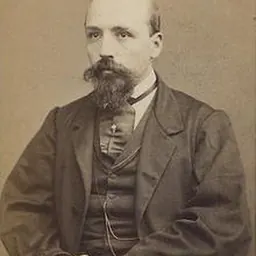
Lived 1870 – 1914 (aged 44). Pompiliu Eliade was a Romanian historian, literary historian, literary critic, politician, philosopher and university teacher.
Pompiliu Eliade (April 13, 1869 – May 24, 1914) was a Romanian literary critic and historian.
Life Born in Bucharest, he attended primary and high school in his native city, followed by the University of Bucharest, where he obtained a literature degree in 1891. In 1912, he was elected a corresponding member of the Romanian Academy. He was part of the Religious Affairs and Public Education Ministry's permanent council.
In 1908, he became director general of theatres, He arrived with grand designs and a serious intent to stage a repertoire of an elevated cultural level, but lacked a practical understanding of the theatre's values and activities. Two individuals took particular issue with Eliade's tenure: the first was Alexandru Davila, whom he had replaced and who formed his own acting troupe in 1909. The second was Ion Luca Caragiale, whose plays Eliade considered too tied to passing phenomena and thus obsolete Eliade nevertheless considered O noapte furtunoasă "a jewel of the genre", and O scrisoare pierdută the pinnacle of the Romanian theatrical repertoire. ) on July 4, 1902, the widow of a Mr. Carp. They raised the child of Elisa, Mariorel, and also had two children: Cristina (who died during the second world war) and Andrei (born July 4, 1906, died June 18, 1991).
Works Eliade's published debut took the form of his undergraduate thesis, inspired by the ideas of Titu Maiorescu: Silogismul și adversarul său Herbert Spencer. He contributed studies, reviews and columns to Literatură și artă română, Vieața nouă, Revista idealistă and L'Indépendance roumaine. They were vehemently attacked by Ștefan Orășanu at the urging of Nicolae Iorga, who himself launched a diatribe against Eliade, who in turn attempted to defend himself. In 1904, he published a study of Grigore Alexandrescu and his French antecedents.
In French, he wrote two fundamental books about the era when the modern Romanian outlook took shape. in the form of fifteen lectures. A follower of Maiorescu's aesthetic principles who was shaped by the impressionist, rationalist, historicist school of French criticism, he preferred literary classicism, shying away from romanticism and naturalism. When it came to symbolism, he valued only its vagueness. He believed that the human soul demands of art both vagueness (music) and clarity (literature). He noted literature's focus on the individual while the artist sees the general, creating rather than copying reality. Art should be essentially humanist, not exclusively personal–only its expression should be thus. Art does not tolerate immorality, but the ethical is distinct from the aesthetic. The critic should follow four steps: the first, external, involves determining whether the work is one of prose or verse, tragic or comic, the impression its language leaves. The artistic phase involves the material condition (prosody, vocabulary, tropes), the ways of sketching action (narrative or descriptive). In the third, the critic attempts to penetrate the author's philosophy, the idea of the work. The fourth step sketches a human profile of the author and his personality traits.
Along with criticism, he considered literary history to be an art, writing that "it would be wonderful for the historian to be able to give the feeling of a novel". Many of his opinions regarding the pre-modern poets have been rendered obsolete by subsequent research: for instance, he did not know that Ienăchiță Văcărescu was familiar with Voltaire, or that Costache Conachi had translated a number of French authors. (Alexis Piron and Jean-Jacques Lefranc de Pompignan, whom he mentions as having influenced this group of writers, in fact had no impact in the Romanian lands.) He valued Vasile Alecsandri but accused him of falling into a great spiritual void; he was less enthusiastic about Mihail Eminescu because of his loose technique, pessimism and philosophical outlook, but nevertheless placed him between William Shakespeare and Johann Wolfgang von Goethe. He disliked Nissim from Ronetti Roman's Manasse, but favored the titular character for his "equilibrium". In Davila's Vlaicu Vodă, he saw the triumph of a centripetal external progress that has no time to await a slow, internal, centrifugal one. He tolerated plays by Haralamb Lecca, Grigore Ventura and others, but only in order to encourage the domestic repertoire.
Eliade was a short man (one contemporary described him as "the smallest of this country's high personages"), a gifted orator, a bel esprit, per Lovinescu. Fairly little has been written about him. His successor as professor, Charles Drouhet, published a study of his literary activity in 1915. In 1940, Drouhet's successor Bazil Munteanu wrote his own study, "De la Pompiliu Eliade la Charles Drouhet". A monograph by Ioana Vușdea appeared in 1985.
Don’t just read it —
keep it.
Full-length biographies made to live with: read them, listen on the way to work, watch them tonight.
- E-book
- Audio
- Video
Instant download · yours to keep · every purchase keeps this site free
Important facts
People in Pompiliu Eliade's life
Named in this biography and alive at the same time



Related people
Same field, nearest in time

Contemporaries
People whose lives overlapped Pompiliu Eliade's




Frequently asked questions
Who was Pompiliu Eliade?
Romanian historian (1870-1914)
When was Pompiliu Eliade born?
Pompiliu Eliade was born on 13 April 1870 in Bucharest.
When did Pompiliu Eliade die?
Pompiliu Eliade died on 24 May 1914 in Bucharest.
What was Pompiliu Eliade's occupation?
Pompiliu Eliade was a historian, literary historian, literary critic, politician, philosopher and university teacher.
What nationality was Pompiliu Eliade?
Pompiliu Eliade was Romanian.
Sources & further reading
Cite this page
APA: Biography.guide. (2026). Pompiliu Eliade. https://biography.guide/pompiliu-eliade/
MLA: "Pompiliu Eliade." Biography.guide, https://biography.guide/pompiliu-eliade/.
Chicago: "Pompiliu Eliade." Biography.guide. https://biography.guide/pompiliu-eliade/.
Data last updated: 2026-09-26 · Spot an error? Report a correction.
Page generated 2026-09-27 05:14 UTC