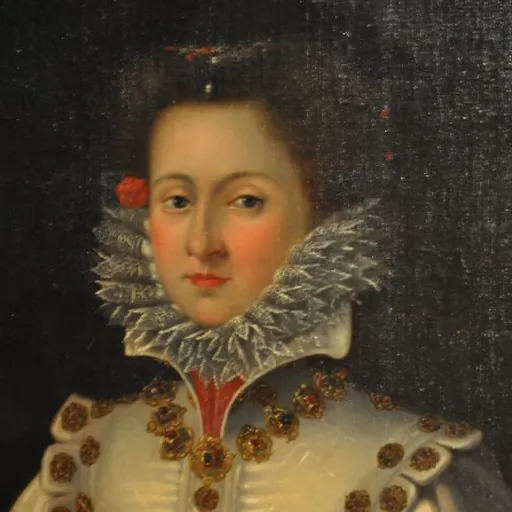
About Polyxena of Lobkovic
Lived 1566 – 1642 (aged 75–76). Polyxena of Lobkovic was a lady-in-waiting.
Polyxena of Lobkowicz (1566 – 24 May 1642) was a politically active Czech noble and styled Princess of the House of Lobkowicz. She played an important role as the channel between the noble families of Bohemia and the imperial court in Vienna through her connection with the Spanish envoy during the counter-reformation in Bohemia after 1618.
Life Born into an ancient House of Pernštejn, she was the daughter of the Imperial High Chancellor of Bohemia, Vratislav II of Pernštejn (1530–1582), and his wife, Maria Maximiliana Manrique de Lara y Mendoza (1538-1608), a Spanish noblewoman. Maria brought with her from Spain a statue of the Child Jesus, which she had received as a wedding present. It became well known for its purported miraculous healing powers.
Maria Pernštejn presented the statue to her daughter, upon Polyxena's marriage to the High Burgrave Wilhelm von Rosenberg in 1587. William died in 1592. In 1603, the widowed Polyxena remarried the Imperial High Chancellor Zdeněk Vojtěch Popel of Lobkowicz (1568-1628). This marriage produced only one son, Wenzel Eusebius von Lobkowicz, whom she gave birth to in 1609 at the age of 42.
In 1618, the aging Emperor Matthias named his cousin Ferdinand of Styria his heir, and had him crowned King of Bohemia. Tensions increased between the Catholic Ferdinand and the Protestant nobles. The application of the Letter of Majesty was controversial in Bohemia. The Protestants argued that it allowed them to build churches on Crown and Catholic prelates' lands, but the Catholics did not accept their interpretation. In 1618 two of the Emperor's royal governors were thrown from the windows of Hradčany Castle by Protestant nobles. They survived the fall and took refuge from a mob in the Lobkowicz Palace below the castle, protected by Polyxena Lobkowicz. The Defenestration in Prague contributed to the subsequent Bohemian Revolt.
In 1628, Polyxena Pernštejn von Lobkowicz donated the statue to the Discalced Carmelites of the Carmelite Church of Our Lady Victorious. It became known as the Infant of Prague.
She is the ancestor of several royal families, including that of the Russian Emperors, the Kings of Denmark, Greece, Norway and Great Britain, and others.
Don’t just read it —
keep it.
Full-length biographies made to live with: read them, listen on the way to work, watch them tonight.
- E-book
- Audio
- Video
Instant download · yours to keep · every purchase keeps this site free
Important facts
Related people
Same field, nearest in time




Contemporaries
People whose lives overlapped Polyxena of Lobkovic's




Frequently asked questions
Who was Polyxena of Lobkovic?
Bohemian noblewoman (1566-1642)
When was Polyxena of Lobkovic born?
Polyxena of Lobkovic was born in 1566.
When did Polyxena of Lobkovic die?
Polyxena of Lobkovic died on 24 May 1642 in Prague.
What was Polyxena of Lobkovic's occupation?
Polyxena of Lobkovic was a lady-in-waiting.
Sources & further reading
· Wikipedia: Polyxena of Lobkovic
· DBpedia: Polyxena of Lobkowicz
Cite this page
APA: Biography.guide. (2026). Polyxena of Lobkovic. https://biography.guide/polyxena-of-lobkovic/
MLA: "Polyxena of Lobkovic." Biography.guide, https://biography.guide/polyxena-of-lobkovic/.
Chicago: "Polyxena of Lobkovic." Biography.guide. https://biography.guide/polyxena-of-lobkovic/.
Data last updated: 2026-09-24 · Spot an error? Report a correction.
Portrait: Wikimedia Commons · author & licence
Page generated 2026-09-27 05:09 UTC