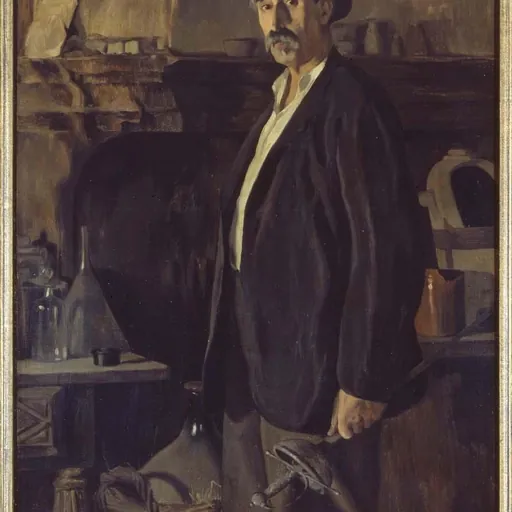
Plazido Zuloaga
Spanish 19th century metalworker
About Plazido Zuloaga
Lived 1834 – 1910 (aged 75). Plazido Zuloaga was a Spanish gunsmith and metalworker.
Works Zuloaga was skilled in all the techniques used by metalworkers of his time, including forging, relief chiselling, engraving, drawing and enamelling. In order to create his most ambitious works in a reasonable time, he led a team of specialist artisans who carried out his designs, each object being produced by eight to twelve individuals.
More than a hundred pieces of Spanish damascened metalwork, including 22 signed by Zuloaga, have been collected by the British-Iranian scholar and philanthropist Nasser D. Khalili, forming the Khalili Collection of Spanish Damascene Metalwork. Included in these are the Fonthill Casket, a iron cassone with gold and silver damascening, decorated with white enamel ornament in black. Its artistic and decorative intent is revealed by it being elaborately decorated on the inside as well as out. Commissioned by Alfred Morrison, it acquired its name from Fonthill manor, Morrison's family home. Zuloaga and his specialists took two years to construct the casket, which was described by The Magazine of Art in 1879 as "a triumph of skilled workmanship". Also commissioned by Morrison are a pair of amphora-shaped urns, high, from 1878 whose style imitated the medieval Alhambra vases. Covered in intricate Hispano-Arabic decoration, possibly drawn from contemporary engravings of a specific Alhambra vase, these were exhibited in Paris before delivery to Morrison.
A writing desk dated 1884–1885 has 44 drawers in a wooden case, each with enamelled floral patterns and a damascened metal button-pull. Not a woodworker himself, Zuloaga subcontracted out the preparation of the wood and veneer. A iron shrine dated 1880 recalls Gothic architecture in its overall shape, but the intricate damascened decoration is more suggestive of Art Nouveau. It contains a cast silver figure of the Virgin and Child in a Gothic style. Other objects signed by Zuloaga include a revolver, snuff boxes, caskets, and containers of various dimensions.
Around 1872, Zuloaga's workshop was commissioned to make the monumental sarcophagus for General Juan Prim. Work began in Eibar, but due to the civil war of 1873 he moved his workshop across to the border to Saint-Jean-de-Luz in France where the work was completed. Prim's tomb now resides in the cemetery at Reus. Around 1900, Zuloaga was commissioned by the Society of Jesus to construct an altar for the Sanctuary of St. Ignatius at Loyola. This was the last major project that he completed, referred to sometimes as his "posthumous" work, although in fact the altar was completed and installed at Loyola in 1909 while he was still alive. It was described by Pedro Celaya in 1981 as "one of the greatest works... that has been produced in Eibar."
Recognition and legacy
Zuloaga died in Madrid at the age of 76 on 1 July 1910 and was buried at Canillejas. Several of his trainees continued as noted artists, and Eibar continued as the centre of Spanish damascene production until the Spanish Civil War.
During his life, Zuloaga was awarded the Officer of the French Legion of Honor, Knight Commander of the Order of Isabel the Catholic, Knight of the Great Cross of Charles III, Knight of the Great Cross of the Lion and Sword of Sweden, Cross of King Leopold of Belgium, Knight of the Portuguese Order of St. James, Grand Cross of Santiago of Portugal, and Knight of the Order of Maria Teresa of Austria. Early twentieth-century art critics took a more negative view of the Zuloaga family's works, but a new wave of interest and critical appreciation emerged in the last decades of that century. Nasser Khalili, who writes that "Spain [has] always led the West in its beauty and quality of its damascene production", describes Zuloaga as "the supreme damascener of [his] family".
Exhibitions
Zuloaga exhibited his works at the 1855 Paris International Exposition (where he was awarded a Medal of Honour) and at the Madrid and Brussels International exhibitions of 1856, then at the Great London Exposition of 1862. "Plácido Zuloaga: Spanish Treasures from The Khalili Collection" was held at the Victoria and Albert Museum in London from May 1997 to January 1998. "El Arte y Tradición de los Zuloaga: Damasquinado Español de la Colección Khalili" toured Spain during 2000 and 2001, exhibiting in the Museo de Bellas Artes, Bilbao; Alhambra Palace, Granada; and Real Fundacion de Toledo. In 2003, "Plácido Zuloaga: Meisterwerke in gold, silber und eisen damaszener–schmiedekunst aus der Khalili-Sammlung" exhibited at the Roemer und Pelizaeus Museum in Germany. "Metal Magic: Spanish Treasures from the Khalili Collection" was exhibited from November 2011 to April 2012 at the Auberge de Provence in Malta.
Personal life With his first wife Lucía Zamora y Zabaleta, he had ten children, five of whom survived to adulthood, including Ignacio Zuloaga, who would become a noted painter. After Lucia died in 1900, he married Francisca Gil y Lete.
Don’t just read it —
keep it.
Full-length biographies made to live with: read them, listen on the way to work, watch them tonight.
- E-book
- Audio
- Video
Instant download · yours to keep · every purchase keeps this site free
Important facts
People in Plazido Zuloaga's life
Named in this biography and alive at the same time

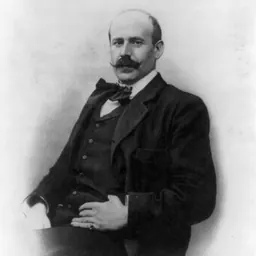

Related people
Same field, nearest in time



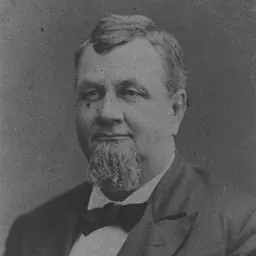

Contemporaries
People whose lives overlapped Plazido Zuloaga's



Frequently asked questions
Who was Plazido Zuloaga?
Spanish 19th century metalworker
When was Plazido Zuloaga born?
Plazido Zuloaga was born on 5 October 1834 in Madrid.
When did Plazido Zuloaga die?
Plazido Zuloaga died on 10 July 1910 in Madrid.
What was Plazido Zuloaga's occupation?
Plazido Zuloaga was a gunsmith and metalworker.
What nationality was Plazido Zuloaga?
Plazido Zuloaga was Spanish.
Sources & further reading
Cite this page
APA: Biography.guide. (2026). Plazido Zuloaga. https://biography.guide/plazido-zuloaga/
MLA: "Plazido Zuloaga." Biography.guide, https://biography.guide/plazido-zuloaga/.
Chicago: "Plazido Zuloaga." Biography.guide. https://biography.guide/plazido-zuloaga/.
Data last updated: 2026-09-20 · Spot an error? Report a correction.
Page generated 2026-09-27 05:09 UTC