
About Pietro Leoni
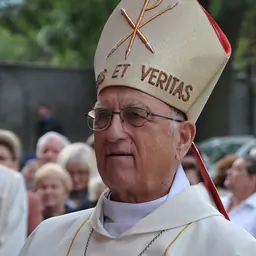
Lived 1909 – 1995 (aged 86). Pietro Leoni was an Italian catholic priest, missionary, political prisoner and military chaplain.
Pietro Leoni (1 January 1909 – 26 July 1995) was an Italian priest of the Society of Jesus and the Russian Greek Catholic Church. His memoir of surviving the Gulag, "Spia del Vaticano!", was published after his return to the West.
Early life He was born to peasant parents in Montaltovecchio, near Forlì, Emilia-Romagna, Kingdom of Italy. In 1922, he entered the minor seminary at Modigliana.
In 1927, Leonid joined the Society of Jesus, which sent him to study at the Pontifical Gregorian University in Rome. He arrived at the Russicum, a Jesuit-run seminary established to train priests of the Russian Greek Catholic Church for missionary work in the Soviet Union and the Russian diaspora, in 1934. After briefly teaching there as an in residence philosophy tutor, Leoni applied to permanently join the Russian Apostolate and was ordained in 1939 as a priest of the Byzantine Rite.
In 1943 he was released from military service as the Italian army disintegrated and he decided to stay on as a missionary priest in Romanian-occupied Odessa.
Even though Soviet anti-religious legislation strictly forbade the registration of foreign priests and even though the NKVD already had a file on him, Fr. Leoni was allowed to register as the pastor of the Catholics of Odessa in November 1944. His congregation numbered about 8,000 people, most of whom were ethnic Poles. Despite this, Fr. Leoni offered only the Byzantine Rite Divine Liturgy in Old Church Slavonic and preached in Russian.
Fr. Leoni also received several Orthodox Christians, including at least one priest, into the Russian Greek Catholic Church,
Fr. Leoni's, "sometimes flippant answers earned him spells in solitary confinement, but surprisingly he was not tortured, or at least he does not mention it."
While refusing to inform against his fellow Catholics, Fr. Leoni had no problem with telling his interrogators exactly what he thought of the Soviet Government. According to his case file, he once said, "Given that I am a Catholic religious, I was and am an enemy of Marxism and of the political regime which exists in the USSR - a regime, which, in my opinion is not different from Fascism... I believe that in the USSR there is neither democracy, not freedom for the people. The Soviet regime has stripped the people of freedom of religion, of freedom of the press, and of freedom of expression. One is forbidden to think freely, to develop one's initiative or creativity... I have never calumniated the Soviet Government: I have only said what I believe without mincing my words..."
When NKVD interrogators confronted him with "witnesses" who claimed that he was a supporter of Fascist dictators Adolf Hitler and Benito Mussolini, Fr. Leoni calmly replied, "I do not deny that I favored a change in the political system in the USSR but I never advocated the achievement of such change through an attack on the Soviet Union... I was not a supporter of the system established by Mussolini in Italy and I never told anyone that I shared Mussolini's political views... In Odessa, during the occupation, I helped several young people to avoid being deported to Germany by the Nazis."
On 13 September 1945, Fr. Leoni's interrogation ended and a formal indictment was approved. He was declared guilty of espionage on behalf of the Vatican, anti-Soviet agitation, and of trying to convert the Orthodox to the Eastern Catholic Churches. On November 12, 1945, an NKVD Collegium sentenced him to ten years in the Gulag.
Even so, on August 28–29, 1947, a special Temlag camp court declared Fr. Leoni guilty of violating article 58 of the Russian Criminal Code and another 25 years in Rechlag were added to his sentence.
On 9 April 1951, Father Leoni had an argument at Rechlag with KGB Captain G., who mockingly said, "God? But if your God really existed he would not allow you to be stuck here."
Leoni replied, "Why would he not permit it? Look, I have been found worthy to suffer for Him and I am sure that if I endure everything to the end He will grant me an eternal reward."
According to Memorial member and historian of Soviet religious persecution Irina Osipova, "Many of his 'outbursts' against the camp administration are not mentioned in his person dossier, but are described by his associates in their memoirs". For example, Yuri Tregubov, a fellow prisoner who was incarcerated with Fr. Leoni in Vorkuta, later recalled how a KGB Lieutenant-Colonel arrived in the camp during the summer of 1953 to deliver a lecture on "Soviet humanism". The Lieut.-Col. began by saying, "Soviet power not only chastises you, it also forgives you... Millions have been released, and that's only a small percentage of those who will be freed." stood up and shouted in flawless Russian, "Don't believe the Chekist liars! Don't believe this godless regime! The Chekists are leading you astray, fight them!"
For a brief moment, chaos reigned and the guards were only able with difficulty to restore order, after which, "humanism notwithstanding", Fr. Pietro Leoni was sent to a punishment cell.
Fellow political prisoner Jan Urwich later wrote about how, in 1955, a delegation from Moscow arrived at the labor camp to collect signatures for the Stockholm Appeal, in which the Cominform-controlled World Peace Council had called for a global ban on nuclear weapons. A lecturer first made a speech calling for signatures and the KGB officer chairing the meeting urged any prisoner who wished to speak in favor of the appeal to do so. Urwich later recalled, "From the back of the hall came a voice speaking in Russian with an Italian accent, 'Whoever signs the Stockholm Appeal signs his own death warrant! Better a cruel death under the atomic bomb than living on in this happy paradise where we find ourselves now!' The hall literally erupted. The resulting noise and chaos could not be quelled and the meeting disintegrated. Everything went to pieces."
Jan Urwich later recalled, "The news of Fr. Leoni's departure for Rome, at a time when no one expected it, planted much hope and joy... This man made us feel confident that he would tell that Free World, to which he was returning, the tragic and incredible truth about the country the champions of Humanism and the brotherhood of peoples."
In response, the Society of Jesus transferred Fr. Leoni to write his memoir "Spia del Vaticano!" at the Jesuit houses in Florence and Cesena. After his memoir was published in 1959, Fr. Leoni, who wished to work as a missionary in the Russian diaspora, was assigned to Canada.
Following his death, the Russian Catholic parish of the Presentation of the Blessed Virgin in Jerusalem was closed down permanently by Fr. Leoni's Ecclesiastical superiors in the Roman Catholic Archdiocese of Montreal. The church building has since been given to the Chaldean Catholic Eparchy of Mar Addai of Toronto and is currently in use as Sts. Martyrs of the East Chaldean Catholic Church.
Since the collapse of the Soviet Union, Fr. Leoni's memoir of the Gulag, "Spia del Vaticano!", has been translated from Italian to Russian and published. It has yet to the translated, however, into English.
Don’t just read it —
keep it.
Full-length biographies made to live with: read them, listen on the way to work, watch them tonight.
- E-book
- Audio
- Video
Instant download · yours to keep · every purchase keeps this site free
Important facts
People in Pietro Leoni's life
Named in this biography and alive at the same time


Related people
Same field, nearest in time

Contemporaries
People whose lives overlapped Pietro Leoni's




Frequently asked questions
Who was Pietro Leoni?
Italian Jesuit missionary (1909-1995)
When was Pietro Leoni born?
Pietro Leoni was born on 1 January 1909 in Premilcuore.
When did Pietro Leoni die?
Pietro Leoni died on 26 July 1995 in Montreal.
What was Pietro Leoni's occupation?
Pietro Leoni was a catholic priest, missionary, political prisoner and military chaplain.
What nationality was Pietro Leoni?
Pietro Leoni was Italian.
Sources & further reading
Cite this page
APA: Biography.guide. (2026). Pietro Leoni. https://biography.guide/pietro-leoni-catholic-priest/
MLA: "Pietro Leoni." Biography.guide, https://biography.guide/pietro-leoni-catholic-priest/.
Chicago: "Pietro Leoni." Biography.guide. https://biography.guide/pietro-leoni-catholic-priest/.
Data last updated: 2026-09-20 · Spot an error? Report a correction.
Page generated 2026-09-27 05:16 UTC