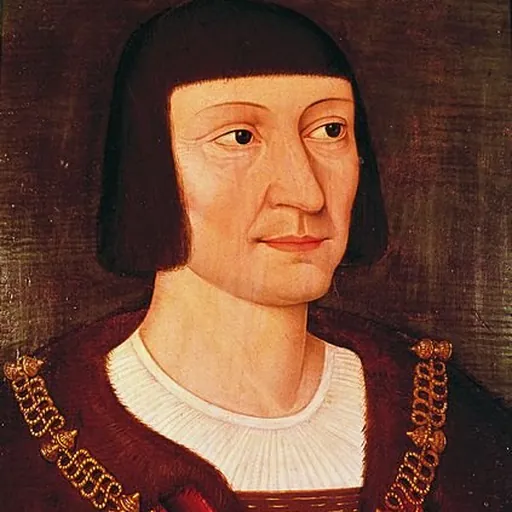
Pierre Terrail, seigneur de Bayard
French military personnel
About Pierre Terrail, seigneur de Bayard
Lived 1476 – 1524 (aged 47–48). Pierre Terrail, seigneur de Bayard was a French condottiero, knight and military officer.
Pierre Terrail, seigneur de Bayard ( – 30 April 1524) was a French knight and military leader at the transition between the Middle Ages and the Renaissance, generally known as the Chevalier de Bayard. Throughout the centuries since his death, he has been known as "the knight without fear and beyond reproach" (le chevalier sans peur et sans reproche). He himself preferred the name given him by his contemporaries for his gaiety and kindness, "le bon chevalier" ("the good knight").
Early life The descendant of a noble family with a military tradition – three generations of Terrail ancestors had fallen in battle successively from 1356 to 1465 – Bayard was born at the Château Bayard, Dauphiné (near Pontcharra, Isère) in southern France. He served as a page to the young Duke Charles I of Savoy until March 1490, when the Duke died of an illness.
At age thirteen he came to the attention of King Charles VIII of France when he put on a remarkable display of horsemanship for the Duke of Savoy that earned him the nickname "piquet" (spur).
1490 – Service of King Charles VIII of France
1490 – Man at arms of Louis de Luxembourg In 1490 Bayard took service as a man-at-arms in the household of Louis de Luxembourg, the seigneur de Ligny (November 1490) and a favorite of King Charles VIII of France. As a youth, Bayard was distinguished by his looks, charming manner, and skill in the tiltyard.
On 20 July 1494 a tournée was held in Lyons, attended by the king and his court. Though not yet eighteen, Bayard won the highest honors, again coming to the attention of the king.
1494 – Battle of Naples In 1494 Bayard accompanied Charles VIII's expedition into Italy to seize the Kingdom of Naples. This campaign is now known as the Italian War of 1494–1498.
1495 – Battle of Fornovo Bayard was knighted after the 1495 Battle of Fornovo, in which he captured a standard. Shortly afterward, entering Milan alone in pursuit of the enemy, he was taken prisoner, but was set free without a ransom by Ludovico Sforza.
Duel with Sotomayor What first made Bayard truly famous in Italy, was an episode that took place in 1502, when a Gascon named Gaspar took prisoner Alonso de Sotomayor, a Spanish knight of gigantic stature and endowed with Herculean strength, while he was on his way to Rome. While Gaspar was waiting for the ransom due, Bayard took over the prisoner to prevent him from suffering ill-treatment, welcomed him into his home and treated him with all the respect and honor that he granted to his friends. However, the Spaniard, after gaining his freedom, accused Bayard of mistreating him and of having suffered terrible pains. As soon as he learned of this, the indignant Bayard challenged him to a duel to the death.
Despite the value of Bayard, the French still had the worst on the Garigliano: their army was nearly annihilated; according to Bartolomeo d'Alviano, the main architect of the resounding Spanish victory, the army of Louis XII counted 1,500 spears, 3,400 cavalrymen, and 8,000 infantry that after the battle had been reduced to just 200 spears, 150 cavalrymen, and 600 infantry. These troops barricaded themselves in Gaeta, where a few days later they negotiated the surrender, but demanded that all prisoners be released and that transit to the north be ensured. Fernández de Córdoba agreed.
Personal life Jacques de Maille reports that for many years – one can say throughout his life, if one excludes his first youthful platonic love – Bayard loved a woman whose identity he never revealed. Bayard's only child was born in Cantù, in 1501: Jeanne Terrail. Since he could not take care of her, engaged as he was in campaigning, Bayard had her raised in France by his sister Jeanne, a nun in the . Since Terrail is never referred to as a "bastard" but always as a "daughter" and since Bayard would refuse in the future the marriage proposed to him by Queen Anne, it is believed that he had married the girl's mother. Various hypotheses have been made about the identity of the mother: numerous clues lead to Bianca di Monferrato, the Duchess of Savoy, who was widowed when very young. This is supported by Bayard's presence at that time in Piedmont and his statement that the child was noble and the daughter of a lady of great house. The hypothesis is strongly supported by Paul Ballaguy, while Camille Monnet categorically rejects it.
Appearance and personality In his portrait by Jacques de Mailles, his squire and biographer, Bayard appears as man with a sharp and pale face, with brown hair, a long nose, attentive and bright eyes. According to a DNA study of Bayard's skull, he had brown eyes, brownish hair and pale skin. Jacques writes that Bayard, small in stature as a child, grew considerably during adolescence; this is supported by modern studies of his skull which hypothesize that he had reached 1.8 meters (5 foot 11 inches), an above-average height for his time.
For the investiture as a knight that he received in battle, Bayard always felt deeply linked to the chivalric code of honor. Absolute loyalty even towards enemies, charity and help were his rules of life, in fact he did his utmost for the recovery of prostitutes and personally assisted the sick of the plague. While his fellow countrymen indulged in violence and raids, Bayard always remained respectful towards the weak and the vanquished, doing his utmost for their defense, and burned with furious anger in the face of all cruelty and injustice. He even used to pay out of his own pocket for the goods he requisitioned for the need for provisions, while his fellow countrymen used to simply snatch them from the peasants with violence.
Since he usually led the vanguard in the advances and passed to the rearguard in the retreats, he ordered his men to extinguish the fires that his colleagues had set in the villages, and placed sentinels in defense of the churches and monasteries to prevent the looting and rape of women who had taken refuge there.
Such was the fame of the magnanimity of Bayard that the people of Italy, who fled into the woods and mountains when armed men arrived, instead came running to meet his troops, loudly acclaiming his name and offering him gifts.
This did not prevent him from becoming a fierce and feared fighter in battle. He knew no mercy either towards his enemies or towards himself, and in this way he did not enter into contradiction with the vivid religious faith that he had nourished since childhood. God had wanted him to be a knight and he limited himself to fulfilling God's will; he always placed himself in God's hands immediately before every battle.
Bayard's DNA A 2017 research paper by Gérard Lucotte verified that Bayard's mtDNA haplogroup was H10E and his YDNA haplogroup was R1b-M269.
Legacy As a soldier, Bayard was considered the epitome of chivalry and one of the most skillful commanders of the age. He was noted for the exactitude and completeness of his information on the enemy's movements, which he obtained by careful reconnaissance and a well-arranged system of espionage.
In the midst of mercenary armies, Bayard remained absolutely disinterested, and to his contemporaries and his successors, he was, with his romantic heroism, piety, and magnanimity, the fearless and faultless knight (le chevalier sans peur et sans reproche). His gaiety and kindness even more frequently won him another name bestowed by his contemporaries, le bon chevalier.
Monuments and memorials
Equestrian statue at Pontcharra (Isère) Statue at Grenoble, place Saint-André Bayard Mausoleum, (1625), Saint-André Collegiate church at Grenoble Musée Bayard at the Château Bayard in Pontcharra Statue at Charleville-Mézières, inaugurated October 2005. An earlier statue was damaged during World War I and demolished by the Germans in World War II. Statue in the Collège Stanislas de Paris Statue in Saint-Denis Statue in Sainte-Anne-d'Auray Clément-Bayard, an automobile manufacturer of Mézières, was named in his honour and his image was incorporated in the logo. Adolphe Clément-Bayard, an entrepreneur who created the Clément-Bayard automobile company in honour of the knight in 1903, and then added Bayard to his family name in 1908
In popular culture Bayard is a recurring character in three novels by author Samuel Shellabarger: Captain from Castile (1945) Prince of Foxes (1947) The King's Cavalier (1950) The 1988 movie Sans peur et sans reproche, directed by Gérard Jugnot, is based on Bayard.
Don’t just read it —
keep it.
Full-length biographies made to live with: read them, listen on the way to work, watch them tonight.
- E-book
- Audio
- Video
Instant download · yours to keep · every purchase keeps this site free
Important facts
People in Pierre Terrail, seigneur de Bayard's life
Named in this biography and alive at the same time
Related people
Same field, nearest in time

Contemporaries
People whose lives overlapped Pierre Terrail, seigneur de Bayard's



Frequently asked questions
Who was Pierre Terrail, seigneur de Bayard?
French military personnel
When was Pierre Terrail, seigneur de Bayard born?
Pierre Terrail, seigneur de Bayard was born in 1476 in Pontcharra.
When did Pierre Terrail, seigneur de Bayard die?
Pierre Terrail, seigneur de Bayard died on 30 April 1524 in Romagnano Sesia.
What was Pierre Terrail, seigneur de Bayard's occupation?
Pierre Terrail, seigneur de Bayard was a condottiero, knight and military officer.
What nationality was Pierre Terrail, seigneur de Bayard?
Pierre Terrail, seigneur de Bayard was French.
Sources & further reading
· Wikipedia: Pierre Terrail, seigneur de Bayard
· DBpedia: Pierre Terrail, seigneur de Bayard
Cite this page
APA: Biography.guide. (2026). Pierre Terrail, seigneur de Bayard. https://biography.guide/pierre-terrail-seigneur-de-bayard/
MLA: "Pierre Terrail, seigneur de Bayard." Biography.guide, https://biography.guide/pierre-terrail-seigneur-de-bayard/.
Chicago: "Pierre Terrail, seigneur de Bayard." Biography.guide. https://biography.guide/pierre-terrail-seigneur-de-bayard/.
Data last updated: 2026-09-20 · Spot an error? Report a correction.
Portrait: Wikimedia Commons · author & licence
Page generated 2026-09-27 04:58 UTC