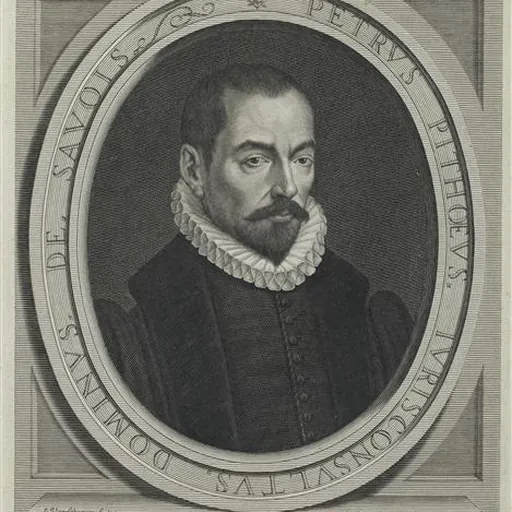
About Pierre Pithou
Lived 1539 – 1596 (aged 57). Pierre Pithou was a French jurist-consultant, historian, renaissance humanist, writer, jurist and humanist.
Pierre Pithou (1 November 1539 – 1 November 1596) was a French lawyer and scholar. He is also known as Petrus Pithoeus.
Life
He was born at Troyes. From childhood he loved literature, and his father Pierre encouraged this interest. Young Pithou was called to the Paris bar in 1560. On the outbreak of the second war of religion in 1567, Pithou, who was a Calvinist, withdrew to Sedan, France and afterwards to Basel, returning to France on the publication of the edict of pacification. Soon afterwards he accompanied the duc de Montmorency on his embassy to England, returning shortly before the massacre of St Bartholomew, in which he narrowly escaped with his life. Next year he followed the example of the future Henry IV of France by abjuring the Protestant faith.
Shortly after his accession to the throne, Henry recognized Pithou's talents and services by giving him various legal appointments. He co-operated in publishing the Satire Ménippée (1593), which did much to damage the cause of the Catholic League; the harangue of the Sieur d'Aubray is usually attributed to Pithou.
Pithou wrote many legal and historical books, besides preparing editions of several ancient writers. His earliest publication was Adversariorum subsectorum lib. II. (1565). In 1569, he became the first to publish Landolfus Sagax' Historia Romana, and under the name by which it became better known: Historia Miscella. Perhaps his edition of the Leges Visigothorum (1579) was his most valuable contribution to historical science; in the same line he edited the Capitula of Charlemagne, Louis the Pious, and Charles the Bald in 1588; he assisted his brother François in preparing the Corpus juris canonici (1687).
Pierre's Libertés de l'église gallicane (1594) is reprinted in his Opera sacra juridica his orica miscellanea collecta (1609). In classical literature he was the first who made the world acquainted with the Fables of Phaedrus (1596).
Pithou contributed to the study of Livy, in collating a manuscript against the edition of Sigonius, and adding notes. It was not published, but has been cited as "Excerpta-", "Exc-" and "notulae Pithoei", and remains in the Bodleian Library, Oxford.
He died at Nogent-sur-Seine. His valuable library, specially rich in manuscripts, was for the most part transferred to what is now the Bibliothèque Nationale in Paris.
Family Three of Pierre Pithou's brothers acquired distinction as jurists: Nicolas, with his twin, Jean co-authored the treatise, Institution du mariage chrétien. François Pithou, the youngest, wrote Glossarium ad libros capitularium (1588) and Traité de l'excommunication et de l'interdit, etc. (1587).
Works
Charlemagne empereur d'Occident. Généalogie des comtes héréditaires de Troyes et de Meaulx, ou de Champaigne et Brie, qui furent aussi Roys de Navarre. Bref recueil des évêques de Troyes. (Signé : P. Pithoeus... .).
Satire Ménippée, 1593. Satyre Ménippée : de la vertu du Catholicon d'Espagne et de la tenue des estats de Paris, Éd. Charles Labitte, Œuvres & Valsery, Ressouvenances, 1841; 1997 . Satyre Menippee de la Vertu du Catholicon d'Espagne et de la tenue des Estats de Paris, éd. critique de Martial Martin, Paris, H. Champion, 2007, « Textes de la Renaissance », n° 117.
Don’t just read it —
keep it.
Full-length biographies made to live with: read them, listen on the way to work, watch them tonight.
- E-book
- Audio
- Video
Instant download · yours to keep · every purchase keeps this site free
Important facts
People in Pierre Pithou's life
Named in this biography and alive at the same time

Related people
Same field, nearest in time



Contemporaries
People whose lives overlapped Pierre Pithou's


Frequently asked questions
Who was Pierre Pithou?
French lawyer and scholar (1539-1596)
When was Pierre Pithou born?
Pierre Pithou was born on 1 November 1539 in Troyes.
When did Pierre Pithou die?
Pierre Pithou died on 1 November 1596 in Nogent-sur-Seine.
What was Pierre Pithou's occupation?
Pierre Pithou was a jurist-consultant, historian, renaissance humanist, writer, jurist and humanist.
What nationality was Pierre Pithou?
Pierre Pithou was French.
Sources & further reading
Cite this page
APA: Biography.guide. (2026). Pierre Pithou. https://biography.guide/pierre-pithou/
MLA: "Pierre Pithou." Biography.guide, https://biography.guide/pierre-pithou/.
Chicago: "Pierre Pithou." Biography.guide. https://biography.guide/pierre-pithou/.
Data last updated: 2026-09-20 · Spot an error? Report a correction.
Portrait: Wikimedia Commons · author & licence
Page generated 2026-09-27 04:57 UTC