
About Pierre Fontaine
Lived 1380 – 1450 (aged 69–70). Pierre Fontaine was a French composer and poet.
Pierre Fontaine (; c. 1380 – c. 1450) was a French composer of the transitional era between the late Middle Ages and early Renaissance, and a member of the Burgundian School of composers. While he was well known at the time, most of his music has probably been lost. All of his surviving music is secular, and all his compositions are chansons.
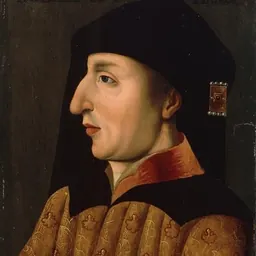
Life He was born in Rouen and is presumed to have had his early musical training there. By 1403 he was a singer at the large and splendid chapel of Philip the Bold, and after it was disbanded in 1404 he became a clerk at Ste. Chapelle in Bourges, where he served at least until 1407.
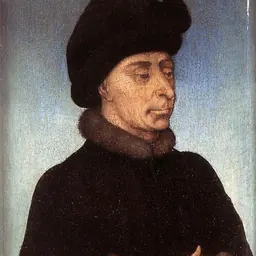
He was a singer at the court chapel of Burgundy when it was reconstituted, after a period of inactivity, by John the Fearless, the new Duke of Burgundy in 1415. When John died in 1419 Fontaine left the chapel and went to northern Italy, joining the singers in the chapel of Pope Martin V, where he probably remained through the early 1420s. Around the end of the decade he came back to Burgundy, where he sang in the chapel yet again, this time under Philip the Good, and where he remained at least until 1447. No record of his death survives, but a replacement for him was hired in 1451.
Music and influence Eight compositions by Fontaine survive, including six rondeaux and a ballade, two of the three types of chansons known as the formes fixes. All of Fontaine's pieces are for three voices.
These pieces contain some unusual features. J'ayme bien celui, a rondeau, includes the unusual direction "contra tenor trompette" for the lowest voice, indicating that it was to be performed on a slide trumpet, an instrument related to the trombone (by the late 15th century, this instrument had been named the sackbut). Not only is this a rare case of a specific instrument being required in an early 15th-century composition, but the piece contains notes outside of the gamut, the range of pitches to which most music of the time was restricted: the part for "contra tenor trompette" goes down to D below the bass staff. It has been suggested that Fontaine may not have written this part, since it appears only in one of the sources in which the rondeau survives, the Escorial V.III.24 manuscript.
Most of Fontaine's pieces are concise: a transcription of Pastourelle en un vergier in modern musical notation only consists of 11 bars. Fontaine a vous dire le voir
Don’t just read it —
keep it.
Full-length biographies made to live with: read them, listen on the way to work, watch them tonight.
- E-book
- Audio
- Video
Instant download · yours to keep · every purchase keeps this site free
Important facts
People in Pierre Fontaine's life
Named in this biography and alive at the same time
Related people
Same field, nearest in time




Contemporaries
People whose lives overlapped Pierre Fontaine's



Frequently asked questions
Who was Pierre Fontaine?
French composer
When was Pierre Fontaine born?
Pierre Fontaine was born in 1380 in Rouen.
When did Pierre Fontaine die?
Pierre Fontaine died in 1450 in Dijon.
What was Pierre Fontaine's occupation?
Pierre Fontaine was a composer and poet.
What nationality was Pierre Fontaine?
Pierre Fontaine was French.
Sources & further reading
· DBpedia: Pierre Fontaine (composer)
Cite this page
APA: Biography.guide. (2026). Pierre Fontaine. https://biography.guide/pierre-fontaine/
MLA: "Pierre Fontaine." Biography.guide, https://biography.guide/pierre-fontaine/.
Chicago: "Pierre Fontaine." Biography.guide. https://biography.guide/pierre-fontaine/.
Data last updated: 2026-09-20 · Spot an error? Report a correction.
Page generated 2026-09-27 05:13 UTC