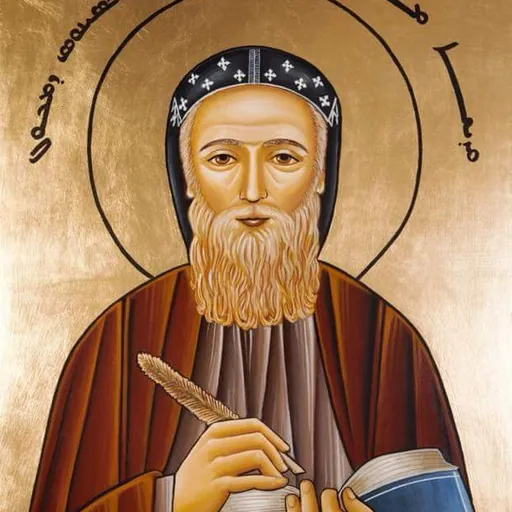
About Philoxenus of Mabbug
Lived 450 – 523 (aged 72–73). Philoxenus of Mabbug was a theologian and writer.
Philoxenus of Mabbug (Syriac: , ; died 523), also known as Philoxenus of Hierapolis, Xenaias, and Akhsenaya, was one of the most notable Syriac prose writers during the Byzantine period and a vehement champion of Miaphysitism.
Life Philoxenus was born between 440 and 455 in the village of Tahal, in the district of Beth Garmaï east of the Tigris, modern-day Iraq. Though a he was a subject of Persia by birth, all of his known public life was spent within the Byzantine Empire. His family originated from Ecbatana in Media, and he had at least two siblings, including a brother named Addai who was a teacher at the School of Edessa. The claims that he had been a slave and was never baptized seem to be malicious fabrications by his theological opponents after his death.
His birth name was Akhsnoyo , which means stranger, rendered in Greek as Xenias. Upon his consecration as bishop by Patriarch Peter II (Peter the Fuller) of Mabbug, his name was changed to the Greek Philoxenus ("lover of strangers"). It was probably during the earlier years of his episcopate that Philoxenus composed his thirteen homilies on the Christian life.
Syriac Bible Later he devoted himself to the revision of the Syriac versions of the Bible, and with the help of his chorbishop Polycarp produced in 508 the so-called Philoxenian version, which was in some sense the received Bible of the Syriac Miaphysites during the 6th century. In the meantime he continued his ecclesiastical activity, working as a bitter opponent of Flavian II of Antioch, who was patriarch of Antioch from 498 to 512 and accepted the decrees of the Council of Chalcedon.
With the support of Emperor Anastasius I Dicorus, the Miaphysites ousted Flavian II in 512 and replaced him with their partisan Severus of Antioch. Of Philoxenus's part in the struggle we possess not too trustworthy accounts by hostile writers, such as Theophanes the Confessor and Theodorus Lector. We know that in 498 he was staying at Edessa; in or about 507, according to Theophanes, he was summoned by the emperor to Constantinople; and he finally presided at a synod at Sidon which was the means of procuring the replacement of Flavian by Severus. But the triumph was short-lived. Justin I, who succeeded Anastasius in 518 and adhered to the Chalcedonian creed, exiled Severus and Philoxenus in 519. Philoxenus was banished to Philippopolis in Thrace, and afterwards to Gangra in Paphlagonia, where he was murdered in 523.
Writings Apart from his redoubtable powers as a controversialist, Philoxenus is remembered as a scholar, an elegant writer, and an exponent of practical Christianity. Of the chief monument of his scholarship – the Philoxenian version of the Bible – only the Gospels and certain portions of Isaiah are known to survive (see William Wright, Syr. Lit., 14). It was an attempt to provide a more accurate rendering of the Septuagint than had hitherto existed in Syriac and obtained recognition among Syriac Miaphysites until superseded by the still more literal renderings of the Old Testament by Paul of Tella and of the New Testament by Thomas of Harkel (both in 616–617), of which the latter at least was based on the work of Philoxenus.
There are also extant portions of commentaries on the Gospels from his pen. Of the excellence of his style and of his practical religious zeal we are able to judge from the thirteen homilies on the Christian life and character which have been edited and translated by E. A. Wallis Budge (London, 1894). In these he holds aloof for the most part from theological controversy, and treats in an admirable tone and spirit the themes of faith, simplicity, the fear of God, poverty, greed, abstinence and unchastity. His affinity with his earlier countryman Aphrahat is manifest both in his choice of subjects and his manner of treatment. As his quotations from Scripture appear to be made from the Peshitta, he probably wrote the homilies before he embarked upon the Philoxenian version. Philoxenus wrote also many controversial works and some liturgical pieces. Many of his letters survive, and at least two have been edited. Several of his writings were translated into Arabic and Ethiopic.
Themes
Philoxenus was a prolific writer whose works continue to influence Christian thought. For him, theology was not merely an intellectual pursuit but the essential path to divine knowledge. He regarded the struggle against heresy as no less important than the struggle against sin and saw it as a central aspect of asceticism.
Legacy and veneration Philoxenus of Mabbug is considered a champion of Miaphysitism and one of the most venerated saints in the Oriental Orthodox tradition. He is celebrated as a master of theology, poetry, and the sciences, and a significant contributor to the golden age of Syriac culture. The Syriac Heritage Project describes him as "a master of eloquence and a distinguished philologist. An outstanding person in intelligence, knowledge and deeds, he was also abstinent and God-fearing. His style was stately and lucid. He masterfully portrayed good manners and sublime Christian virtues, producing a book on the perfect life which contains much benefit and is written in an infinitely beautiful style."
His feast day in the Syriac Orthodox Church and Malankara Orthodox Syrian Church is on December 10, and his relics are interred in Midyat in the Syriac Orthodox cultural region of Tur Abdin (modern-day Turkey), where his veneration remains strong.
Don’t just read it —
keep it.
Full-length biographies made to live with: read them, listen on the way to work, watch them tonight.
- E-book
- Audio
- Video
Instant download · yours to keep · every purchase keeps this site free
Important facts
People in Philoxenus of Mabbug's life
Named in this biography and alive at the same time

Related people
Same field, nearest in time


Contemporaries
People whose lives overlapped Philoxenus of Mabbug's




Frequently asked questions
Who was Philoxenus of Mabbug?
Assyrian writer and theologian (died 523)
When was Philoxenus of Mabbug born?
Philoxenus of Mabbug was born in 450 in Beth Garmai.
When did Philoxenus of Mabbug die?
Philoxenus of Mabbug died in 523 in Çankırı.
What was Philoxenus of Mabbug's occupation?
Philoxenus of Mabbug was a theologian and writer.
Sources & further reading
· Wikipedia: Philoxenus of Mabbug
· DBpedia: Philoxenus of Mabbug
Cite this page
APA: Biography.guide. (2026). Philoxenus of Mabbug. https://biography.guide/philoxenus-of-mabbug/
MLA: "Philoxenus of Mabbug." Biography.guide, https://biography.guide/philoxenus-of-mabbug/.
Chicago: "Philoxenus of Mabbug." Biography.guide. https://biography.guide/philoxenus-of-mabbug/.
Data last updated: 2026-09-24 · Spot an error? Report a correction.
Portrait: Wikimedia Commons · author & licence
Page generated 2026-09-27 05:08 UTC