
Philotheus I of Constantinople
Patriarch of Constantinople
About Philotheus I of Constantinople
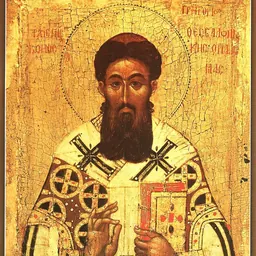
Lived 1300 – 1379. Philotheus I of Constantinople was a Byzantine writer, eastern Orthodox priest and patriarch.
Philotheos Kokkinos (; – 1379) was the Ecumenical Patriarch of Constantinople for two periods from August 1353 to December 1354 and from 8 October 1364 to August 1376, and a leader of the Byzantine monastic and religious revival in the 14th century. His numerous theological, liturgical, and canonical works received wide circulation not only in Byzantium but throughout the Slavic Orthodox world.
Philotheus I was appointed patriarch in August 1353 by the emperor John VI Kantakouzenos, deposed by John V Palaiologos in December 1354, then restored to the patriarchal throne on 8 October 1364. He opposed Emperor John V in his intent to negotiate the political re-union of the churches with Popes Urban V and Gregory XI. Instead, in 1367 he supported the proposed assembly of an authentic, ecumenical union-council, in order to properly resolve the differences with the Western Church. and is regarded as a "Protector of Orthodoxy", alongside Saints Photius I of Constantinople, Mark of Ephesus, and Gregory Palamas.
Early life Philotheus' early life is not known. He was a native of Thessalonika and is believed to have been born about the year 1300. His mother was a Jewish convert to Orthodox Christianity.
Early career Philotheus entered the monastic life early, first becoming a monk at Mount Sinai, then later at Mount Athos.
At Mount Athos, he lived his monastic life first at Vatopedi monastery, where he formed a relationship with Savvas the New of Kalymnos the Fool-For-Christ (d. 1350), for whom he became a biographer. Later he went on to the Great Lavra Monastery, where he formed a relationship with Saint Gregory Palamas, for whom he became a biographer as well. Threatened anew, John V Palaiologos appealed to the West for help in defending Constantinople against the Turks, proposing, in return, to end the East–West Schism between Constantinople and Rome. In October 1369 John V, having travelled through Naples to Rome, formally converted to Catholicism in St. Peter's Basilica and recognised the Pope as supreme head of the Church. Opposed to re-union on political terms, Philotheus I opposed these efforts by John V to negotiate with Popes Urban V (1362–1370) and Gregory XI (1370–1378).
On the other hand, Philotheus I's second period as Patriarch was notable for his efforts to open sincere discussions with the Roman Church to end the East–West Schism — not by diplomatic efforts like those of Emperor John V, who had just abjured Orthodoxy for the Latin faith — but out of a real desire for a true and authentic union.
Synod in 1368 The authority of the Acts of the "Hesychast Council" of 1351 were confirmed in the synod of 1368. |group=note In addition, Philotheus I led the synodal decision to proclaim Gregory Palamas a Saint, ordaining the Second Sunday of Great Lent to be his feast and composing the Church's services to Saint Gregory Palamas.
The 1368 synod would be ranked as part of the Fifth Council of Constantinople in 2016 by the Council of Crete, thus granting it "universal authority" and Ecumenical status.
Relations with the Slavic Orthodox world Philotheus I also nourished a strong commitment to the unity of the Orthodox world in his second tenure, pursuing an ecclesiastical policy to organize the Orthodox churches of the Serbians, Russians, and Bulgarians, unto which hesychastic theology and spirituality spread. Secondly, the monastery's close links with Constantinople facilitated the spread of Hesychasm to Central and Northern Russia. The act of excommunication of was revoked and the Serbian Church was recognized as a Patriarchate, under the condition of returning all eparchies in contested southern regions to the jurisdiction of the Patriarchate of Constantinople.
In 1375 Patriarch Philotheus I consecrated Cyprian as "Metropolitan of Kiev, Lithuania, and Russia" in the lifetime of Alexius, the lawful incumbent of two of these three sees. The Russians felt deeply humiliated by this affront to their popular metropolitan, and the confusion ended only in 1390 when the Muscovites accepted Cyprian as Metropolitan of Russia.
Writer and hymnographer Philotheus I was also engaged in writing a number of works setting forth the theology of the uncreated Energies and successfully taking issue with the humanist theologians who, in the works of Western scholastics, especially Thomas Aquinas, found a natural philosophy that enabled them to express their love of classical antiquity to the full.
Along with Callistus I of Constantinople, Philotheus I was a Hesychast Patriarch of Constantinople, who used the lives of saints to extol the ideal of hesychia.
Exile and death In 1376, Patriarch Philotheus I was deposed by Emperor Andronikos IV Palaiologos when the latter ascended to the imperial throne.
Philotheus I reposed in exile in 1379. His tomb at the Monastery of Akatalyptos Maria Diakonissa (Theotokos Kyriotissa) became a place of many miracles.
Notes and references
Don’t just read it —
keep it.
Full-length biographies made to live with: read them, listen on the way to work, watch them tonight.
- E-book
- Audio
- Video
Instant download · yours to keep · every purchase keeps this site free
Important facts
People in Philotheus I of Constantinople's life
Named in this biography and alive at the same time
Related people
Same field, nearest in time



Contemporaries
People whose lives overlapped Philotheus I of Constantinople's
Frequently asked questions
Who was Philotheus I of Constantinople?
Patriarch of Constantinople
When was Philotheus I of Constantinople born?
Philotheus I of Constantinople was born in 1300 in Thessaloniki.
When did Philotheus I of Constantinople die?
Philotheus I of Constantinople died in 1379 in Constantinople.
What was Philotheus I of Constantinople's occupation?
Philotheus I of Constantinople was a writer, eastern Orthodox priest and patriarch.
What nationality was Philotheus I of Constantinople?
Philotheus I of Constantinople was Byzantine.
Sources & further reading
· Wikipedia: Philotheus I of Constantinople
· DBpedia: Philotheos Kokkinos
Cite this page
APA: Biography.guide. (2026). Philotheus I of Constantinople. https://biography.guide/philotheus-i-of-constantinople/
MLA: "Philotheus I of Constantinople." Biography.guide, https://biography.guide/philotheus-i-of-constantinople/.
Chicago: "Philotheus I of Constantinople." Biography.guide. https://biography.guide/philotheus-i-of-constantinople/.
Data last updated: 2026-09-20 · Spot an error? Report a correction.
Page generated 2026-09-27 05:30 UTC